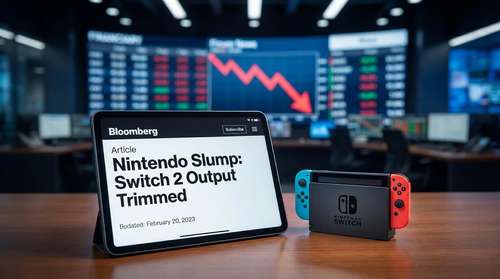
The video game industry is facing a surprising reality check this week following a breaking Bloomberg Nintendo report. Despite enjoying a record-shattering global launch in mid-2025, the Japanese gaming giant is officially hitting the brakes on its latest hardware. A sudden Nintendo Switch 2 production cut will see the company manufacture just 4 million units this quarter—a drastic 33% reduction from its initial 6 million target. The culprit isn't supply chain woes, but rather surprisingly sluggish consumer demand during the crucial year-end holiday shopping season, particularly in the United States.
The Holiday Hangover: Analyzing Switch 2 US Holiday Sales
When the $450 Switch 2 hit retail shelves last June, it flew off them. The system sold over 3.5 million units in its first four days, moving an impressive 17.37 million units globally in its first seven months. However, that explosive momentum simply did not carry over into the winter months. Recent data shows that Switch 2 US holiday sales experienced a noticeable 35% decline compared to what the original Switch managed during its own first holiday season back in 2017.
While the console continues to perform exceptionally well in its native Japan—partially bolstered by a lower-priced, unprofitable domestic variant—the American market is telling a very different story. Consumers are feeling the pinch of a tightening economy, and many die-hard early adopters already secured their systems during the summer launch window. This divergence is becoming a major talking point when analyzing broader next-gen console market trends, as hardware manufacturers adjust to shifting post-launch consumer behavior and price sensitivity in Western markets.
Market Fallout: The Nintendo Stock Price Drop
Wall Street and international markets reacted swiftly to the production news. Following the circulation of the report, investors triggered a notable Nintendo stock price drop, with shares tumbling as much as 6.3% to $55.72 per share in Tokyo trading before stabilizing.
For analysts tracking Nintendo financial news, this volatility highlights the immense pressure the company faces to prove the longevity of its new platform. Nintendo historically operates with highly conservative financial forecasting. They typically set lower sales bars early in the fiscal year and revise them upward as holiday momentum builds. Reversing that trend and actively scaling back assembly lines for a flagship console in its inaugural year is an incredibly rare move that has left investors reassessing the system's long-term momentum.
What's Driving the Slump? Software Woes vs. Hardware Realities
Industry analysts have been quick to point fingers at the console's early software library rather than its hardware capabilities. Amir Anvarzadeh, a Japan equity strategist at Asymmetric Advisors, didn't mince words when speaking to Bloomberg. He noted that experiencing a hardware shortfall during a console’s first massive holiday season is a troubling indicator, directly linking the slowed momentum to a lackluster initial exclusive lineup.
Crucially, sources familiar with Nintendo's supply chain confirmed that this Nintendo Switch 2 production cut is entirely demand-driven. Several factors appear to be influencing this slowdown:
- Price Point: At $450, the console faces stiff resistance from budget-conscious families.
- Software Gaps: A lack of massive system-seller exclusives during the November and December window.
- Economic Headwinds: Slower consumer spending on discretionary entertainment items globally.
It's important to note that rising global memory prices and component shortages—which are currently squeezing the artificial intelligence sector—did not factor into Nintendo's decision to curb output.
Can Pokémon Pokopia Turn the Tide?
Despite the gloomy outlook presented in the latest Switch 2 sales report 2026, there is a bright spot. The recent release of Pokémon Pokopia has emerged as a certified sleeper hit, shifting over 2 million copies in less than a week. The title has single-handedly injected life back into the console's ecosystem and helped Nintendo's stock recoup some of its earlier losses.
However, Nintendo executives are reportedly playing it safe. Rather than immediately ramping assembly lines back up, the company is waiting to see if Pokopia and other upcoming titles have the consistent staying power required to justify a return to their original 6-million-unit manufacturing targets.
Looking Ahead: The Remainder of 2026
The reduced 4-million-unit output rate is slated to continue straight through April 2026. Behind the scenes, the company is also reportedly preparing for future hardware revisions, including an EU-compliant model featuring a replaceable battery to meet 2027 legislation.
Despite the temporary setback in the West, Nintendo remains firmly on track to meet its fiscal year target of 19 million units shipped globally—proving just how massive that initial summer launch truly was. While this easily outpaces most historic console launches, the 19-million goal still falls slightly short of the 20-million-unit target many Wall Street analysts had initially modeled.
As the dust settles, the broader gaming industry will be watching closely. Will a strategic pivot and a stronger upcoming software slate be enough to reignite American demand, or is the Switch 2 destined to follow a more modest trajectory than its predecessor? For now, the house of Mario is choosing calculated caution over unchecked production.