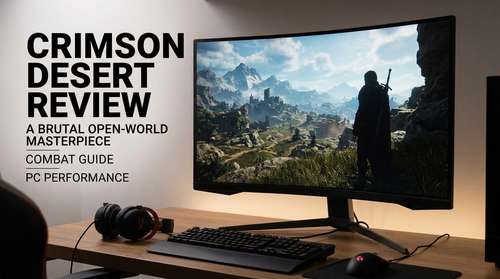
Following its highly anticipated launch on March 19, 2026, the critical consensus for Pearl Abyss’s latest epic is officially in. If you have been wondering whether the years of development and hype would pay off, our definitive Crimson Desert review has the answer. Selling over three million copies within its first week across PC, PlayStation 5, Xbox Series X/S, and Mac, this sprawling single-player adventure has cemented itself as a leading contender for the best open world RPG 2026. However, while critics are universally praising its genre-defying mechanics, an intense debate is raging over its demanding hardware requirements. Here is everything you need to know about the journey of Kliff Macduff and the breathtaking continent of Pywel.
The Pywel World Map: A Sandbox Like No Other
When you step into the Pywel world map, the sheer scale is staggering. Pearl Abyss has managed to craft an environment that reportedly dwarfs the landmasses of both Skyrim and Red Dead Redemption 2, spanning five distinct and fully explorable regions. From the freezing, wind-battered peaks of Kweiden to blistering desert sands and bustling medieval cities, every zone feels meticulously handcrafted and alive.
Exploration is virtually seamless. The developer's proprietary BlackSpace Engine renders this massive continent without relying on immersion-breaking loading screens. Whether you are taming wild horses, soaring through the skies on a fire-breathing dragon mount, or taking a quiet moment to fish and cook in a mountain stream, the environmental detail is unparalleled. It is easy to get blissfully lost in these lands, engaging with dynamic weather systems and discovering hidden ancient ruins that hold powerful Abyss Artifacts.
The narrative grounds all this exploration. Kliff’s quest is a gripping tale of revenge and redemption that thrusts players into the middle of complex political strife. As you navigate the fractured alliances of Pywel, your choices and the quests you undertake blend dark medieval grit with unexpected high-fantasy elements, keeping the overarching storyline compelling from start to finish.
Pearl Abyss Crimson Desert Gameplay: Brutal Mercenary Combat
At the heart of the experience is Kliff Macduff, the weary leader of the Greymane mercenaries fighting to reunite his scattered comrades after a devastating ambush. The Pearl Abyss Crimson Desert gameplay completely redefines third-person action. Rather than relying on simple hack-and-slash mechanics, the combat is heavily physics-based, deeply strategic, and incredibly brutal.
You can grapple enemies, execute devastating wrestling-style suplexes, and seamlessly transition into fluid swordplay. Any comprehensive Crimson Desert combat guide must highlight the brilliant "Watch and Learn" system. If you perfectly time a prompt while a boss or elite enemy executes a unique move, time slows down, allowing Kliff to permanently learn the skill without spending your hard-earned skill points. Add in the Axiom bracelet—which infuses your attacks with elemental forces like ice, fire, and thunder—and the tactical possibilities are practically endless. Players can also switch between two other playable characters, Damiane and Oongka, each featuring massive, independent skill trees rooted in Stamina, Spirit, and Health.
Your arsenal is just as diverse as your moveset. Beyond traditional sword and shield setups, players have access to two-handed axes, dual daggers, bows, and even early firearms like pistols and hand cannons. You will need every tool at your disposal, as the enemy variety ranges from rival mercenary factions like the Black Bears to mythical beasts and surprisingly advanced mechanical foes.
A Minor Caveat on Controls
If there is one consistent critique regarding the game's systems, it is the steep learning curve. Because the game utilizes a soft lock-on system to handle large groups of dynamic enemies, the controls can occasionally feel clunky during tight, enclosed encounters. Navigating your character through chaotic skirmishes takes patience and practice, but mastering the rhythm yields a deeply satisfying reward.
Crimson Desert PC Performance: Next-Gen Marvel or Hardware Hog?
Visually, the game is an absolute triumph, boasting native 4K resolutions at 60fps with full ray-traced global illumination on premium hardware. However, Crimson Desert PC performance has become the center of a massive online debate.
To simply install the game, your rig needs a staggering 150GB of SSD space and a minimum of 16GB of RAM. While the entry-level GPU requirements are surprisingly modest—asking for an Nvidia GTX 1060 or AMD RX 6500 XT—pushing the game to its visual limits demands serious power. Recommended specs require an RTX 2080 or RX 6700 XT just to hit 1080p at 60fps. Those wanting to max out the BlackSpace Engine's ultra capabilities are looking at modern juggernauts like the RTX 5070 Ti or RX 9070 XT. On current-gen consoles, the optimization is largely stable, though heavy particle effects during massive dragon encounters can cause minor, temporary frame dips.
Crimson Desert Review Scores and Final Verdict
So, where does the final critical consensus land? The Crimson Desert review scores speak volumes about the game's overall quality. The title currently boasts a "Very Positive" rating on Steam, with 83% of over 30,000 user reviews singing its praises. Major gaming outlets are consistently awarding it 9 out of 10, celebrating its sheer ambition, rich storytelling, and dynamic combat systems.
Pearl Abyss took a massive risk pivoting from a Black Desert Online MMO prequel to a standalone single-player narrative, but the gamble has paid off spectacularly. Despite the steep hardware demands and a slight learning curve with its combat controls, the jaw-dropping density and interactivity of Pywel make it an essential experience. It is a triumphant, genre-defying masterpiece that will undoubtedly dominate gaming conversations for the rest of the year.