
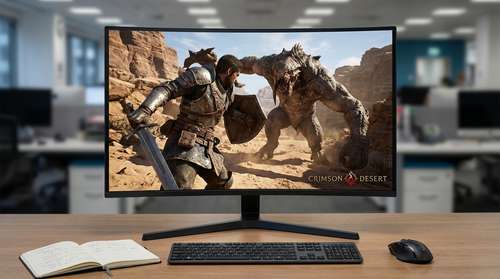
The wait is finally over. The first wave of critics and creators have rendered their verdict, making a Crimson Desert review the most sought-after read in gaming today. Developed by Pearl Abyss, this highly anticipated epic has officially emerged as a colossal achievement. While early impressions and leaked critiques praise its jaw-dropping scale and visceral mechanics, they also highlight a title that demands patience and high-end hardware. As players prepare to step into the war-torn continent of Pywel, it is becoming clear that this might just be the definitive open-world RPG 2026 has delivered.
A Stunning Addition to the Best RPGs 2026
Taking a massive leap from their MMORPG roots, Pearl Abyss has crafted a dedicated, single-player narrative that refuses to hold your hand. You step into the boots of Kliff, the battle-hardened leader of the Greymane mercenaries, navigating a world teetering on the brink of collapse. Rather than relying on branching dialogue trees and deep narrative choices, the story serves as a vehicle for spectacular set-pieces. The sheer scale of Pywel is staggering. According to early hands-on impressions, players can spend upwards of 50 hours exploring just the starting region without scraping the bottom of the content barrel.
Instead of relying on heavy-handed exposition, the game leans into environmental storytelling and emergent encounters. The world design draws favorable comparisons to heavyweights like The Legend of Zelda: Tears of the Kingdom and Red Dead Redemption 2, mixing incredible verticality with a dense, interactive sandbox. It easily stakes its claim among the best RPGs 2026, delivering a setting where floating ruins, sprawling camps, and dynamic weather systems feel genuinely alive. You do not just walk across a map; you climb, grapple, and interact with an ecosystem that reacts to your presence.
Crimson Desert Gameplay: Unforgiving and Unmatched
If you expect a standard block-and-parry rhythm, you are in for a shock. Crimson Desert gameplay is chaotic, expressive, and wildly deep. Critics have drawn parallels to character-action staples like Devil May Cry, but transposed onto a massive seamless map. You are not just swinging a sword; you are utilizing wrestling moves, grappling onto massive bosses, and executing cinematic combos that dynamically shift based on your environment.
There is a catch, however. Reviewers universally note a punishing learning curve. The first eight hours demand absolute focus as you adapt to its unconventional rhythm and complex control scheme. Progression is intentionally slow. Yet, once the mechanics finally click, the combat opens up into an exhilarating ballet of destruction. Add in high-fantasy elements like mechanical suits and dragon riding, and the sandbox becomes a playground of spectacular violence.
Inventory Quirks and Quality of Life
Despite the mechanical brilliance, early reviews highlight a few rough edges. The inventory system has been described as somewhat chaotic, with limited bag space and quest items cluttering the user interface. Furthermore, the lack of traditional camp storage means players have to rely heavily on banking mechanics to manage their loot. These are minor frustrations, but they stand out in a game that otherwise swings for the fences.
Pushing Hardware to the Limit: Crimson Desert PC Performance
Powering this massive endeavor is Pearl Abyss's proprietary BlackSpace Engine, and the visual payoff is undeniable. Lighting, weather effects, and character models are remarkably detailed, making night cycles feel genuinely oppressive and atmospheric. However, that fidelity comes at a steep computational cost, pushing modern hardware to its absolute limits.
Crimson Desert PC performance has been a major talking point leading up to launch. While top-tier rigs equipped with the latest Nvidia and AMD machine learning tech handle the complex lighting beautifully, mid-range systems might struggle to maintain a flawless 60 frames per second at higher resolutions. The late confirmation of Denuvo anti-tamper technology for the PC release has also ruffled some feathers in the community. Players naturally worry about DRM-related stutters, though developers insist the final retail code is heavily optimized. Console players, meanwhile, are faring quite well. Recent technical deep dives confirm that the PS5 Pro handles the game's fidelity modes brilliantly, while base PS5 models deliver a surprisingly stable 1080p presentation hovering around 40-45 FPS.
Crimson Desert Scores: A Diamond in the Rough
So, where do the early Crimson Desert scores land? Based on leaked evaluations and creator impressions ahead of the official embargo, critics are largely labeling the game a rough diamond. Expect to see ratings comfortably settling in the 80 to 85 range, primarily dragged down by its demanding onboarding process and quirky inventory management. If those quality-of-life snags had been ironed out, we might be looking at universal top-tier praise.
Before stepping into Pywel, here are the critical takeaways:
- Combat mastery takes time: Expect a steep learning curve for the first few hours.
- Hardware is tested: Mid-range PCs will need to rely heavily on upscaling tech for smooth performance.
- Exploration is king: The map is overwhelmingly dense, rewarding curiosity over waypoint-chasing.
Yet, for those willing to embrace the friction, the scores hardly matter. Reviewers who breached the 10-hour mark insist the title offers an unmatched sense of freedom and mechanical expression. Pearl Abyss has not just built a beautiful backdrop; they have engineered a sandbox of epic moments. If you have the hardware to run it and the patience to master its brutal combat, the game delivers a breathtaking adventure that redefines expectations for action titles moving forward.