Following its highly anticipated mid-March launch, the critical consensus for Pearl Abyss's latest epic has solidified. In this comprehensive Crimson Desert review, we examine a game that swings wildly between breathtaking ambition and infuriating technical hurdles. Holding a strong Crimson Desert OpenCritic score of around an 80 average, this sprawling adventure has immediately sparked debate among players and critics alike. Often hailed as a new benchmark for Unreal Engine 5-level fidelity—despite actually running on Pearl Abyss's own proprietary BlackSpace Engine—the game pushes modern hardware to its absolute limits. While it easily secures a spot among the best open world RPGs 2026 has to offer, prospective buyers need to understand the heavy technical tax required to run it smoothly.
Pearl Abyss Crimson Desert Gameplay: A Jack of All Trades
The core loop of Pearl Abyss Crimson Desert gameplay feels like a mad scientist's experiment to fuse the most engaging mechanics from the last decade of gaming. You step into the boots of Kliff MacDuff, a seasoned mercenary leader exploring a rugged medieval-fantasy continent. The combat is intensely physical and deeply satisfying. Players can grapple enemies, execute hand-to-hand combos, and utilize an intricate skill tree fueled by Abyss Cores and ancient artifacts.
Beyond the flashy swordplay, the game is overflowing with MMO-style activities. You will find yourself fishing, managing a mercenary camp, recruiting allies, and surviving the harsh elements. However, this sheer volume of mechanics sometimes works against it. The user interface can feel overwhelming, and the controls occasionally lack the precision found in more focused action games. Still, when the systems harmonize, the experience is nothing short of magical.
Exploring Pywel: A World Map Built for Discovery
If there is one area where the game universally succeeds, it is the sheer scale of its environment. Any thorough Pywel world map review must begin with its staggering size. Estimated at 80 to 110 square kilometers, the continent is larger than Skyrim and Red Dead Redemption 2 combined.
But Pearl Abyss did not just create empty space. The map is divided into five distinct regions, from the fertile forests of Hernand to the harsh, snow-capped Pailune Mountains. Dynamic NPC routines, unexpected bandit ambushes, and intricate environmental puzzles ensure that exploration is constantly rewarded. It is a world that demands dozens of hours just to scratch the surface, offering gorgeous vistas that practically beg you to utilize the photo mode.
The Heavy Technical Tax: Crimson Desert PC Performance Benchmarks
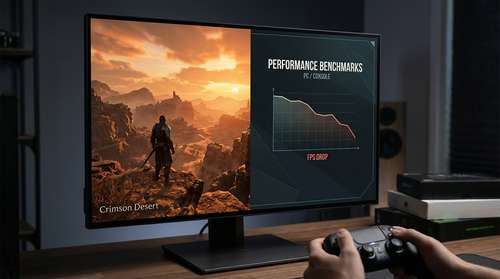
All of this beauty comes at a severe cost. Looking at the latest Crimson Desert PC performance benchmarks, the game heavily favors high-end hardware. On premium rigs equipped with modern GPUs, the game shines brilliantly. With DLSS and FSR fully supported, PC players can experience the open-world in stunning 4K without sacrificing fluid frame rates. The volumetric lighting, dense vegetation, and particle effects create an unparalleled visual feast.
However, mid-range setups will struggle without aggressive upscaling. The BlackSpace engine processes complex physics and massive draw distances simultaneously, meaning CPU bottlenecks are a frequent issue in crowded settlements like Demeniss.
Console Compromises: Crimson Desert PS5 vs Switch 2
The situation becomes significantly more complicated when moving to consoles. While the PS5 Pro utilizes Sony's newly updated PSSR upscaling to achieve a respectable 4K at 60fps, the base PS5 tells a different story. In Performance Mode, the standard PlayStation 5 suffers from severe visual downgrades, cutting ray tracing and dropping native resolution to 1080p just to hover around 40 to 60 frames per second.
This steep hardware requirement has ignited intense discussions regarding a Crimson Desert PS5 vs Switch 2 comparison. With Nintendo's next-generation hardware dominating recent industry conversations, many wonder if Pywel will ever make the jump to the hybrid console. Given that the base PS5 already compromises heavily to run the game, porting this massive adventure to the Switch 2 would require monumental graphical sacrifices. Achieving a stable frame rate on Nintendo's platform would likely mean stripped-back lighting, reduced NPC density, and massive visual cuts.
Is the Journey Worth the Upgrade?
Ultimately, Kliff's journey across Pywel is an unforgettable experience marred by its own colossal ambition. If you have the hardware to support it, this is a generation-defining sandbox that you can easily sink 100 hours into. For those on older consoles, you may need to endure some technical compromises or wait for future optimization patches. Regardless of where you play, Pearl Abyss has crafted a fascinating, flawed masterpiece that will dominate gaming discussions for years to come.