
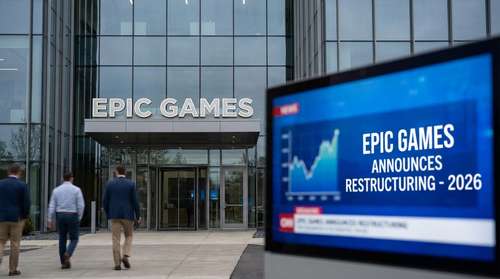
Epic Games is once again making waves in the tech and gaming world, but this time, the news is decidedly grim. On Tuesday, March 24, the powerhouse publisher behind Fortnite and the ubiquitous Unreal Engine announced the Epic Games layoffs 2026, confirming that over 1,000 employees—roughly 20% of its total workforce—are losing their jobs. This massive restructuring effort comes as the company grapples with an ongoing financial imbalance, where aggressive spending has significantly outpaced revenue following a turbulent year. With a workforce that had previously hovered around 5,000 people, this latest reduction dwarfs the company's previous cuts of 830 staff members back in September 2023, marking a historic and painful shift for the North Carolina-based developer.
Dissecting the Tim Sweeney Epic Games Statement
In a sobering, company-wide memo distributed to staff, the CEO offered candid insight into the difficult decision. The Tim Sweeney Epic Games statement highlighted that a noticeable downturn in Fortnite engagement, which began in 2025, has severely impacted the company's bottom line. "We're spending significantly more than we're making, and we have to make major cuts to keep the company funded," Sweeney wrote to his employees.
To stabilize the developer, Epic has identified an additional $500 million in cost savings achieved through reduced contracting, marketing budget trims, and the permanent closure of several open roles. Interestingly, Sweeney addressed a growing anxiety in the tech sector head-on, explicitly stating that these cuts are entirely unrelated to artificial intelligence. While AI has been a convenient scapegoat for recent workforce reductions, Sweeney emphasized that Epic still desperately needs talented human developers.
For the impacted staff, the company is offering a relatively comprehensive severance package, which includes:
- At least four months of base severance pay
- An acceleration of stock options vesting through January 2027
- Extended healthcare coverage for six months for U.S. employees
Broader Context: PC Gaming Industry Layoffs and Ecosystem Wars
The stark situation in Cary, North Carolina, is a direct reflection of a much larger, systemic crisis. The ongoing PC gaming industry layoffs have continued to ravage studios worldwide throughout early 2026, driven by tougher cost economics, sluggish console sales, and the definitive end of the pandemic-era gaming boom. Players are now dedicating their screen time to competing social media platforms and other highly engaging forms of digital entertainment. As consumer spending weakens globally, publishers are finding it increasingly difficult to justify the massive budgets required for modern blockbuster game development.
Furthermore, the relentless battle of the Epic Games Store vs Steam 2026 has required an unsustainable level of capital investment. Epic’s strategy of securing timed exclusives and giving away premium free games to capture market share from Valve's dominant storefront has been notoriously expensive. When combined with the lingering financial toll of drawn-out legal battles against tech giants Apple and Google over app store fees and monopoly practices, Epic’s aggressive expansion strategy has finally caught up with its balance sheet.
Pivoting Toward the Fortnite Next Generation Update
Despite the heavy blow to its internal workforce, Epic is attempting to look toward a profitable, streamlined future. A major part of the company's survival strategy relies heavily on the highly anticipated Fortnite next generation update. Sweeney noted that his remaining developers need to focus purely on building fresh, awesome experiences with compelling seasonal content, updated gameplay mechanics, and massive live events to reignite player engagement. As the company regroups, it plans to launch the next era of the Epic ecosystem toward the end of the year, hoping to recapture the cultural dominance and player retention it enjoyed in its prime.
Mobile expansion serves as another crucial lifeline for the restructuring publisher. For anyone closely following mobile gaming news 2026, it is no secret that Epic is still only in the early stages of properly returning its flagship battle royale to smartphones following historic antitrust settlements. Optimizing Fortnite for mobile devices remains a top corporate priority. Reaching casual and hardcore gamers alike on iOS and Android platforms is viewed as essential for patching the current revenue leak and tapping into lucrative international markets where mobile gaming reigns supreme.
The Future of Unreal Engine 2026 Development
While the consumer-facing, live-service side of the business undergoes radical changes, the company’s enterprise foundation remains a steadfast priority. Unreal Engine 2026 development continues to be a cornerstone of Epic’s long-term viability and industry influence. By maintaining a strong focus on its proprietary 3D creation tool—which powers countless rival video games, major Hollywood film productions, and complex enterprise software—Epic ensures a steady, diversified revenue stream that exists entirely outside of direct game sales.
As the dust settles on this brutal wave of job cuts, the global gaming community is left watching closely. Epic Games has survived massive industry upheavals before—from the leap from 2D to 3D in the 1990s to the live-service boom of the 2010s. Now, facing what Sweeney himself calls "the most extreme" market conditions since those early days, the company must prove that this painful restructuring will truly position it as a resilient winner on the other side.