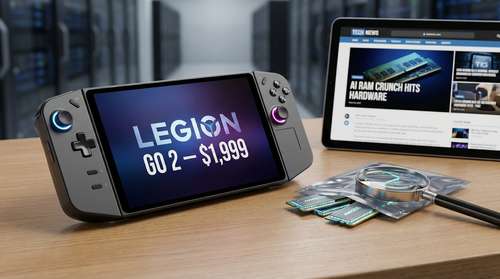
The golden age of accessible portable gaming hardware just hit a massive roadblock. This week, the Lenovo Legion Go 2 price was officially hiked by nearly 50%, sending shockwaves through the portable gaming community. The flagship 32GB model, which already carried a premium status, is now retailing for a staggering $1,999. Lenovo has attributed this abrupt and massive increase to the global "AI-driven RAM crunch," a supply chain crisis that has redirected crucial, high-performance memory components to enterprise data centers and left consumer hardware manufacturers scrambling to absorb surging costs.
The Lenovo Legion Go 2 Price Hike: What You Need to Know
Just days ago, prospective buyers checking online retailers found that the Lenovo Legion Go 2 price had skyrocketed. Originally launched in late 2025 as a premium but attainable device for enthusiasts, the flagship tier featuring 32GB of LPDDR5X memory now sits firmly in high-end gaming laptop territory. A 50% price markup effectively alters the device's target demographic, pushing it out of reach for the average consumer looking to upgrade their portable setup.
Lenovo's official statements point directly to compounding manufacturing expenses. Memory components that were once plentiful and relatively cheap have become the tech industry's rarest commodity. For a system heavily reliant on shared system memory to feed its integrated graphics, dropping the RAM capacity wasn't a viable option for the flagship tier. Instead, the company opted to pass the ballooning costs directly to the consumer, a move that is setting a dark precedent for handheld PC gaming 2026.
How the 'AI RAM Shortage' is Crippling Consumer Tech
To understand why your next gaming handheld costs as much as a used car, you have to look at the enterprise sector. The global AI RAM shortage stems from the explosive growth of artificial intelligence models and the massive data centers required to train them. The world's top three memory producers—Micron Technology, Samsung Electronics, and SK Hynix—have aggressively pivoted their fabrication plants to prioritize High Bandwidth Memory (HBM).
These high-margin HBM chips are essential for the enterprise GPUs powering AI infrastructure. Every silicon wafer dedicated to an AI data center is one less available for consumer-grade LPDDR5X chips, creating an unprecedented supply bottleneck. Because tech giants are buying up approximately 70% of the total worldwide memory supply, manufacturers like Lenovo are forced into bidding wars for whatever standard memory remains.
The Ripple Effect on Handheld PC Gaming 2026
The AI impact on gaming hardware extends far beyond a single Lenovo product. The entire ecosystem of portable gaming hardware is feeling the squeeze. Competing devices are navigating the same treacherous supply chain waters. We've already seen Valve quietly adjust entry prices and phase out older LCD models of the Steam Deck to offset broader production inflation. More alarming are the reports from industry insiders suggesting that traditional console manufacturers are terrified of this trend. Analysts predict that upcoming console generations—including the heavily rumored next Xbox and PlayStation 6—might face significant delays stretching into 2028 or 2029. Launching a mass-market console is impossible if the baseline memory costs force retail prices north of $1,000.
Are the Ryzen Z2 Extreme Specs Still Worth the Cost?
At $1,999, buyers are rightfully questioning whether the internal hardware justifies the extreme investment. Under the hood, the Ryzen Z2 Extreme specs remain undeniably impressive, representing the pinnacle of what AMD can cram into a handheld form factor. The APU utilizes a sophisticated 8-core, 16-thread configuration combining three high-performance Zen 5 cores with five high-efficiency Zen 5c cores. This hybrid architecture, which boosts up to 5.0 GHz, allows the device to manage battery life while delivering desktop-like responsiveness during demanding titles.
Crucially, the visual heavy lifting is managed by the Radeon 890M integrated GPU featuring 16 RDNA 3.5 compute units. When paired with the 32GB of ultra-fast LPDDR5X-8000 memory—the very component driving the current price crisis—it delivers top-tier framerates on the device's gorgeous 8.8-inch, 144Hz 1200p OLED display. For those who demand uncompromised visual fidelity on the go, the Legion Go 2 is a technical marvel. The device also features a dedicated XDNA 2 NPU capable of 50 TOPS for accelerating local AI workloads.
However, the sheer economic value proposition has been heavily distorted. While the performance jump from the previous generation's Z1 Extreme is highly notable—offering over a 26% uplift in single-core speeds and substantial graphics improvements—paying two thousand dollars for an integrated graphics solution challenges the very concept of portable accessibility. Gamers could traditionally build a robust mid-range desktop PC or buy a dedicated high-end gaming laptop for the same price.
The Bleak Reality for Portable Gaming Hardware
We are currently witnessing a fundamental shift in the landscape of consumer electronics. The Legion Go 2 price hike is merely the canary in the coal mine for a technology market increasingly dominated by enterprise AI interests. As long as tech conglomerates are willing to write blank checks for server-grade memory, the consumer-facing AI RAM shortage will persist, and potentially worsen throughout the year.
For dedicated players heavily invested in handheld PC gaming 2026, the golden era of aggressive competitive pricing and affordable raw power has been abruptly suspended. Budget-conscious consumers will likely be forced into lower-tier models—such as those featuring the lesser Ryzen Z2 or Z2 Go chips with a restrictive 16GB of RAM—compromising performance just to afford entry into the ecosystem. If you were holding out for a seasonal price drop on premium portable hardware, the current macroeconomic trajectory suggests a harsh reality: securing a high-end device now might be the only way to avoid paying even more tomorrow.