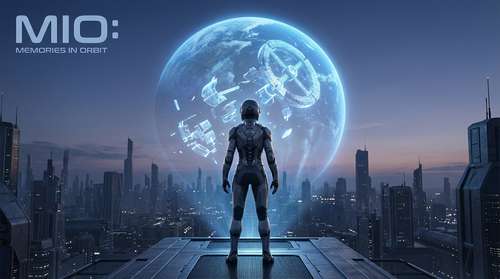
The wait is finally over. After captivating audiences with its initial reveal years ago, MIO: Memories in Orbit has officially launched today, January 20, 2026, delivering one of the most visually arresting and mechanically demanding experiences of the year. Developed by Douze Dixièmes and published by Focus Entertainment, this sci-fi Metroidvania invites players aboard the Vessel—a colossal, decaying spaceship drifting through the cosmos. While the game’s breathtaking hand-drawn art style invites you in, its punishing difficulty will force you to fight for every inch of progress. As the first major contender for best metroidvanias 2026, MIO strikes a delicate balance between beauty and brutality, though not without stumbling over its own ambition.
A Decay Worth Exploring
From the moment MIO awakens on the derelict ark, the game establishes a hauntingly beautiful atmosphere that rivals genre titans like Ori and the Blind Forest. The distinct watercolor aesthetic brings the Vessel to life, painting a world where overgrown vegetation chokes futuristic machinery. Each biome feels meticulously crafted, from the neon-lit industrial sectors to the organic, pastel-hued gardens.
The narrative is delivered with subtle environmental storytelling, tasking you with saving the Vessel from oblivion by reactivating its lost AI caretakers, known as Pearls. Much like Hollow Knight, the story is cryptic but emotionally resonant, driving you forward to uncover why this technological marvel fell into ruin. It is a world that feels ancient and lived-in, making exploration its own reward.
MIO Gameplay Difficulty: Precision or Punishment?
Let’s address the elephant in the room: MIO gameplay difficulty is relentless. This is not a casual platformer; it is a precision test that demands mastery of its unique movement mechanics. MIO controls a wire-like tendril ability that allows for grappling, swinging, and lashing out at enemies. The flow of movement is undeniable once mastered, allowing you to zip through hazards with satisfying speed. However, the learning curve is steep.
The platforming sections often approach Celeste-tier levels of challenge, requiring frame-perfect inputs. Combat is equally unforgiving, with 30+ distinct enemy types and 15 guardian bosses that punish hesitation. A major talking point in early reviews is the polarizing difficulty spike found in the mid-game. Unlike the gradual ramp-up seen in other titles, MIO throws players into the deep end quickly.
The "Erosion" System: A Controversial Mercy
To mitigate frustration, Douze Dixièmes has implemented a unique assist feature called "Erosion." If enabled, this optional setting reduces a boss's maximum health by a small percentage each time you die, effectively simulating the enemy wearing down over time. It’s a brilliant diegetic solution for accessibility, allowing players to push through walls without trivializing the mechanics entirely. Purists can ignore it, but for many, it will be the difference between finishing the game and abandoning ship.
MIO vs Hollow Knight Comparison
Comparisons are inevitable, and MIO invites them boldly. In the MIO vs Hollow Knight comparison, MIO holds its own in terms of world design and atmosphere. The interconnected map of the Vessel is massive, filled with shortcuts and secrets that reward backtracking. However, where Hollow Knight focused heavily on melee combat precision, MIO leans more into aerial mobility and platforming puzzles.
One area where MIO falters slightly is the save system. Checkpoints are sparse, leading to punishingly long "runbacks" to boss arenas—a design choice that feels somewhat dated in 2026. While the world is a joy to traverse, repeating a three-minute gauntlet of spikes just to retry a boss can drain the excitement.
MIO Memories in Orbit Switch 2 Performance
Launching alongside the new hardware generation, the MIO Memories in Orbit Switch 2 performance is a standout success. We tested the game extensively on Nintendo's new console, and it runs at a locked 60 frames per second in both docked and handheld modes. The vibrant OLED screen of the Switch 2 makes the watercolor art pop significantly, and the input latency is virtually non-existent—crucial for a game requiring such high precision.
On PC and PlayStation 5, the game supports higher resolutions, but the Switch 2 version feels like the definitive way to play for portability without compromising fluidity. It is easily one of the Focus Entertainment new releases that best showcases the capabilities of the new handheld hybrid.
Verdict: A Soul-Crushing Gem
MIO: Memories in Orbit is a triumph of artistic vision and mechanical depth. It successfully carves out its own identity in a crowded genre, offering a sci-fi twist that feels fresh and urgent. While the difficulty spikes and sparse checkpoints may alienate some players, those who persevere will find one of the most rewarding top rated indie games 2026 has to offer.
If you have the patience for its trials, the Vessel is a journey worth taking. Just be prepared to die—a lot—before you uncover its secrets.