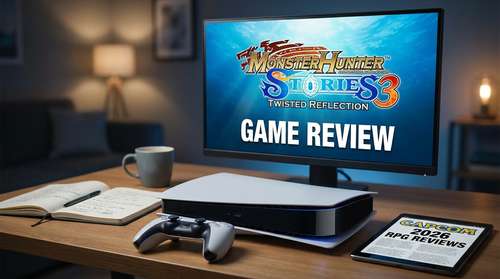
Capcom has consistently pushed the boundaries of the role-playing genre, but their latest release on March 13, 2026, sets a completely new benchmark for the industry. In this definitive Monster Hunter Stories 3 review, we examine how the beloved franchise has evolved from its humble handheld beginnings into a sprawling, continent-spanning epic. Subtitled Twisted Reflection, the game drops players directly into a politically charged conflict between the warring kingdoms of Azuria and Vermeil. All the while, a terrifying environmental disaster known as the Crystal Encroachment threatens to wipe out the natural order completely. By delivering a massive leap in visual fidelity and introducing a seamlessly integrated open map, Capcom has crafted what is easily one of the premier releases in the current gaming calendar.
A Vast, Untamed Open World Experience
The transition to a fully open environment fundamentally changes how Riders interact with the local ecosystems. Gone are the segmented, loading-screen-heavy zones of previous iterations; instead, players are treated to massive, contiguous landscapes teeming with roaming beasts. As you take on the role of a Ranger—an elite tier of Rider tasked with rebuilding devastated habitats—the sense of scale becomes immediately apparent. You will track invasive species across sweeping plains, scale treacherous volcanic ridges, and dive deep into intricate cavern systems to rescue endangered eggs.
This underlying environmentalist ideology breathes fresh life into the world. You are actively restoring balance to nature rather than just slaying everything in your path. Hatching and releasing creatures back into their native habitats creates a rewarding loop that adds significant narrative weight to your exploration. From lush, sun-drenched forests to volatile corrupted zones, the brilliant world design consistently rewards your curiosity while reinforcing the high-stakes storyline surrounding the legendary twin Rathalos.
Twisted Reflection Gameplay Verdict: Refining the Hunt
For anyone keeping a close eye on recent turn-based JRPG reviews, combat stagnation is a frequently cited critique of the genre. Fortunately, the Twisted Reflection gameplay verdict is overwhelmingly positive, largely due to Capcom's complete overhaul of the foundational combat mechanics. Every single encounter out in the wild now carries the heavy weight and cinematic flair of a mainline boss fight. The familiar rock-paper-scissors mechanic returns but is layered with complex environmental interactions, precise part-breaking strategies, and dynamic dual-kinship attacks that can devastate enemy ranks.
Expanding the Monster Hunter Stories 3 Monster List
A creature-collection game ultimately lives or dies by its roster. Thankfully, the sheer scope of the Monster Hunter Stories 3 monster list is staggering. You will find beloved fan favorites returning with entirely new attack patterns alongside aggressive, never-before-seen invasive species that trigger unique spontaneous world events. Building a balanced team of Monsties requires careful consideration of genetics and elemental affinities. The game's robust, content-rich endgame revolves around tracking down ultra-rare elusive variants and optimizing your party's genetic bingo boards, easily cementing its status among the best monster taming games 2026 has to offer.
Performance Showdown: MH Stories 3 Switch 2 vs PS5
With the title launching simultaneously across multiple platforms, the technical discussion has inevitably focused on hardware capabilities. The MH Stories 3 Switch 2 vs PS5 debate reveals fascinating insights into how Capcom optimized their proprietary engine for vastly different ecosystems. On the PlayStation 5, the game runs at a flawless 60 frames per second with native 4K resolution. This raw power highlights the intricate scale textures on every creature and the terrifying, crystalline beauty of the Encroachment's corruption spreading across the land.
However, the Nintendo Switch 2 version is perhaps the most impressive technical achievement among all Capcom 2026 RPG reviews. The highly anticipated handheld console manages to maintain the seamless open-world design without sacrificing the dense monster populations or the vibrant art direction. While the Switch 2 targets a dynamic 1440p resolution and utilizes advanced spatial upscaling to maintain a highly stable framerate, the visual gap between the handheld and high-end home consoles is shockingly narrow. Both platforms deliver stunning, fully voiced cinematic cutscenes that perfectly highlight the emotional tension between the Azurian heir and Princess Eleanor of Vermeil.
The Final Takeaway on Capcom's Latest Triumph
Navigating the complex webs of wildlife preservation, political betrayal, and ancient prophecies makes this third installment an absolute triumph for the studio. While some companion characters—particularly the occasionally abrasive and overly protective Palico named Rudy—might grate on certain players' nerves during tense story moments, the overarching narrative remains gripping from the opening cinematic to the final post-game boss hunt.
By marrying a mature, politically driven storyline with addictive creature collection mechanics, Capcom has delivered a masterclass in modern role-playing design. The transition to a seamless map, combined with deeply tactical battles, ensures that both veteran Riders and newcomers will find hundreds of hours of entertainment. It is a monumental achievement that will undoubtedly influence the trajectory of the role-playing genre for years to come.