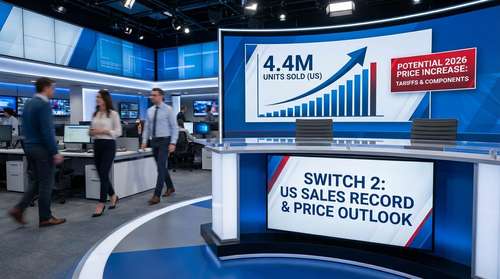
The Nintendo Switch 2 has officially cemented its status as a commercial juggernaut, shattering US sales records just seven months into its lifecycle. According to the latest data released this week by Circana (formerly NPD Group), Nintendo's next-generation hybrid console has moved an astounding 4.4 million units in the United States since its June 5, 2025 launch. This figure makes it the fastest-selling console in US history, outpacing the previous record-holder, the PlayStation 4.
However, the celebration may be short-lived for prospective buyers. A confluence of economic pressures—specifically skyrocketing NAND memory costs and volatile trade tariffs—has led leading market analysts to issue a stark warning: the Switch 2's $449.99 retail price could see a significant increase before the end of 2026.
Shattering Records: Inside the Switch 2's 4.4 Million Milestone
The Switch 2's ascent has been nothing short of meteoric. Mat Piscatella, Executive Director at Circana, confirmed that the console's momentum has defied the typical post-holiday slump. "The Switch 2 isn't just selling; it's accelerating," Piscatella noted in the January 2026 report. By crossing the 4.4 million unit threshold in just under seven months, the system has effectively eclipsed the launch-window performance of both the PlayStation 4 and the original Nintendo Switch.
This success is largely attributed to a "perfect storm" of software availability. Unlike previous generations plagued by launch droughts, the Switch 2 arrived with Mario Kart World on day one, followed quickly by heavy hitters like Pokémon Legends: Z-A in October and the long-awaited Metroid Prime 4: Beyond in December. These flagship titles have driven hardware adoption at a rate the industry hasn't seen in over a decade.
The Sticking Point: Why Analysts Predict a 2026 Price Surge
Despite the sales triumph, the hardware economics are grim. New reports from market intelligence firm Niko Partners and semiconductor analysts at TrendForce suggest that Nintendo may be forced to abandon its current pricing strategy. The primary culprit is the global cost of components.
The NAND Flash Crisis
The most immediate threat comes from the memory sector. NAND flash memory—the storage technology used in the Switch 2's internal drive and game cartridges—is undergoing a massive price correction. TrendForce data indicates that NAND contract prices are projected to rise by 20% to 30% throughout 2026. This surge is driven by aggressive demand from the AI server market, which is cannibalizing the supply of memory chips available for consumer electronics.
For a console sold at $449 with razor-thin margins, a 30% hike in memory costs is catastrophic. "Nintendo has historically absorbed minor fluctuation, but the current NAND 'supercycle' is unsustainable for consumer hardware priced under $500," explains a supply chain analyst from SCMR.
Tariff Volatility
Compounding the component crisis is the shifting landscape of US trade policy. The recently implemented trade tariffs on electronics manufactured in East Asia have added a layer of uncertainty to Nintendo's supply chain. While the initial 10% universal tariff was absorbed by many manufacturers in late 2025, fears of "reciprocal tariffs" escalating later this year could force Nintendo's hand.
What This Means for Gamers in 2026
If these economic headwinds persist, analysts believe Nintendo has two options: raise the base MSRP or discontinue the entry-level model in favor of higher-priced bundles. Niko Partners has explicitly warned that the $449 SKU might quietly disappear from shelves, replaced by $499 or $529 bundles that include software or accessories to mask the effective price hike.
For consumers sitting on the fence, the window to secure a Nintendo Switch 2 at its launch price may be closing. With inventory already tight following the holiday rush and production costs climbing, 2026 is shaping up to be a year where availability isn't the problem—affordability is.