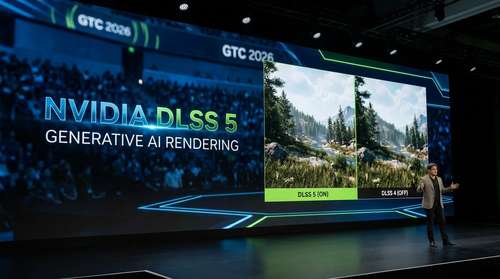
The landscape of interactive entertainment just experienced a seismic shift. During a packed keynote at this week's GTC 2026, CEO Jensen Huang delivered the most significant NVIDIA DLSS 5 news to date, unveiling a technology poised to completely reshape the future of PC gaming visuals. Moving far beyond traditional AI graphics upscaling technology, DLSS 5 introduces full real-time generative AI reconstruction to consumer graphics. By dynamically re-imagining textures, lighting, and materials on the fly, NVIDIA is promising Hollywood-grade photorealism for everyday gaming setups.
NVIDIA GTC 2026 Highlights: The "GPT Moment" for Graphics
For years, gamers and developers alike have relied on Deep Learning Super Sampling to squeeze extra frames out of heavily demanding titles. However, the standout moment among the NVIDIA GTC 2026 highlights was the revelation that the newest iteration isn't just about speed—it's about fundamentally altering how digital worlds are rendered. Huang boldly described the update as the "GPT moment for graphics," illustrating how the company is blending handcrafted game assets with generative neural networks to achieve an unprecedented leap in visual realism.
This new neural rendering model operates by analyzing a game's color and motion vectors on a frame-by-frame basis. Instead of simply enlarging an image or predicting intermediate frames, the AI model understands complex scene semantics. It recognizes the fundamental differences between coarse fabric, highly reflective metal, translucent skin, and individual strands of hair. The AI then seamlessly adjusts how environmental lighting interacts with each specific material in real time, ensuring consistency without jarring visual artifacts,.
DLSS 5 vs DLSS 4 Performance: A Paradigm Shift
When analyzing DLSS 5 vs DLSS 4 performance, it becomes immediately clear that NVIDIA has shifted its core developmental objective. DLSS 4.5, which debuted earlier this year at CES, focused heavily on raw rendering efficiency by utilizing AI to draw 23 out of every 24 pixels seen on screen,. While that was a massive technical triumph for maintaining high frame rates, DLSS 5 is prioritizing ultimate visual fidelity.
How Real-Time Generative AI Gaming Works
The leap to real-time generative AI gaming means the background software no longer just guesses the next pixel to smooth out performance stutters. It actively re-lights and re-textures the entire scene simultaneously. The neural network is trained end-to-end to account for incredibly diverse lighting conditions—whether a character is heavily back-lit by a setting sun, standing under an overcast sky, or walking through a neon-drenched alleyway. By processing these semantic elements at up to 4K resolution, DLSS 5 crosses the uncanny valley, eliminating dead eyes and plastic-looking skin without sacrificing smooth, interactive gameplay,.
Crucially, this AI-driven filtering preserves developer intent. Artists retain strict control over their unique aesthetics, utilizing the AI to organically enhance rather than overwrite their original creative vision,. During the GTC presentation, major titles like Starfield, Resident Evil Requiem, Assassin's Creed Shadows, and Hogwarts Legacy were showcased with the technology enabled, transforming previously flat character models into strikingly lifelike figures,. Heavy-hitting publishers, including Bethesda, Capcom, Tencent, and Ubisoft, have already pledged Day-One support for the technology ahead of its slated Fall 2026 release,.
Hardware Demands and RTX 60-Series Rumors 2026
Naturally, generating photorealistic cinematic visuals on the fly requires immense computational horsepower. Early previews at GTC reportedly ran on a specialized dual-RTX 5090 setup, though NVIDIA was quick to confirm that the final consumer version will run efficiently on a single standard GPU at launch. This steep hardware constraint directly ties into the latest RTX 60-series rumors 2026 that have been dominating hardware forums.
Industry insiders currently suggest that while DLSS 5 will launch this fall for the high-end RTX 50-series, it is truly architected to synergize with NVIDIA's upcoming next-generation Rubin architecture,. Recent supply chain reports and leaks indicate that the highly anticipated RTX 6090—rumored to offer a massive 30% to 40% rendering uplift over the current 5090—might be pushed back, not hitting consumer shelves until late 2027 or potentially 2028 due to ongoing memory supply constraints,. Until those next-generation discrete cards finally arrive, DLSS 5 will serve as the ultimate bridge, utilizing intelligent neural rendering to maximize the absolute graphical potential of today's high-end gaming rigs.
Reshaping the Future of PC Gaming Visuals
The official introduction of DLSS 5 marks a definitive, irreversible turning point for the interactive entertainment industry. We are rapidly transitioning from an era where rigid hardware limitations dictated our graphical ceilings to one where software and artificial intelligence can dynamically elevate a game's presentation beyond its base code. As real-time neural rendering becomes the new industry standard, the historical line separating interactive media and pre-rendered cinematic visual effects will blur completely. For PC graphics enthusiasts and developers alike, this fall cannot come soon enough.