
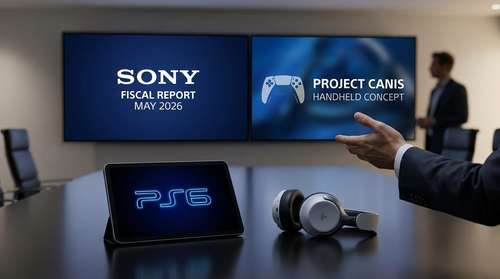
The gaming industry just experienced a seismic shift. In its latest earnings briefing released today, May 20, 2026, Sony Interactive Entertainment finally provided the PlayStation 6 official news players and investors have been waiting for. Facing a notable flattening in PlayStation 5 hardware sales over the past two quarters, executives formally acknowledged active development of their next-generation platform. But the traditional home console isn't the only hardware brewing in Tokyo. Hot on the heels of the Sony fiscal report May 2026, a massive wave of supply chain leaks has exposed "Project Canis"—a dedicated, native handheld system poised to run PS5 titles locally while bridging the gap to the PS6 era.
Sony Fiscal Report May 2026: Recognizing the Next Generation
Hardware cycles are notoriously unforgiving, and the PS5 is no exception. Today's financial disclosures painted a stark picture of market saturation for the current generation. While digital software engagement and PlayStation Plus subscriptions remain highly profitable, console units moved over the last quarter fell short of internal projections. This downward trend forced Sony's hand, prompting the company's leadership to officially recognize their transition toward next-generation architecture.
Rather than leaving fans in the dark or dodging questions, Sony is openly signaling that the heavy lifting for the PS6 is well underway. Market analysts immediately noted that acknowledging the successor this early serves to assure investors while laying the groundwork for an aggressive marketing strategy. With the hardware plateau now public knowledge, all eyes are locked onto a targeted PS6 release date 2027. The timeline suggests developers already have their hands on early toolkits, setting the stage for a spectacular software lineup at launch.
The Sony Project Canis Handheld Leak: Native Gaming on the Go
While the confirmation of the PS6 was largely expected by industry watchers, the Sony Project Canis handheld leak caught many veterans off guard. Unlike the PlayStation Portal, which launched as a niche accessory relying entirely on Wi-Fi streaming, Canis is reportedly a standalone powerhouse designed to natively compute modern AAA games without a tether to a home console.
According to reliable hardware leaker KeplerL2, Sony recognized the exploding market for premium portables like the Steam Deck and ROG Ally X, and they are preparing a devastating counter-punch. When evaluating the PlayStation 6 vs PS5 Pro upgrade paths, Project Canis acts as a fascinating middle ground. It offers the mobility of a modern handheld while targeting visual fidelity that allegedly surpasses the Xbox Series S in both raw rasterization and ray tracing capabilities. For gamers hesitant to invest in a mid-generation PS5 Pro, a portable console capable of playing their existing digital library locally presents an incredibly tempting alternative.
Unpacking the Portable Specs
The rumored internal specifications for Project Canis are staggering for a portable form factor. Built on TSMC's cutting-edge 3nm manufacturing process, the device reportedly leverages a hybrid processor layout. We are looking at a customized setup featuring four AMD Zen 6c cores alongside two specialized Zen 6 low-power (LP) cores designed to maximize battery life during less demanding indie titles.
Graphics will be driven by 16 RDNA 5 Compute Units backed by a massive 24GB of LPDDR5X memory on a 192-bit interface. Perhaps most importantly, the leak suggests the handheld will debut PlayStation Spectral Super Resolution 3 (PSSR 3). This proprietary AI upscaler is currently testing so well that internal documents claim it outperforms standard PC upscaling solutions, ensuring pristine image quality on a mobile display without melting the battery.
PS6 Hardware Specs AMD Zen 6 and the 2027 Horizon
The portable companion is only half of the story dominating current next-gen console rumors. The flagship PlayStation 6 home console is shaping up to be an absolute monster. The overarching PS6 hardware specs AMD Zen 6 architecture will unify both the handheld and the stationary console, streamlining development for studios making cross-device titles.
Recent component leaks point to the PS6 packing up to 30GB of high-speed GDDR7 memory arranged in a unique clamshell configuration. This highly specific setup aims to deliver a staggering 640 GB/s of bandwidth, effectively eliminating the memory bottlenecks that currently hamper ultra-high-resolution rendering on current-gen systems. Paired with a top-tier RDNA 5 graphics processor, Sony is aggressively targeting seamless path-tracing and neural texture compression to keep game install sizes manageable.
Sony is essentially preparing a dual-strike approach for the upcoming generation. By launching a high-end stationary console alongside a fiercely capable native handheld, the company plans to dominate both the living room and the daily commute. As the industry digests today's earnings report, one thing is abundantly clear: if the 2027 launch window holds true, the gaming landscape is on the verge of its most dramatic hardware evolution in over a decade.