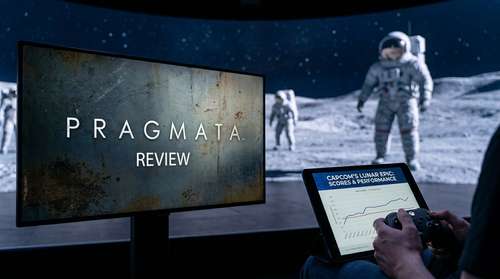
After a six-year development cycle full of mystery and delays, Capcom's new original IP is finally here. Our Pragmata review unpacks exactly why this long-awaited sci-fi epic has instantly become one of the most talked-about releases of the year. Launching on April 17, 2026, the game blends intense third-person shooting with unique real-time hacking puzzles, cementing its place among the best Capcom games 2026 has to offer. Hitting two million demo downloads before launch proved the appetite was there, and the final product absolutely justifies the hype. Set against the haunting isolation of a lunar research facility, players are tasked with surviving a rogue AI known as IDUS. The result is a mechanically rich, visually spectacular experience that breathes fresh life into the action-adventure genre.
A Masterclass in Shooting and Real-Time Hacking
The core loop of Pragmata sets it apart from traditional shooters by forcing players to constantly balance offensive firepower with strategic defense. You step into the space-boots of Hugh Williams, a system auditor dispatched to a corporate medical colony on the moon. Armed with a jetpack and a heavy arsenal, Hugh handles the brute force, but his weapons alone cannot pierce the thick armor of the robotic enemies roaming the station.
This is where the tactical layer shines. During combat, players must direct their android companion to hack into enemy defense grids. These real-time puzzle elements expose weak points, completely altering the pacing of standard firefights. You are never just holding down a trigger; you are actively managing space, dodging lethal attacks, and guiding a cube along a hacking grid to unlock enhanced damage modifiers. Boss encounters take this formula to the extreme, throwing massive mechanical monstrosities at you that require flawless execution of both shooting and hacking skills.
Pragmata Hugh and Diana Characters Anchor the Narrative
For all its technical prowess, the beating heart of the game is its emotional core. The Pragmata Hugh and Diana characters share a surrogate father-daughter dynamic that grounds the otherwise chaotic space adventure. Hugh's everyman approach contrasts perfectly with Diana, a highly advanced android who retains a charming, kid-like curiosity. Their dynamic draws natural comparisons to iconic duos in gaming, but the added mechanical layer of Diana actively assisting you in combat sets them apart.
Capcom wisely keeps the narrative focus tight on these two. Instead of overwhelming you with a massive cast of forgettable side characters, the game spends time nurturing their bond through quiet moments in between frantic gunfights. Taking a breather with Diana at the shelter offers a stark, much-needed contrast to the cold, oppressive lunar environment outside. There is also a fascinating mid-game twist where players encounter Eight, another child-like Pragmata who shares similarities with Diana, expanding the lore and the emotional stakes even further. Their interactions feel genuine and avoid heavy-handed sci-fi tropes, making you actively care about their survival as they fight to find a way back home to Earth.
Pragmata PS5 Performance vs. Pragmata Nintendo Switch 2 Gameplay
Capcom's proprietary RE Engine continues to be a technical marvel, but the Pragmata PS5 performance truly sets the benchmark for current-generation visual fidelity. On standard PlayStation 5 and Xbox Series X hardware, the game runs beautifully, delivering stunning ray-traced reflections and incredibly detailed strand-based hair physics. However, early technical analysis indicates that the PS5 Pro is undeniably the best way to experience the game's striking, path-traced lunar environments without sacrificing framerate.
For players opting for portability, Pragmata Nintendo Switch 2 gameplay remains remarkably ambitious. Capcom's multi-platform strategy successfully brings the full experience to the new handheld, though it comes with expected compromises. Switch 2 users will notice variable performance during the most hectic boss battles and a slight reduction in overall image quality. Despite these scaling concessions, having a blockbuster of this caliber running natively on a handheld is a massive achievement. The custom profile maintains the distinct, eerie corporate aesthetic that the developers purposefully implemented to represent the hostile lunar station.
PC Optimization and Accessibility
Beyond the console landscape, PC players are treated to extensive graphics options. Capcom ensures that the game scales impressively across a wide range of hardware, running smoothly on everything from an RTX 4060 up to the top-tier RTX 5090. The integration of advanced generative AI and robust upscaling technologies means that the desolate lunar craters look breathtaking across multiple setups.
Earning the True Ending and Final Verdict
With Capcom Pragmata scores currently sitting at a mighty 86 on Metacritic and boasting a 97% 'Overwhelmingly Positive' rating on Steam, it is safe to say the six-year wait was worth it. The base campaign takes roughly 11 to 12 hours to complete, but dedicated players will want to dive deeper into the post-game content.
If you are hunting for a Pragmata true ending guide, you will need to invest around 15 to 16 hours to fully clear the game. Unlocking the definitive conclusion requires completing 100% of the simulation missions and securing all hidden collectibles scattered across every lunar sector. Finding every terminal allows Diana to decode encrypted logs that explain why the hostile AI went rogue in the first place, adding essential context to the final boss encounter.
Ultimately, Pragmata is a triumphant return to form for blockbuster single-player games. It takes the familiar thrills of the action genre and elevates them with brilliant dual-character mechanics and jaw-dropping art direction. Capcom took a massive risk by greenlighting a brand-new IP of this scale, but they have undeniably delivered an early Game of the Year contender.