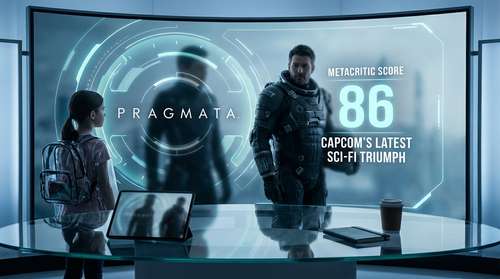
After six years of anticipation, multiple delays, and an air of mystery, the embargo has finally lifted. The first wave of Pragmata review publications has painted a fascinating picture of Capcom’s latest original IP. Set against the bleak but breathtaking backdrop of a collapsed lunar colony, the game teams up a jetpack-clad spacefarer named Hugh with a young android girl, Diana. Gamers have been eager to know whether the final product matches its mesmerizing reveal trailers. With an impressive Pragmata Metacritic score debuting at 86, the consensus is clear: Capcom has delivered a mechanical masterpiece that cements its ongoing renaissance, even if the narrative plays it surprisingly safe.
Decoding the Capcom Pragmata Scores
When a major publisher drops a completely new franchise, the industry holds its collective breath. The early Capcom Pragmata scores indicate that the studio's massive gamble has paid off. Currently stabilizing at an 85 on Metacritic for the PS5 version (and an equally stellar 87 on OpenCritic), the game is being heralded as a standout achievement in action-adventure design.
Outlets across the board are praising the title's audacity. GamesRadar awarded it 4 out of 5 stars, noting its old-school charm wrapped in a polished, modern exterior. IGN handed the game a solid 8/10, highlighting the satisfying and punchy combat loop. Alongside recent blockbuster releases like Resident Evil Requiem and Monster Hunter Stories 3, this sci-fi shooter is quickly cementing itself as one of the best PS5 games 2026 has to offer. The stellar optimization extends across platforms, with critics noting shockingly seamless performance even on the newly launched Nintendo Switch 2.
A Deep Dive: The Pragmata Gameplay Review
To truly understand the critical acclaim, you have to look at how the game actually plays in the hands of the consumer. Any comprehensive Pragmata gameplay review must center on the title's defining feature: the highly publicized "sync-combat" system. You essentially manage both Hugh and Diana simultaneously, creating a beautifully chaotic dance of bullets, jetpack maneuvers, and binary code.
Masterful Sync-Combat Mechanics
Hugh acts as the primary muscle, utilizing a versatile jetpack for rapid evasion alongside an arsenal of futuristic firearms. However, the robotic enemies controlled by the hostile AI known as IDUS boast nearly impenetrable armor. Brute force alone will get you killed on the lunar surface. This is where Diana steps in. While Hugh draws aggro and dodges incoming fire, Diana engages in real-time hacking minigames to strip away enemy defenses, disable shields, and expose critical weak points. Reviewers have lauded this gameplay loop as electrifying. The constant tempo shifts between aggressive third-person shooting and tactical puzzle-solving keep encounters fresh from the opening hours all the way through the robust post-game content.
Pushing the RE Engine to Its Limits
Visually, the game is an undeniable triumph that fully justifies the long development cycle. Capcom’s proprietary RE Engine flexes its muscles with stunning path-traced lighting on PC and buttery-smooth 60fps performance modes on current-generation consoles. The desolate lunar research station, known as the Cradle, provides a hauntingly gorgeous playground. Environmental details pop, making the backtracking for collectibles feel rewarding rather than tedious.
The Narrative Stance: Style Over Substance?
While the combat, boss fights, and art direction receive near-universal praise, the story itself has drawn some mild critique from top outlets. Some reviewers argue that the plot leans heavily on established sci-fi clichés. The overarching narrative of an infected, rogue AI trying to trap our heroes on a derelict space station is a trope we have seen countless times before. Critics noted that the world-building is fascinating, but the central plot progression feels slightly underdeveloped.
Yet, despite a somewhat predictable script, the game avoids falling entirely into the "style over substance" trap thanks to its dynamic protagonists. The emotional anchor of the entire experience is the growing bond between the hardened spacefarer and the innocent but remarkably powerful android. Their chemistry is tangible, elevating the dialogue and providing a massive amount of heart. You might see the narrative twists coming from a mile away, but the character work ensures you will genuinely care about getting this duo safely back to Earth.
The Final Verdict: Is Pragmata Worth It?
For those on the fence and wondering, "is Pragmata worth it?" the answer from the critical community is a resounding yes. It is incredibly rare to see a AAA studio take a massive financial and creative swing on a weird, experimental, and fully realized new IP in an era heavily dominated by safe sequels and endless remakes.
The official Pragmata release date is locked in for April 17, 2026, launching globally on PlayStation 5, Xbox Series X/S, PC via Steam, and Nintendo Switch 2 (with the Japanese Switch version arriving on April 24). Players who want a taste before buying can even check out the Pragmata: Sketchbook demo available right now. Whether you are craving innovative action-adventure mechanics or simply want to experience a visually stunning world, Capcom’s lunar odyssey delivers in spades. It might not completely reinvent sci-fi storytelling, but its electrifying gameplay loop and massive heart make it an essential addition to your gaming library.