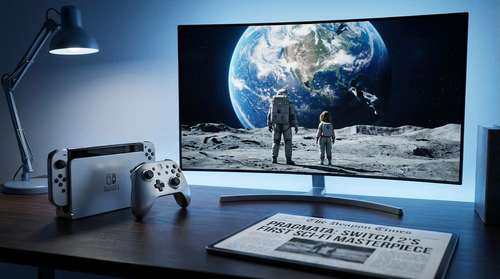
The long wait is finally over. Ever since its cryptic reveal back in 2020, players have been desperate to uncover the mysteries of Capcom's bizarre lunar adventure. After years of refinement, internal delays, and a massive shift in scale, the journey to the moon is ready for launch. In our definitive Pragmata review, we examine how this bold new IP delivers on its lofty promises. It isn't just one of the most anticipated Nintendo Switch 2 games of the year; it is a masterclass in blending atmospheric storytelling with a surprisingly tactical combat system.
Capcom Pragmata Gameplay: The Puzzle-Shooter Evolution
If you expected a standard third-person action title, the Capcom Pragmata gameplay loop will quickly prove you wrong. You step into the heavy boots of Hugh Williams, a spacefarer sent to a lunar research facility known as "The Cradle", only to find it entirely overrun by a hostile AI called IDUS. Survival requires more than just pulling a trigger. Hugh is equipped with high-tech firearms and a responsive jetpack for vertical mobility, but raw firepower isn't enough to pierce the heavily armored robotic enemies roaming the desolate station.
This is where the game's brilliant hacking mechanic steps in. Instead of mindless shooting, combat becomes a high-stakes puzzle. Hugh's companion, an android girl named Diana, must hack into enemy defense systems to expose their critical weak points. When she initiates a hack, players navigate a grid-based interface to reach target nodes while dodging countermeasures. Hitting bonus nodes unlocks damage buffs and strips away enemy armor. It transforms the typical run-and-gun loop into a thoughtful, strategic dance that feels completely fresh. For players planning their optimal route through the game's toughest encounters, studying a Pragmata walkthrough will likely focus heavily on mastering these split-second grid sequences.
The Heart of the Moon: Pragmata Hugh and Diana
Beneath the cutting-edge mechanics lies a deeply emotional core. The dynamic between Pragmata Hugh and Diana drives the entire narrative forward. Hugh serves as the grizzled, practical anchor, while Diana—an incredibly advanced android built to resemble a young girl—brings warmth and unbridled curiosity to the cold, sterile corridors of the ruined lunar colony.
Capcom smartly avoids the exhausting "escort mission" tropes that drag down other action titles. Diana is a capable partner who actively turns the tide in battle, and you never feel like you're babysitting her. Throughout the campaign, their relationship grows organically. Hugh's initial reluctance softens as he learns to rely on Diana's immense processing power, and the game spends quiet moments letting them interact. Whether it's Diana marveling at a corrupted hologram of Earth in a fake Times Square environment, or Hugh nervously repairing her systems after a massive firefight, the script treats them with genuine care. It’s a surrogate father-daughter dynamic that rivals the absolute best in the industry.
Switch 2 Performance Modes: 1440p Quality and Beyond
Running on the highly scalable RE Engine, the game is a visual feast. But how does it hold up on Nintendo's newest hardware? The answer is beautifully. The Switch 2 performance modes offer an impressive level of customization for a console hybrid, proving that Capcom's optimization team remains at the top of their game.
The standout feature is undoubtedly the 1440p Quality Mode when docked. Capcom has managed to retain the game's striking path-traced lighting and complex hair physics for Diana without compromising visual stability. The corporate artificiality of the lunar station—deliberately designed to look uncanny and unnerving—pops off the screen. If you prefer smoother action, the Performance Mode drops the resolution slightly but locks in a blistering framerate. This fluidity is essential for those split-second hacking puzzles during the massive, multi-stage boss fights against IDUS-controlled mechs.
Unlocking the Lunar Secrets
Beyond the main campaign, the development team packed the game with robust side content. Exploring off the beaten path rewards players with cosmetic upgrades—like the Sengoku-era Neo Bushido outfits—and vital data logs that flesh out what happened to The Cradle before it went dark. The interconnected level design encourages backtracking, ensuring that every newly acquired gadget opens up previously inaccessible zones. It adds layers of replayability that will keep completionists busy long after the credits roll.
Earning Its Spot Among the Best Sci-Fi Games 2026
It takes a lot of confidence for a major publisher to launch a brand-new IP in an era heavily dominated by sequels and safe remakes. Capcom took a massive risk, and it paid off immensely. Between the innovative puzzle-shooter combat, the stellar engine optimization, and a story that actually resonates on a human level, this lunar expedition lands perfectly.
Whether you are exploring the desolate beauty of the moon or diving deep into the intricate hacking grids, every element feels meticulously crafted. With a global launch set for April 17, 2026, and the Japanese Switch 2 physical release following on April 24, prepare your spacesuit. This is unequivocally the first essential title for Nintendo's new console and easily ranks as one of the best sci-fi games 2026 has to offer.