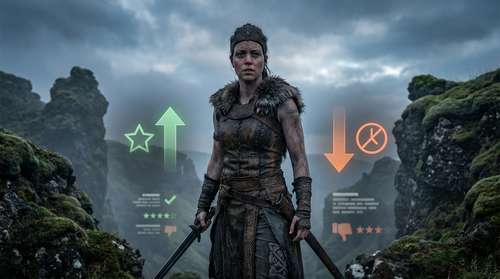
The wait is finally over. Reviews for Ninja Theory’s highly anticipated sequel, Senua’s Saga: Hellblade 2, have officially dropped, and the verdict is as intense as the game’s protagonist. As the first major exclusives to fully leverage Unreal Engine 5 on the Xbox Series X, the game has established itself as a photorealistic benchmark for the current console generation. However, while the visual fidelity and binaural audio are receiving universal acclaim, a sharp divide has emerged regarding the title's six-hour runtime and cinematic-focused gameplay. This Hellblade 2 review roundup breaks down what critics are saying about Senua's harrowing journey.
Metacritic Consensus: A Technical Marvel with a Polarizing Soul
The Hellblade 2 Metacritic score currently sits in the low 80s, reflecting a critical landscape that is impressed but conflicted. Outlets like IGN and GamesRadar+ have praised the game for its uncompromising artistic vision, calling it one of the most visually stunning experiences ever created. The consensus highlights that Ninja Theory Xbox studios have delivered a production value that rivals blockbuster films.
Critics universally agree that the presentation is flawless. The facial capture technology and environmental detail in 10th-century Iceland are being hailed as industry-leading. However, the Senua's Saga Hellblade II scores vary significantly depending on how much weight a reviewer places on traditional gameplay mechanics versus narrative immersion. For players seeking a best Xbox Series X games 2024 contender, the reception suggests a must-play experience, provided you know what you are signing up for.
Hellblade 2 Graphics and Audio: Setting a New Standard
If there is one aspect of the Hellblade 2 review cycle that is undisputed, it is the technical achievement. The Hellblade 2 graphics are being described as "next-gen realized." Utilization of Nanite and Lumen technologies has resulted in environments that feel startlingly real, from the rugged coastlines to the terrifyingly detailed giants. Reviewers note that the line between cutscene and gameplay has been almost entirely erased, creating a seamless flow that maintains immersion without loading screens.
Equally praised is the audio design. Ninja Theory recommends playing with headphones, and critics agree. The binaural audio, which simulates the voices (Furies) in Senua’s head, creates a 3D soundscape that is both terrifying and empathetic. This sensory overload is a core part of the experience, grounding the player in Senua’s psychosis in a way that few other games attempt.
The Gameplay Debate: Immersion vs. Interactivity
The primary point of contention in the Hellblade 2 review discourse surrounds the gameplay loop. The combat has been described as visceral and heavy, focusing on intimate 1v1 duels rather than crowd control. While the motion capture in these fights is spectacular—giving every sword swing a palpable sense of weight—some critics feel the mechanics are too simplified compared to other action titles.
Furthermore, the puzzle design, which largely returns to the perspective-shifting mechanics of the first game, has been criticized by some outlets as repetitive. The argument is that the game prioritizes cinematic pacing over mechanical depth. For some, this "walking simulator" approach serves the narrative perfectly; for others, it limits the replay value. This divide is central to the varied Senua's Saga Hellblade II scores seen across major gaming sites.
Hellblade 2 Length: Quality Over Quantity?
Another hot topic is the Hellblade 2 length. Clocking in at approximately 6 to 8 hours, the game is significantly shorter than the sprawling 100-hour RPGs that dominate the market. Ninja Theory has been transparent about this, pricing the game at $49.99 rather than the full $70 standard.
Many reviews defend the shorter runtime, arguing that the game’s intensity would be difficult to sustain over a longer period. The concise "saga" format allows for a tight, pacing-focused narrative that respects the player's time. However, value-focused gamers have expressed hesitation, sparking a broader conversation about the place of shorter, linear narrative games in the modern Xbox Series X ecosystem.
Final Verdict: Is Hellblade 2 Worth It?
Despite the criticisms of its gameplay depth, Senua’s Saga: Hellblade 2 stands as a monumental achievement in digital storytelling. It is an essential title for those who value narrative, acting, and audiovisual spectacle above complex combat systems. As reviews continue to pour in, it is clear that while it may not be for everyone, it is undeniably one of the most important technical showcases of the year. For Game Pass subscribers, it is an absolute no-brainer to download and experience the madness firsthand.