
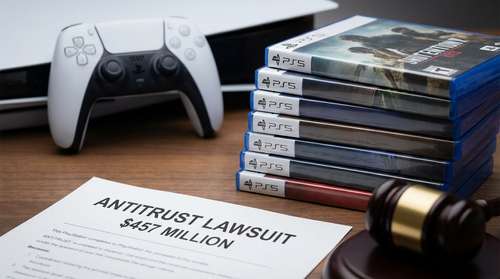
Sony's recent announcement detailing the PlayStation physical discs ending by January 2028 has swiftly mutated from a public relations nightmare into a high-stakes international legal battle. Just days after the Japanese gaming titan confirmed its controversial shift to an all-digital future, a prominent European consumer advocacy group launched a massive legal strike. The resulting Sony 457 million lawsuit alleges that eliminating physical media is a calculated move to trap players in an inescapable digital monopoly, sparking a global conversation about consumer rights, predatory pricing, and the future of the video game industry.
The Core of the PS5 Digital Only Controversy
At the center of this rapidly escalating PS5 digital only controversy is Stichting Massaschade & Consument (SM&C), a Dutch non-profit foundation. Representing approximately 1.7 million gamers in the Netherlands, the organization has officially filed a €400 million ($457.3 million) claim against Sony. The collective action lawsuit argues that the transition to a purely digital distribution model strips consumers of their last remaining alternatives to the PlayStation platform's proprietary marketplace.
Lucia Melcherts, chair of the SM&C, emphasized the sheer market control this strategy grants the corporation. Without physical retail copies or a robust second-hand market, players become entirely dependent on Sony's closed ecosystem. The organization's 'Fair PlayStation' campaign contends that this enables the publisher to arbitrarily dictate pricing, effectively locking users into a monopolized marketplace where traditional retail competition ceases to exist.
Inside the PlayStation Store Antitrust Lawsuit
This PlayStation Store antitrust lawsuit hinges on what industry critics call the 'Sony Tax'—a mandatory 30% commission that the company levies on third-party digital game sales and in-game content. Historically, price-conscious gamers could bypass exorbitant digital prices by purchasing physical discs from brick-and-mortar retailers or acquiring used copies. This secondary market naturally drove prices down as games aged, giving buyers financial flexibility.
Legal and economic experts suggest Sony may have inadvertently sabotaged its own legal standing. Andrew Ching, marketing chair at Johns Hopkins Carey Business School, recently noted that the company has repeatedly used the existence of the physical retail market to fend off previous monopoly accusations. By cementing the Sony physical games phase out 2028, the corporation essentially destroys its primary defense. Without a physical option, price-sensitive consumers have nowhere to go but Sony's own digital storefront, forced to absorb the full retail price with zero alternatives in the resale space.
Mexico and International Lawmakers Join the Fray
The legal firestorm is not confined to European borders. Across the Atlantic, Mexican lawmakers are preparing to file their own antitrust complaints, signaling that this battle will be fought on multiple international fronts. Iraís Reyes, an advocate representing Mexican gamers, along with Senator Colosio, have voiced severe concerns regarding digital game ownership rights and the broader economic impact of a digital-only console environment.
Mexican officials argue that the elimination of physical media transforms the fundamental nature of video game purchases. In a digital-only ecosystem, consumers do not actually own the video games they purchase; instead, they buy a revocable license subjected strictly to the platform holder's terms of service. This fundamentally alters consumer rights, threatening video game preservation and leaving entire game libraries vulnerable to server shutdowns, delistings, or unceremonious account bans. Reyes warned that when one company controls every single aspect of a market—acting as both the referee and the sole vendor—consumer exploitation is almost inevitable.
The Road to 2028: Will the Policy Survive?
As the outrage builds, player retaliation has been remarkably fierce. A viral online petition dubbed 'Don't Kill the Disc' has rapidly amassed over 300,000 signatures, and industry analysts report a noticeable spike in PlayStation Network subscription cancellations. Consumers are drawing a line in the sand, demanding that hardware manufacturers respect their right to physical ownership and competitive pricing.
Whether the Dutch courts will side with the SM&C or if Mexican regulators will successfully force Sony's hand remains to be seen. However, the sheer scale of the antitrust pushback proves that the transition away from physical media will not happen quietly. As the 2028 deadline approaches, this landmark dispute will undoubtedly set legal precedents that dictate how the entire video game industry handles digital distribution, marketplace monopolies, and the very concept of digital ownership.