If you were holding out for the next generation of portable gaming, the latest supply chain developments deliver a brutal reality check. A severe global component drought, recently dubbed "RAMageddon," has effectively crippled the hardware market over the last few days. This crisis has triggered a staggering PC gaming handheld price hike across major retailers and fundamentally altered the roadmap for top manufacturers,. Most notably, mounting industry reports confirm a significant Valve Steam Deck 2 delay, leaving fans stranded as component costs skyrocket to unprecedented levels,.
The Valve Steam Deck 2 Delay: Why 2028 is the New Target
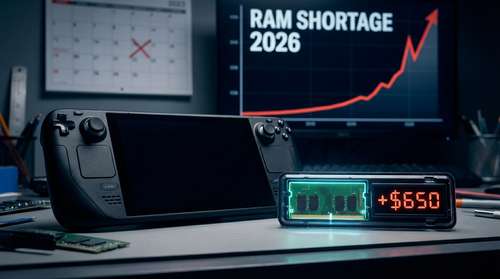
Recent Steam Deck 2 rumors painted an optimistic picture of a late 2026 launch, but those hopes evaporated this week. According to prominent hardware insider KeplerL2 posting on the gaming forum NeoGAF, Valve has pushed the highly anticipated Steam Deck 2 release date back to at least 2028,,. The primary culprit is a severe lack of affordable NAND flash storage and LPDDR5 memory, completely disrupting production schedules.
Rather than forcing an expensive, iterative console onto the market, Valve is reportedly playing the long game. The company is waiting for the silicon market to stabilize and for AMD's next-generation Zen 6 and RDNA 5 architectures to mature. Valve's internal goal is a massive three-fold increase in performance-per-watt—a leap impossible to achieve affordably when memory costs are at record highs.
Because Valve isn't locked into a rigid semi-custom SoC contract like Sony or Microsoft, this delay gives them the flexibility to pivot specs and source better components down the line,. However, the wait will be painful. With the base Steam Deck OLED suffering intermittent stock shortages across several regions right now, Valve's entire hardware ecosystem, including the rumored Steam Machine, is caught in a holding pattern,.
The $650 Legion Go 2 Price Increase Shocks Gamers
While Valve avoids the current hardware gauntlet by delaying its console, Lenovo is forcing consumers to bear the brunt of the component crisis. On Friday, a massive Legion Go 2 price increase hit major retailers like Best Buy, sending shockwaves through the enthusiast community,. The top-tier Lenovo handheld, featuring the AMD Ryzen Z2 Extreme processor, 1TB of storage, and 32GB of RAM, originally launched late last year for $1,349.99,. Overnight, that exact model jumped to $1,999.99—a blistering $650 markup representing a 48 percent hike in less than six months,.
Even the entry-level Legion Go S models weren't spared, seeing retail bumps between $50 and $150. Lenovo isn't alone in this struggle. Chinese manufacturer Ayaneo recently canceled its upcoming flagship model entirely. Producing their top-end system under current market conditions would have forced a retail price of $4,000. Mobile hardware is rapidly transforming into a luxury item reserved for the wealthiest early adopters.
Dissecting the RAM Shortage 2026
Understanding this affordability crisis requires looking at the broader tech landscape. The RAM shortage 2026 is a direct byproduct of the artificial intelligence boom. Mega-corporations building massive AI data centers are completely outbidding consumer electronics manufacturers for available memory and storage components,.
According to market research firms like TrendForce and IDC, DRAM contract prices skyrocketed by an astounding 90 to 95 percent in just the first quarter of this year. Handheld PCs, which already operate on razor-thin profit margins to compete with traditional consoles, simply cannot absorb these ballooning component costs.
When the raw materials for a gaming rig double in price, companies have no choice but to pass that financial burden directly to the buyer or halt production entirely. This dynamic isn't isolated to handhelds; traditional PC manufacturers like Dell and HP are actively raising hardware prices by up to 20 percent to offset these identical supply chain pressures.
Navigating the Best Portable PC Gaming 2026 Market
With top-tier systems breaching the $2,000 threshold and next-generation devices years away, finding the best portable PC gaming 2026 has to offer requires a strategic approach. Right now, sitting on the sidelines waiting for a 2028 unicorn is a losing bet.
Consumers looking for value should immediately seek out existing stock of the current Steam Deck OLED or the Asus ROG Ally X. As of early April, Asus has managed to hold the Ally X steady at its original $1,000 MSRP,. Compared to the current Lenovo listings, the Asus machine looks like an absolute bargain.
However, hardware experts warn that Asus cannot hold that price forever. If you are in the market for a portable powerhouse, buying sooner rather than later is the smartest move. Alternatively, dipping into the refurbished or second-hand market for standard 2022 Steam Decks might be the only way budget-conscious players can survive the ongoing hardware drought.