The original Steam Deck revolutionized the portable gaming landscape when it launched in 2022. Since then, the community has been hungrily devouring every shred of information regarding its successor. If you have been hoping for a Steam Deck 2 release date in the near future, you might want to brace yourself for a longer wait. A highly credible industry insider recently revealed that Valve's target launch window is still years away.
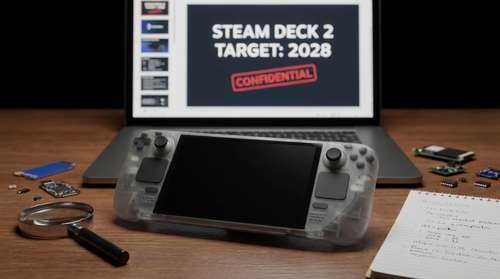
According to a fresh leak from renowned hardware tipster KeplerL2, Valve is actively targeting a 2028 launch for the next-generation handheld. However, an ongoing global RAM and NAND memory shortage could easily push the debut into 2029. Let's break down what this newly leaked Valve hardware roadmap means for gamers and why a delayed console cycle might actually work out in your favor.
The 2028 Target: What the Steam Deck 2 Release Date Leak Reveals
Over the past few days, the handheld gaming community has been buzzing over a series of posts on the NeoGAF forums. Hardware insider KeplerL2, known for accurate semiconductor and gaming hardware predictions, claims that 2028 is the internal goal for the new console. This timeline aligns perfectly with Valve's previously stated design philosophy.
Valve engineers, including Pierre-Loup Griffais, have openly stated they have no interest in releasing a minor spec bump that offers a mere 20 to 30 percent performance increase. Instead, the company is waiting for a true generational leap in compute power that will not utterly destroy battery life. By targeting 2028—roughly six years after the original LCD model hit shelves—Valve is treating its handheld ecosystem more like a traditional console lifecycle than a smartphone refresh.
This approach stands in stark contrast to competitors pushing iterative upgrades. For players monitoring handheld PC gaming news 2026, Valve's patience signals a commitment to long-term software support over rapid hardware obsolescence.
Navigating a Crowded Market: Valve vs. the Competition
Since the original Deck debuted, the portable PC space has exploded. Devices like the Asus ROG Ally, the Lenovo Legion Go, and various iterations from Ayaneo have saturated the market, often boasting higher-resolution screens and faster APUs. Even traditional console makers are preparing to shake up the portable landscape with new hardware.
Yet, Valve remains largely unfazed by the growing competition. The company's unique advantage lies in its tightly integrated ecosystem. SteamOS provides a streamlined user experience that Windows-based handhelds still struggle to replicate seamlessly. By holding off the Steam Deck successor until late in the decade, Valve is betting that user experience, software optimization, and battery efficiency will matter more to gamers than chasing raw, brute-force benchmark scores.
Why the Steam Deck 2 Release Date Could Slip to 2029
While a 2028 launch serves as the best-case scenario, the tech industry is currently grappling with severe supply chain constraints. KeplerL2 explicitly noted that "the whole RAM/NAND situation could delay it," throwing a wrench into Valve's production timeline.
The global memory market is experiencing a massive squeeze, an event some industry analysts are colloquially dubbing a memory crisis. This crunch is heavily driven by insatiable demand from enterprise tech companies and massive data center expansions. Tech conglomerates are securing multibillion-dollar contracts to lock in memory supplies, drastically reducing the volume of DDR5 and NAND flash storage available for consumer gaming hardware.
This shortage is actively driving up the cost of components across the entire tech sector, forcing manufacturers to either raise retail prices or stall production entirely. If the supply of affordable memory does not stabilize, manufacturing a powerful, cost-effective handheld will become nearly impossible by 2028. Consequently, a slip into 2029 looks increasingly plausible.
Upgraded Steam Deck 2 Specs Rumors: The Silver Lining of a Delay
While nobody wants to wait an extra year to get their hands on a new device, a potential delay isn't purely bad news. In fact, following recent Valve handheld PC leaks, it appears a pushed timeline could fundamentally alter the device's internal power.
Unlike Microsoft and Sony—which lock in semi-custom System-on-a-Chip (SoC) designs years in advance for consoles like the upcoming PS6 or next-generation Xbox—Valve has more architectural flexibility. According to KeplerL2, the next-gen Steam Deck 2028 will not rely on a rigid, semi-custom SoC.
Because Valve uses more adaptable, off-the-shelf component architecture, pushing the launch back allows the engineering team to swap in newer, more advanced processors much later in the development cycle. If the release slips to 2029, the handheld could launch with significantly higher performance ceilings, faster memory bandwidth, and better efficiency cores than what would be available in 2028.
What This Means for the Valve Hardware Roadmap
If you are currently gaming on an original LCD or the 2023 OLED model, these extended timelines are actually a massive win. Valve's protracted strategy guarantees that developers will continue optimizing games for the current hardware profile for at least another three years.
Furthermore, with translation layers like Proton constantly improving, the current Deck remains highly capable of handling modern PC libraries. You don't have to worry about your machine becoming obsolete anytime soon.
As the industry navigates the current memory shortage, all eyes remain on Valve. While waiting until 2028—or potentially 2029—feels like an eternity in tech years, the promise of a monumental hardware leap combined with thrilling Steam Deck 2 specs rumors makes the next chapter of portable gaming incredibly exciting to watch.