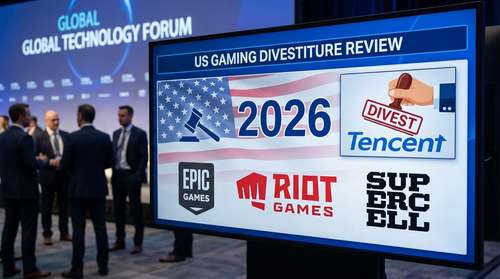
The global gaming industry is bracing for a seismic shift as the White House evaluates a mandate that could dismantle one of the most powerful portfolios in interactive entertainment. Following recent internal debates within the Trump administration, the prospect of a forced Tencent divestiture 2026 is moving closer to reality. Government officials are reportedly weighing whether to compel the Chinese tech conglomerate to sell its massive stakes in Western studios, including Epic Games, Riot Games, and Supercell. Cited as a necessary measure to protect user privacy and national security, the potential mandate mirrors the aggressive strategies previously used against platforms like TikTok.
Escalating US China Gaming Regulations
The scrutiny surrounding Tencent is not entirely unprecedented, but the pressure has intensified significantly ahead of President Donald Trump's planned summit with Chinese President Xi Jinping this April. The Committee on Foreign Investment in the United States (CFIUS) has been investigating the company's reach for years. During the previous administration, then-Deputy Attorney General Lisa Monaco aggressively pushed for CFIUS to force Tencent to divest its gaming companies. However, the Treasury Department favored allowing the investments to remain under strict data-protection mitigation measures, resulting in interagency gridlock.
Now, under stricter US China gaming regulations, the calculus has changed. In January 2025, the Pentagon classified Tencent as a Chinese military company, a label the conglomerate strongly denies. Cabinet officials had scheduled a high-level meeting in early March to finalize an approach regarding foreign ownership of gaming platforms, though scheduling conflicts temporarily delayed the decision.
Epic Games Ownership News and Riot Updates
A forced divestiture would fundamentally upend the governance of some of the world's most popular titles. In the crosshairs is the studio behind Fortnite and the ubiquitous Unreal Engine. Recent Epic Games ownership news highlights that Tencent currently holds a massive 28 percent stake in the North Carolina-based developer. Authorities fear that this level of influence could give foreign entities a backdoor into Fortnite national security data, exposing the personal information and behavioral metrics of millions of American citizens.
The implications extend far beyond consumer video games. The Unreal Engine is a fundamental software framework utilized not only by game developers worldwide but also by Hollywood film productions, the automotive industry, and the US military for simulation and training. Having a foreign conglomerate holding a major stake in the architecture that powers critical industries represents a vulnerability that defense officials are eager to eliminate.
The situation is even more precarious for the Los Angeles-based developer of League of Legends and Valorant. Tencent acquired full ownership of Riot Games over several years. Any Riot Games sale updates in the coming weeks will be closely monitored by the global esports community. Forcing a complete spin-off would require finding buyers with the billions of dollars necessary to absorb such a massive enterprise, and a chaotic transition could disrupt server operations and competitive circuits.
Supercell Tencent Divestment and Industry Fallout
The administration's focus is not limited to companies operating exclusively within US borders. The Finnish studio Supercell, creator of Clash of Clans and Clash Royale, is also under the microscope. Because the mobile giant boasts a colossal American player base, a Supercell Tencent divestment is actively on the table. Regulators argue that geographic location does not negate the intelligence-gathering risks associated with global digital storefronts.
As we look at the broader PC and mobile gaming trends 2026, the sheer scale of Tencent's financial footprint makes a clean break incredibly complicated. Finding domestic or allied investors capable of absorbing Tencent's equity across Epic, Riot, and Supercell, not to mention its minority holdings in Discord, Klei Entertainment, and numerous others, would require tens of billions of dollars. Industry experts predict that traditional gaming publishers lack the liquidity for such acquisitions. Instead, massive private equity firms might step in to fill the financial vacuum, fundamentally altering the corporate culture of these beloved studios.
What Happens Next?
While no official executive order has been signed, the threat alone has sent ripples through the financial markets, causing Tencent's shares to dip by over 1.7 percent earlier this month. The delayed cabinet meeting is expected to be rescheduled soon, setting the stage for a dramatic showdown between Washington and Beijing. Whether the US government ultimately forces a complete sell-off or settles for aggressive data-containment policies, the era of unchecked foreign investment in the American gaming sector appears to be ending.