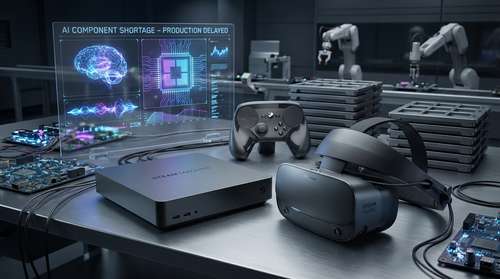
Valve has officially updated its release window for the highly anticipated next-generation hardware suite, signaling a significant shift in plans for the new Steam Machine, Steam Frame VR headset, and Steam Controller 2. In a quiet but critical update to its Steam Year in Review 2025 post on March 7, 2026, the gaming giant confirmed that while it still intends to launch these devices this year, the original early 2026 target has been scrapped. The culprit? A severe global shortage of memory and storage components driven by the voracious infrastructure demands of the artificial intelligence industry.
Steam Machine Release Date Pushed Back Amid Component Shortages
For months, rumors have swirled regarding the Valve Steam Machine release date, with initial expectations set for a Q1 or early Q2 2026 launch. AMD CEO Lisa Su had even previously hinted at an early 2026 window. However, the reality of the 2026 PC hardware market has forced Valve to pump the brakes. The company's updated blog post now states they "will be shipping all three products this year," a firm commitment to 2026 but a notable retreat from the first-half release window that enthusiasts were banking on.
This delay isn't just internal bureaucracy; it is a direct result of supply chain volatility. Valve explicitly cited "challenges with memory and storage shortages" as the primary friction point. By moving the goalposts to a broader "2026" window, Valve is buying itself time to navigate a market where prices for high-speed RAM and NAND flash storage have nearly tripled since late 2025.
How the AI Impact on Gaming Prices is Real
The AI impact on gaming prices has transitioned from a theoretical warning to a tangible consumer crisis. The root cause of Valve's delay lies in the explosive growth of AI data centers. Major tech conglomerates are aggressively buying up vast quantities of high-bandwidth memory (HBM) and enterprise-grade SSDs to power large language models and generative AI tools. This has created a "zero-sum game" for manufacturing capacity.
According to recent industry reports, AI data centers are projected to consume upwards of 70% of the world's high-end memory supply in 2026. For a company like Valve, which aims to price the Steam Machine competitively against consoles like the PlayStation 5 and Xbox Series X, this presents a nightmare scenario. Unlike Sony or Microsoft, Valve has historically been reluctant to heavily subsidize hardware hardware losses. Building a powerful hybrid console in the middle of a 2026 PC hardware shortage means facing bill-of-materials costs that are significantly higher than projected just six months ago.
The 2026 PC Hardware Shortage Explained
It is not just Valve feeling the pinch; the entire PC gaming ecosystem is under pressure. The "wafer penalty"—a manufacturing reality where producing AI-grade chips consumes significantly more silicon wafer area than standard consumer chips—has reduced the overall supply of DDR5 RAM and NVMe storage available for gamers. This scarcity is driving up prices for the exact components Valve needs for the Steam Machine and the high-fidelity Steam Frame VR headset.
Updates on Steam Frame VR Headset News and Steam Controller 2
While the Steam Machine grabs the headlines, the Steam Frame VR headset news is equally significant for virtual reality enthusiasts. The Steam Frame, Valve's standalone wireless VR solution, relies heavily on fast, onboard storage and memory to deliver low-latency experiences without a tethered PC. The component squeeze threatens to either delay this headset further or force a higher launch price than the originally targeted "accessible" price point.
Similarly, the Steam Controller 2 delay is a blow to players waiting for the successor to Valve's cult-classic input device. The new controller is expected to feature advanced haptics and potentially onboard processing for input optimization—features that, while less memory-intensive than a console, still rely on a supply chain that is currently gridlocked.
Valve Steam Year in Review 2025: A subdued Roadmap?
The Valve Steam Year in Review 2025 was originally intended to be a victory lap for the platform's software dominance, but it has morphed into a sober update on hardware realities. In the updated text, Valve notes that they "hope to ship in 2026," phrasing that some analysts initially interpreted as a risk of slipping into 2027. However, the subsequent clarification to "will be shipping" offers a glimmer of certainty amidst the chaos.
For now, SteamDB updates show the release status for all three devices has been changed to a generic "Coming Soon." This placeholder status suggests that Valve is waiting for the memory market to stabilize—or at least stop spiraling—before committing to a specific day or month. Gamers looking for next-gen PC gaming hardware should likely adjust their expectations toward the holiday season of 2026 rather than the summer launch many had hoped for.