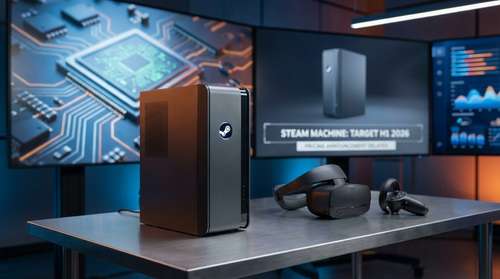
Valve has officially broken its silence regarding the rumors swirling around its highly anticipated 2026 hardware lineup. In a statement released late Friday, the gaming giant addressed the mounting industry-wide anxieties over RAM and storage shortages, confirming that while the launch of the new Steam Machine and Steam Frame VR headset remains scheduled for the first half of 2026, specific pricing has been indefinitely postponed. The news comes just days after reports surfaced that global DRAM prices had quadrupled due to unprecedented demand from the AI sector, forcing Valve to "revisit" its MSRP strategy for what was touted as the ultimate console-killer.
The AI Boom’s Collateral Damage: Why Valve Can’t Name a Price
The core of the delay lies not in manufacturing capacity, but in the volatility of component costs. According to Valve’s press release, "the limited availability and growing prices of critical components"—specifically DDR5 memory and NAND flash storage—have made it impossible to lock in a consumer-friendly price point without risking significant losses. Industry analysts note that the explosion of AI data centers has created a vacuum for high-performance memory, leaving consumer hardware manufacturers scrambling.
For gamers hoping for a sub-$800 entry point for the new Steam Machine, this is a sobering development. Reports from supply chain insiders suggest that the cost of the 16GB DDR5 kits and NVMe drives slated for Valve’s new console has nearly doubled since the hardware was first teased in late 2025. Valve’s hesitation indicates a struggle to balance their "console-like" pricing promise against an unforgiving component market.
Steam Machine & Steam Frame: Still Coming H1 2026
Despite the pricing turbulence, Valve’s commitment to a 2026 release appears unshaken. The company reiterated that all three major hardware pillars—the Steam Machine, the Steam Frame, and the Steam Controller 2—are still on track to begin shipping within the first six months of the year. This aligns with recent comments from partners like AMD, who confirmed that production of the semi-custom Zen 4 and RDNA 3 chips powering the devices is proceeding as planned.
The Specs Behind the Shortage
The new Steam Machine is rumored to feature a hybrid architecture designed to bridge the gap between high-end PC gaming and living-room convenience. Leaked specifications point to a system utilizing unified memory similar to the Steam Deck, but with higher bandwidth to support 4K targets via advanced upscaling. It is this reliance on premium memory that makes the current shortage particularly painful for Valve’s bill of materials.
Steam Frame and the 'Deckard' Dream
Perhaps the most exciting confirmation is that the Steam Frame—long rumored under the codename "Deckard"—is not being pushed back to a later window. This standalone VR headset is poised to do for virtual reality what the Steam Deck did for portable gaming. By offloading processing to a wireless, face-mounted unit running a VR-optimized SteamOS, Valve aims to cut the tether to the PC.
However, the Steam Frame is equally susceptible to the memory crisis. Standalone VR requires fast, low-latency onboard storage and RAM to prevent motion sickness and ensure smooth tracking. If the Steam Machine’s price is in flux, the Steam Frame’s price tag could see an even steeper adjustment, potentially pushing it into the premium enthusiast tier alongside competitors like Apple’s mixed-reality offerings.
Steam Controller 2: The Unsung Hero
Amidst the high-stakes drama of consoles and headsets, the Steam Controller 2 (internally dubbed "Ibex") remains the most likely device to hit shelves without a major price hike. Leaks from early this week show a design that marries the beloved trackpads of the original with the ergonomic sticks and layout of the Steam Deck. For many PC purists, this controller is the missing link for couch gaming, and its production is reportedly less affected by the specific memory shortages plaguing its larger siblings.
What This Means for Your Wallet
The reality for prospective buyers is that the "console-killer" might require a bigger war chest than anticipated. While Valve has historically been willing to sell hardware at thin margins (or even a loss) to drive software sales, the current component spike is unprecedented. We may see a tiered launch where a base model with less storage arrives at a competitive price, while higher-spec versions bear the brunt of the inflation.
For now, the launch window is safe. But as we inch closer to June 2026, all eyes will be on the memory market—and Valve’s next move.