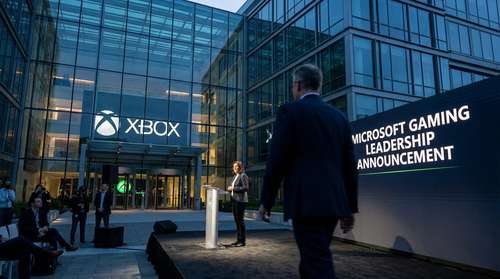
In a stunning announcement that has sent shockwaves through the gaming industry, Microsoft Gaming revealed a massive leadership overhaul today. After 38 years with the company, CEO Phil Spencer is retiring, marking the end of an era for the Xbox brand. In an equally surprising move, Xbox President Sarah Bond—widely viewed as Spencer’s successor—has announced her resignation effective immediately. As the dust settles on this Microsoft Gaming leadership change, the tech giant has appointed former AI executive Asha Sharma as the Xbox new CEO 2026, signaling a bold and controversial new direction for the platform.
The End of the Spencer Era and Bond’s Surprise Exit
Phil Spencer’s departure, while momentous, was not entirely unforeseen. Internal memos revealed that Spencer had been discussing his retirement with Microsoft CEO Satya Nadella since late 2025. “It’s rare in life to know when a chapter is closing, but after 38 years at Microsoft, that moment has arrived for me,” Spencer wrote in a heartfelt farewell to staff. His tenure is defined by the resurrection of the Xbox brand following the Xbox One launch, the acquisition of Activision Blizzard, and the massive expansion of the ecosystem.
However, the Sarah Bond resignation has left analysts and fans stunned. As the driving force behind the growth of Xbox Game Pass and the company’s developer relationships, Bond was a central figure in Microsoft’s modern gaming strategy. Her decision to leave to “begin a new chapter” rather than step into the CEO role has fueled speculation about internal disagreements regarding the division's future strategy. With both leaders departing, a significant void has opened at the top of the gaming giant.
Meet Asha Sharma: The AI Exec Taking the Helm
Stepping into the role of CEO is Asha Sharma, a move that has raised eyebrows across the Xbox PC gaming news sphere. Sharma joined Microsoft in 2024 as Corporate Vice President of the CoreAI product line, bringing experience from previous leadership roles at Meta and Instacart. Her appointment suggests that Microsoft sees the future of gaming as inextricably linked with artificial intelligence and platform agnosticism.
Addressing immediate concerns from gamers about her non-gaming background, Sharma issued a memo outlining three core commitments: making “great games,” prioritizing the “return of Xbox” core values, and defining the “future of play.” She explicitly promised that the company would not “flood our ecosystem with soulless AI slop,” a statement clearly aimed at assuaging fears about her AI origins. “Games are and always will be art, crafted by humans,” Sharma affirmed.
Matt Booty Promoted to Chief Content Officer
To bridge the gap between Sharma’s tech background and the creative needs of the studios, Microsoft has promoted Matt Booty to Executive Vice President and Chief Content Officer. In this expanded role, Booty will oversee the entirety of Microsoft’s massive content pipeline, including Xbox Game Studios, Bethesda, and Activision Blizzard. His promotion is seen as a crucial stabilizing move, ensuring that veteran gaming leadership remains at the decision-making table.
The Future of Xbox Game Pass and Hardware
The dual departures raise critical questions about the future of Xbox Game Pass. Sarah Bond was the architect of the service’s business model, and her exit comes amidst reports that Xbox Series console sales fell 70% year-over-year during the 2025 holiday period. While Sharma has pledged to “invent new business models,” it remains to be seen if the aggressive expansion of Game Pass will continue or if the company will pivot back to a more traditional sales model under new management.
Industry Reaction and What Lies Ahead
The reaction to the Phil Spencer retirement has been a mix of gratitude and anxiety. Competitors and partners alike have praised Spencer for his player-first approach. However, the introduction of an AI-focused leader has polarized the community. As Microsoft navigates this transition, the pressure is on Sharma and Booty to prove that this new era will honor the Xbox legacy while reversing the recent hardware sales slump. For now, all eyes are on Redmond to see how this dramatic Microsoft Gaming leadership change will reshape the industry in 2026 and beyond.