
The Consumer Electronics Show (CES) has once again transformed Las Vegas into the global epicenter of future technology, and the Best of CES 2026 lineup is nothing short of revolutionary. As the curtains close on this year's expo, the gaming landscape has been fundamentally altered by a surge in AI-driven graphics, display refresh rates breaking the four-digit barrier, and a definitive shift toward Linux-based handhelds. From the SteamOS-powered Lenovo Legion Go 2 to NVIDIA's mind-bending DLSS 4.5, this year's innovations aren't just incremental upgrades—they are rewriting the rules of performance.
Whether you are a competitive esports athlete hunting for the fastest pixels or a tech enthusiast waiting for the next form factor revolution, this year's show delivered. We have scoured the show floor to bring you the definitive list of the top gaming tech 2026 has to offer. Here are the 10 most groundbreaking reveals that will define the year ahead.
1. Lenovo Legion Go 2: The SteamOS Revolution
Undoubtedly one of the most talked-about reveals was the Lenovo Legion Go 2 SteamOS edition. After years of Windows dominance in the high-end handheld market, Lenovo has made a bold pivot by offering a native SteamOS model. Launching this June with a starting price of $1,199, this handheld pairs Valve's efficient operating system with the raw power of the AMD Ryzen Z2 Extreme chip.
The device features a stunning 8.8-inch 144Hz OLED display that makes games pop with incredible vibrancy. By stripping away the overhead of Windows, Lenovo claims to have unlocked significant performance gains and battery life improvements, positioning the Legion Go 2 as the true successor to the high-performance handheld throne.
2. NVIDIA DLSS 4.5: AI Graphics Reimagined
NVIDIA continues to lead the AI arms race with the announcement of NVIDIA DLSS 4.5 news. This latest iteration introduces "Multi Frame Generation 6X," a feature designed specifically for the upcoming RTX 50 series GPUs. This technology can generate up to six AI frames for every traditionally rendered one, effectively quadrupling frame rates in supported titles.
The goal is ambitious: powering 4K gaming at 240Hz with full ray tracing enabled. For gamers, this means fluid motion clarity previously thought impossible on consumer hardware. DLSS 4.5 also brings enhanced neural rendering to older cards, ensuring that the benefits of AI upscaling ripple across the entire GeForce ecosystem.
3. Acer Predator XB273U F6: The 1,000Hz Barrier Broken
Speed freaks, rejoice. The 1000Hz gaming monitor is no longer a theoretical concept. Acer stunned crowds with the Predator XB273U F6, a display that offers a native 500Hz refresh rate at 1440p but can push to a blistering 1,000Hz when switched to 720p mode. Designed for the most extreme tier of esports competitors, this monitor virtually eliminates motion blur.
While 720p might sound like a step back in resolution, for Counter-Strike 2 and Valorant pros, the sub-millisecond response time offers a tangible competitive advantage. It stands as a testament to how far panel technology has come, earning it a spot among the CES 2026 innovation awards honorees.
4. Lenovo ThinkBook Plus G6: The Rollable Future
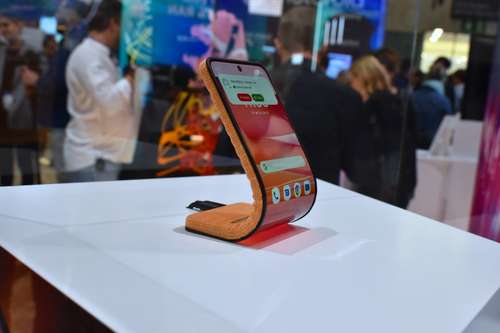
Foldables are so 2025. The new frontier is rollable, and the Lenovo ThinkBook Plus G6 is leading the charge. Utilizing a flexible OLED panel provided by Samsung Display, this laptop features a screen that unrolls vertically to expand from a 14-inch standard aspect ratio to a massive 16.7-inch portrait workspace.
This "waterfall" effect allows creators and coders to have nearly double the vertical screen real estate without increasing the laptop's footprint. It’s one of the best gaming gadgets 2026 has to offer for those who need a portable battlestation that adapts to their workflow.
5. MSI GeForce RTX 5090 Lightning Z
If subtle isn't your style, the MSI GeForce RTX 5090 Lightning Z is your card. This behemoth of a GPU was unveiled with a massive triple-fan cooler and a built-in 8-inch LCD screen for monitoring stats (or playing GIFs). Built to handle the massive power draw of NVIDIA’s new flagship silicon, the Lightning Z is designed for 8K gaming and heavy AI workloads.
6. Intel Core Ultra 300 "Panther Lake"
Mobile gaming received a massive shot in the arm with Intel's official deep-dive into its "Panther Lake" architecture. The Core Ultra 300 series processors feature the new Xe3 integrated graphics, which demonstrated performance rivaling discrete entry-level GPUs from just two years ago. This chip will power the next generation of ultra-thin gaming ultrabooks, allowing for 1080p 60fps gaming in chassis thinner than 15mm.
7. Samsung Odyssey 3D G90XH
Glasses-free 3D is making a comeback, but this time it actually works. Samsung's Odyssey 3D G90XH monitor uses eye-tracking cameras and a lenticular lens layer to deliver convincing 3D depth without the need for goofy eyewear. The effect is particularly stunning in flight simulators and racing games, adding a layer of immersion that flat screens simply can't match.
8. NVIDIA ACE: NPCs That Finally Talk Back
Software stole some of the hardware's thunder with the latest demo of NVIDIA ACE (Avatar Cloud Engine). This middleware allows developers to integrate LLM-powered NPCs into games, enabling players to have unscripted, natural voice conversations with in-game characters. The CES demo showed a detective game where players could interrogate a suspect in real-time, with the AI generating unique, context-aware responses instantly.
9. LG UltraGear Evo 5K2K OLED
LG continues to refine its OLED dominance with the UltraGear Evo, a 39-inch curved ultrawide with a 5K2K resolution. It combines the deep blacks of OLED with a pixel density that makes text look razor-sharp, bridging the gap between a productivity powerhouse and a high-end gaming display. With a 240Hz refresh rate, it is arguably the ultimate "do-it-all" monitor revealed this year.
10. The Rise of Modular Handhelds
Rounding out our list is a trend rather than a single product: modularity. Several manufacturers, including newcomers like Ayaneo and stalwarts like ASUS, showcased handheld prototypes with hot-swappable controller modules and upgradeable compute units. This shift toward repairability and customization ensures that your expensive handheld doesn't become e-waste the moment a faster chip is released.
The Year Ahead
If CES 2026 is any indication, the year ahead will be defined by smarter silicon and faster pixels. The hardware released this week sets a new baseline for what we consider "high-end," pushing the industry toward a future where AI handles the heavy lifting and screens adapt to our needs, not the other way around.