
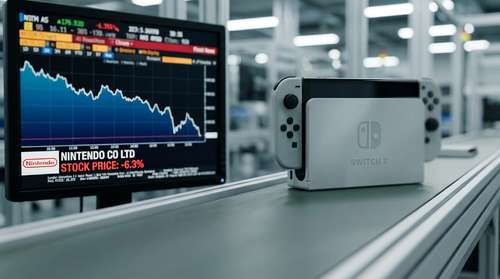
Nintendo has officially slammed the brakes on its manufacturing lines. According to a surprising new Bloomberg Nintendo report, the Japanese gaming titan is actively executing a significant Nintendo Switch 2 production cut. Originally targeting an output of 6 million units for the quarter ending March 31, 2026, the company is now restricting its assembly volume to just 4 million consoles. This aggressive 33% scale-back arrives squarely on the heels of a softer-than-expected Switch 2 holiday sales performance in Western markets.
The financial markets reacted swiftly to the development. The Nintendo stock price March 2026 valuation took a noticeable hit, tumbling 6.3% in Tokyo trading hours immediately following the leaked manufacturing adjustments. While the console enjoyed a record-breaking debut last summer, this sudden pivot illustrates the volatile nature of the current hardware landscape.
Unpacking the Switch 2 Sales 2026 Outlook
To understand this Nintendo hardware output reduction, you have to look at the regional disparities from the recent winter shopping season. The Switch 2 launched on June 5, 2025, to rapturous fanfare, rapidly becoming the fastest-selling console in history by moving 17.37 million units through December 31. However, momentum staggered slightly as the year closed.
Nintendo President Shuntaro Furukawa recently addressed shareholders, conceding that while domestic Japanese sales outpaced internal projections, overseas sales were somewhat weaker than expected. Industry analysts note that without a marquee holiday system-seller—such as a new mainline 3D Super Mario or The Legend of Zelda entry—Western consumers were less motivated to upgrade. In Western markets, particularly the US, holiday demand softened considerably, resulting in the PlayStation 5 reportedly outselling the Switch 2 by a notable 3-to-1 margin during peak November shopping weeks. For instance, the December release of Metroid Prime 4: Beyond achieved respectable but modest numbers, reportedly shifting just over 1 million copies combined across both Switch generations.
Software Attach Rates and The Pokémon Pokopia Factor
Hardware alone does not sustain profit margins; software attachment is the critical metric for long-term platform health. This dynamic is a primary driver behind the current next-gen console sales trends. Nintendo is notoriously conservative with inventory, preferring to artificially constrain supply rather than risk warehouse surpluses and inevitable retail discounts.
Waiting on the Next Blockbuster
The recent release of the highly anticipated exclusive Pokémon Pokopia injected a much-needed jolt into the ecosystem, selling a staggering 2.2 million units globally within its first four days on the market. Despite this commercial victory, Nintendo executives are reportedly holding their ground on the manufacturing limits. Rather than instantly spinning up assembly lines, the company is treating Pokopia as a litmus test. They want to verify if consistent software sales momentum can be maintained before they commit to reversing the production cuts.
Logistical Headwinds and Rising Manufacturing Costs
Consumer demand only paints half the picture. The decision to scale down hardware availability is equally rooted in supply chain economics. Skyrocketing RAM and storage chip prices have heavily compressed hardware profitability across the consumer electronics sector. For a $450 console operating on already razor-thin margins, producing excess units during a period of peak component pricing is a massive financial risk.
Furthermore, Nintendo's hardware engineering teams are currently dividing their attention. Reports indicate the company is developing a mandatory hardware revision specifically for the European market to comply with strict new EU regulations requiring user-replaceable batteries. Navigating these disparate regional manufacturing requirements simultaneously makes a temporary reduction in US-bound inventory a logical logistical maneuver.
Will Nintendo Hit Its Fiscal Targets?
Despite the negative optics of slashed manufacturing quotas, panic is entirely unwarranted. Niko Partners analyst Daniel Ahmad highlighted that while reports attribute the shift primarily to weak US sales, this framing ignores the macroeconomic realities facing the entire gaming industry. Ahmad points out that Nintendo’s manufacturing pipeline remains exceptionally strong by historical standards, but global economic headwinds have prompted a more conservative approach to inventory management. Market analysts remain confident that the company will comfortably meet its ambitious forecast of 19 to 20 million Switch 2 consoles sold by the end of this fiscal year.
The reality is that this scale-back represents a strategic recalibration rather than a structural collapse. By tightening the supply chain now, Nintendo preserves its pricing power and protects its profit margins while the global economy stabilizes. The true test for the platform will not be navigating a quiet spring release window, but rather how the company positions its heavy-hitting first-party exclusives heading into its critical second holiday season.