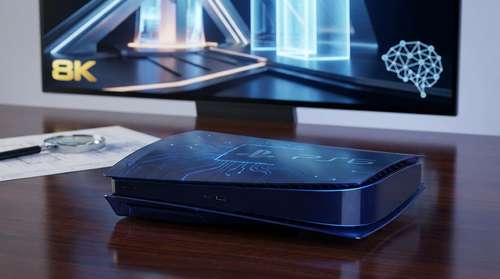
The gaming industry is reeling from a massive wave of fresh intelligence regarding Sony’s upcoming hardware. Over the last 48 hours, highly credible PlayStation 6 leaks originating from deep within Sony’s Asian supply chain have laid bare the foundational architecture of the next console generation. As of mid-April 2026, the discussion around interactive entertainment has dramatically shifted. Unlike the iterative upgrades seen in the PS5 Pro, the reports suggest that the console aims to bridge the gap between high-end PC performance and home consoles by prioritizing native 8K resolution and full path-tracing capabilities. For enthusiasts eagerly tracking the Sony next-gen console 2026 development roadmap, these revelations indicate a seismic shift in how PlayStation handles rendering, compute power, and neural networking.
Unpacking the PS6 Specs and Features: The 'Orion' Architecture
Recent documents unearthed on April 10 reveal that Sony is prepping a multi-tiered hardware approach, but the flagship console—codenamed "Orion"—is the true powerhouse. Peeling back the curtain on the PS6 specs and features, insiders claim the system is built on a cutting-edge 3nm TSMC node. The silicon integrates a custom AMD Zen 6 CPU alongside a colossal RDNA 5 graphics processor.
Specifics from the hardware leak detail a robust 10-core CPU configuration, splitting the workload between high-performance Zen 6c cores for gaming and specialized low-power cores dedicated to running the operating system. To feed this massive graphics engine and hit the ambitious 8K gaming performance targets, Sony is reportedly equipping the Orion console with an unprecedented 30GB of high-speed GDDR7 memory operating on a 160-bit bus. This massive memory pool is critical. While previous console generations struggled to maintain high resolutions without compromising texture quality, a staggering 640 GB/s of bandwidth ensures that uncompressed 8K assets can stream flawlessly without bottlenecking the system's advanced lighting engines.
Revolutionizing AI Upscaling in Consoles
Brute-forcing native 8K resolution alongside dynamic, physically accurate lighting is a monumental task for any machine. To achieve this, Sony is leaning heavily into neural rendering. A standout detail from the latest supply chain chatter is the inclusion of a bespoke, on-die AI-processing unit. This dedicated silicon handles the mathematical heavy lifting for the next iteration of PlayStation Spectral Super Resolution, dubbed PSSR 3.
The evolution of AI upscaling in consoles is moving at breakneck speed. Industry analysts and hardware insiders note that PSSR 3 is engineered to outperform even NVIDIA's current DLSS 4.5 standards. By utilizing machine learning algorithms and advanced multi-frame generation techniques, the PS6 will reconstruct ultra-high-resolution images and intelligently insert AI-generated frames to maintain fluid motion. This synergy of hardware and software allows developers from studios like Naughty Dog and Insomniac to implement full path tracing. Unlike basic ray tracing, path tracing simulates the physical behavior of light, shadows, and reflections across an entire scene in real-time. Previously restricted to elite PC rigs, this visual fidelity will now be a standard benchmark in the living room.
PlayStation 6 vs Xbox Next: The Premium Performance War
As Microsoft quietly develops its own next-generation hardware under the "Project Helix" moniker, the PlayStation 6 vs Xbox Next battle lines are already being drawn. Microsoft is widely expected to push heavily into hybrid cloud processing to offset local rendering costs. Sony’s strategy, conversely, relies on raw, localized, ultra-premium hardware.
To capture different market segments, Sony is allegedly preparing a digital-only "Lite" console and a dedicated PS6 Handheld, codenamed "Canis," which is rumored to beat the Xbox Series S in raw rasterization and ray-tracing performance. However, for the hardcore demographic, the flagship Orion model represents an uncompromising vision of localized graphical supremacy. This premium approach comes at a cost. Leaked pricing models from earlier this week suggest the flagship PS6 could retail anywhere between $699 and $999 due to an estimated $750 bill of materials.
PS6 Release Date Rumors and Future Outlook
Despite the rapid influx of granular hardware details, consumers will need to exercise patience. The latest PS6 release date rumors consistently point to mass production kicking off in the second quarter of 2027, placing the retail launch in the late 2027 to early 2028 window. Industry watchers initially feared that ongoing global memory market constraints might push the launch to 2029, but stable TSMC production contracts have reportedly kept Sony's timeline intact.
While an immediate 2026 launch is off the table, early development kits are already circulating among top-tier studios. These kits feature a unified software development kit designed for seamless cross-generation network compatibility, easing the transition for developers. By focusing unequivocally on native 8K capabilities and AI-driven path tracing, Sony is ensuring that when the PlayStation 6 finally arrives, it will fundamentally redefine the technical boundaries of interactive entertainment.