The gaming industry is officially on notice. A massive wave of PlayStation 6 leaks 2026 has just shattered our expectations for Sony's next console generation. Following a bombshell April presentation leaked by industry insider Moore's Law is Dead (MLID), we now have a comprehensive blueprint of Sony's hardware roadmap. Gone is the traditional single-console launch. Instead, the Japanese tech giant is preparing an aggressive three-device strategy spearheaded by a custom AMD architecture that delivers unprecedented graphical fidelity and a dedicated portable companion.
Sony's Three-Tier Strategy and PlayStation 6 Price Tiers
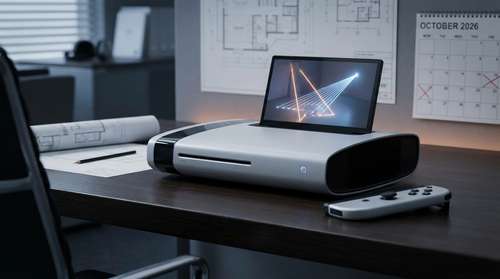
Recent Sony next-gen console rumors suggested the company was working on a hybrid approach, but the actual internal documents reveal something far more ambitious. Sony is reportedly planning a three-pronged hardware assault for 2027. This lineup utilizes two distinct chips codenamed "Orion" and "Canis," creating a versatile ecosystem designed to capture every segment of the gaming market.
The flagship PlayStation 6, powered by the massive Orion APU, is designed for no-compromise 4K 120FPS gaming. However, according to the latest PlayStation 6 leaks 2026, the real twist lies in the PlayStation 6 price tiers and the accompanying budget hardware. Sony is adapting the smaller Canis chipset for two additional devices: a dedicated handheld and a budget-friendly home console currently dubbed the "PS6 S" or "Lite".
Current supply chain estimates from MLID project the mainline Orion console will retail between $699 and $999, reflecting the high cost of premium silicon. The budget-oriented PS6 S could land between $349 and $549, making it a highly competitive entry point for casual players. Meanwhile, the standalone portable is projected to sit comfortably in the $499 to $699 range.
Unpacking the PS6 Canis Handheld Specs
Hardware enthusiasts have spent months analyzing the Sony Canis leaked details, and the resulting profile is nothing short of a technical marvel. Unlike the PlayStation Portal, which merely streamed games from a local console, the Canis handheld is a native processing powerhouse built on TSMC's cutting-edge 3nm lithography node.
According to the leaked PS6 Canis handheld specs, the device packs a custom AMD monolithic SoC featuring six CPU cores. Specifically, it uses four high-performance Zen 6c cores paired with two low-power Zen 6 LP cores reserved entirely for the operating system and background tasks. Graphically, the handheld utilizes 16 RDNA 5 Compute Units clocked at 1.20 GHz in handheld mode, with a boost up to 1.65 GHz when docked.
When combined with a projected 16GB to 24GB of LPDDR5X RAM operating on a 192-bit memory bus, the 135mm² Canis chip reportedly outperforms current-generation entry-level consoles like the Xbox Series S,. Sony has managed to compress roughly half the raw rasterization power of a base PS5 into a die that fits perfectly inside a thermal-constrained portable chassis.
The Holy Grail: Flawless PS6 Backwards Compatibility
One of the most persistent concerns regarding the transition to a new hardware architecture is the fate of existing game libraries. Thankfully, the newest PlayStation 6 leaks 2026 bring a definitive answer regarding PS6 backwards compatibility. Internal AMD presentation slides explicitly detail an "active, structured engineering workstream" ensuring native compatibility for both PS4 and PS5 titles,.
This initiative extends seamlessly to the handheld tier. Players will not have to rely on cloud streaming or spotty remote play features to access their digital back catalog on the go. The leaked documentation confirms the portable unit will natively process PS4 and PS5 game code directly from its internal storage.
The Power Saver Blueprint
Interestingly, Sony has been subtly preparing for this transition for over a year. Developers recently spotted a new "Low Power Mode" mandated in PS5 development kits. Industry analysts now believe this was a quiet strategy designed to force game creators to optimize their engines for an 8-thread environment. By making current titles highly scalable, Sony guarantees a massive, perfectly optimized launch library for the handheld companion.
A Visual Revolution: PS6 Ray Tracing Performance
While the rasterization capabilities of the upcoming generation are undeniably impressive, the true generational leap lies in the rendering pipeline. The PS6 ray tracing performance is targeting an astronomical 5x to 10x multiplier over the base PlayStation 5.
By leveraging the massive architectural overhaul of AMD's upcoming RDNA 5 graphics, the console will handle highly complex global illumination, accurate shadow mapping, and photorealistic reflections without suffering the crippling framerate drops that plague current-gen hardware. Fellow leaker Kepler_L2 corroborated these claims, noting that the RDNA 5 efficiency gains will allow the flagship Orion console to potentially outpace high-end PC graphics cards like the RTX 5080 in pure ray tracing workloads.
Even the smaller handheld benefits immensely from this architectural leap. Portable players can expect hardware-accelerated lighting with full backward compatibility for PS5 RT titles. As the rumored late 2027 release window inches closer, these comprehensive leaks prove that Sony's vision for a flexible, high-fidelity gaming ecosystem is finally coming into sharp focus.