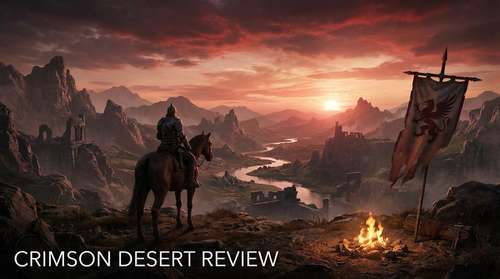
After years of staggering trailers and mounting anticipation, Pearl Abyss has finally unleashed its colossal action-RPG onto the masses. Released globally on March 19, 2026, the game is a massive undertaking that attempts to redefine the modern sandbox. In this comprehensive Crimson Desert review, we examine whether the developer behind the hit MMO Black Desert has successfully transitioned into the single-player prestige space.
There is no understating the sheer ambition on display here. While early critic scores have settled around an 80 on OpenCritic—causing a surprising 28% to 30% dip in Pearl Abyss's stock—the reality is that this title is a chaotic, breathtaking masterpiece that easily secures a spot among the best open world RPGs 2026 has to offer.
Surviving the Expansive Pywel World Map
You step into the battle-worn boots of Kliff, a seasoned mercenary tasked with rebuilding the legendary Greymanes faction after a devastating ambush by the rival Black Bears. The opening prologue sets a brutal tone, thrusting you into a fiery conflict that leaves your surviving comrades scattered. But the narrative, while serviceable and occasionally dipping into Assassin's Creed-style conspiracies, is simply a vehicle to get you out into the breathtaking Pywel world map.
The scale of Pywel is staggering, reportedly dwarfing the landmasses of several genre staples combined. From the snow-capped mountains of the northern territories to the bustling, densely populated streets of Hernand, the map is packed with dynamic events, hidden puzzles, and rival settlements. You can spend dozens of hours ignoring the main questline to engage in arm wrestling, taming wild horses, managing a sprawling mercenary camp, or simply exploring the wilderness for crafting materials. It is a living, breathing ecosystem that rewards curiosity at every turn, ensuring that no two players will experience the early hours in the exact same way.
Pearl Abyss Crimson Desert Gameplay: Unrelenting Combat
If you are expecting a traditional, frictionless hack-and-slash experience, you will be swiftly humbled. Pearl Abyss Crimson Desert gameplay is deeply rooted in the studio's MMO pedigree but significantly elevated for a strictly single-player environment. The combat system is a visceral, bone-crunching dance of parries, grapples, and elemental magic, utilizing the proprietary BlackSpace engine to deliver weighty, impact-heavy animations.
The learning curve is undeniably steep. You are constantly monitoring stamina, dodging unblockable strikes from mechanical dragons, and managing crowds of ruthless enemies that do not politely wait their turn to attack. Players can even seamlessly transition into the air, using magical traversal abilities to drop devastating plunge attacks on unsuspecting foes. Frankly, many players will be searching for a comprehensive Crimson Desert combat guide within their first five hours just to understand the intricate combo system. However, once the mechanics finally click, chaining together a flawless sword combination before physically wrestling a bandit to the ground feels incredibly rewarding.
Crimson Desert vs The Witcher 3: A Generational Leap?
Since its initial reveal, the gaming community has eagerly set up a Crimson Desert vs The Witcher 3 comparison. Does Kliff's journey dethrone Geralt of Rivia as the pinnacle of the genre? The answer is complicated. When it comes to world design and player freedom, Pearl Abyss has undeniably pushed the boundaries. The sheer number of interactable elements and dynamic world systems outpaces CD Projekt Red's classic.
Yet, where it falters is in its lack of focus. By attempting to incorporate everything from The Legend of Zelda: Tears of the Kingdom's freeform puzzle-solving to Red Dead Redemption 2's slow-paced camp mechanics, the game occasionally buckles under its own immense weight. Inventory management at launch has been notoriously clunky, and the sheer volume of overlapping systems—from cooking and fishing to complex territory takeovers—can feel exhausting to navigate. The writing also lacks the dark, nuanced maturity of The Witcher, often leaning into broad high-fantasy tropes. Still, the visceral highs of exploring this realm far outweigh the friction of its bloated menus.
Crimson Desert PC Performance: A Technical Marvel
A major point of contention leading up to launch was whether modern rigs could even run this behemoth. Following the review embargo lift on March 18, it became clear that Crimson Desert PC performance is actually one of the game's brightest spots. Powered by the studio's upgraded BlackSpace Engine, the visual fidelity is unmatched, rendering incredibly detailed character models and vast draw distances.
You will need to clear some serious hard drive space, as the game demands a hefty 150 GB of storage for its massive assets. But those who meet the strict hardware requirements are in for a technical treat. The game ships with day-one support for advanced upscaling technologies, including NVIDIA DLSS 4.5 and AMD FSR 4, as well as Ray Reconstruction. This ensures that frame rates remain stable even during the most chaotic, particle-heavy boss fights. While the PS5 and Xbox Series X versions feature well-optimized quality and performance modes, the PC version stands as the definitive way to experience Pywel's majesty, assuming you have the graphics card to handle it.