
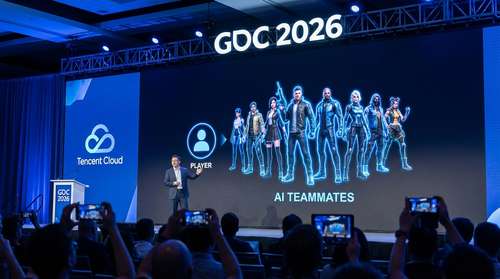
The gaming industry is officially converging on San Francisco's Moscone Center this week, and the earliest GDC 2026 news is already sending shockwaves through the multiplayer landscape. Kicking off the Game Developers Conference on Monday, Tencent Cloud took center stage to reveal a sweeping overhaul of its gaming infrastructure. The headline announcement? A new era of conversational gaming driven by highly responsive Tencent AI teammates that can talk, strategize, and react in real time alongside human players.
For years, the industry has chased the dream of non-playable characters (NPCs) that act less like scripted bots and more like actual friends in a lobby. Now, through a massively upgraded suite of tools, Tencent is bridging the gap between large language models (LLMs) and competitive multiplayer environments. Here is how the tech giant plans to reshape the social fabric of online gaming.
The Evolution of Tencent Cloud GVoice
The foundation of this breakthrough is the newly rebranded Game Multimedia Engagement Solution (GMES), an evolution of Tencent's legacy communication engines. At the heart of GMES sits Tencent Cloud GVoice, a high-performance voice gateway that has been fundamentally rebuilt for the generative AI era.
Rather than simply transmitting player audio across a server, the new GVoice infrastructure actively processes and understands it. The system features built-in Automatic Speech Recognition (ASR), directional voice pickup, and interruption handling. This means a player's microphone input is instantly cleaned up, transcribed, and fed into an LLM with virtually zero latency. According to Shichuan Liu, Director of Game Solutions at Tencent Cloud, this upgrade is about treating games as vibrant communities rather than mere entertainment. The goal is to make multiplayer sessions richer, safer, and inherently more inclusive.
Alongside the conversational tech, Tencent also highlighted Magic Voice, an AI timbre engine that goes far beyond traditional pitch shifting. Players engaging in roleplay or social hubs can now seamlessly reconstruct their vocal characteristics in real time, letting them sound exactly like their in-game avatars—whether that is a gruff tactical commander or a fantasy rogue.
Enter the Era of 'AI Teammates'
The most compelling application of this new tech is the introduction of dynamic AI-powered multiplayer games where synthetic players fill out your squad. If your regular gaming group is offline, these intelligent agents step in to fill the void, utilizing voice-to-text and text-to-speech pipelines to maintain a continuous, natural dialogue.
These aren't the rudimentary bots of the past that endlessly run into walls. Powered by real-time speech AI, these teammates understand emotionally charged callouts, squad communications, and rapid tactical shifts. For example, if you yell that an enemy is flanking from the left, your AI companion processes that audio cue, acknowledges the command verbally, and adjusts its positioning on the map.
The technical hurdles of making this a reality are massive, primarily due to the strict latency requirements of competitive games. During a specialized Tuesday afternoon session at GDC, Tencent and Amazon Web Services (AWS) detailed how they are utilizing cloud infrastructure to balance low-latency inference, cost, and safety moderation, ensuring these voice interactions don't drag down server tick rates.
Local Processing for Zero-Latency Action
While cloud infrastructure does the heavy lifting for massive player bases, the push for the future of game development AI also relies heavily on local hardware. Tencent showcased a major collaboration with Qualcomm's Snapdragon platform to push on-device AI processing for these conversational features.
By moving the Automatic Speech Recognition directly to the player's device—leveraging edge computing and NPU acceleration—the system achieves near-instantaneous voice-to-text translation. This localized processing means that giving a voice command to an AI squadmate in a fast-paced tactical shooter happens just as quickly as pressing a button on a controller. For developers of competitive mobile titles and cross-platform shooters, this eliminates the network bottleneck that previously made real-time voice commands unviable.
Security and Game Developers Conference 2026 Highlights
As AI in gaming 2026 moves beyond conceptual demos and into live-ops production, the challenges of maintaining fair play scale accordingly. To address this, Tencent's GDC presence also heavily emphasized its Anti-Cheat Expert (ACE) platform and the EdgeOne security suite, ensuring that the same infrastructure powering AI communication also strictly governs network integrity.
The company rounded out its showcase by debuting the HY 3D AI creation engine, a tool capable of generating high-quality 3D assets from text and image prompts in minutes. While asset generation is certainly a massive time-saver for studios, the true industry-disrupting potential lies in how players will interact with the game world itself.
The days of selecting dialogue options from a static menu are rapidly ending. As Tencent's new suite of GMES tools rolls out to developers worldwide, the line between human and artificial teammates is about to get delightfully blurry.