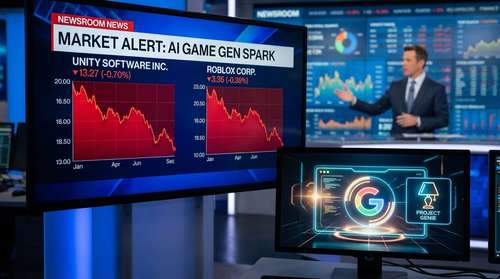
January 31, 2026 – The video game industry is reeling this morning after Google’s official unveiling of Project Genie triggered a historic sell-off in major gaming stocks. In a move that investors fear could render traditional game engines and user-generated platforms obsolete, Google has demonstrated a new AI model capable of generating fully playable, interactive 3D worlds from simple text prompts. The market reaction was swift and brutal: shares of Unity Software (U) plummeted nearly 25%—its worst single-day performance in years—while Roblox (RBLX) dropped over 13% and Take-Two Interactive (TTWO) fell nearly 9%.
The Billion-Dollar Panic: Why Unity and Roblox Are Crashing
The massive sell-off represents a sudden loss of confidence in the traditional "moats" of the gaming industry. For over a decade, Unity has been the bedrock engine for mobile and indie developers, while Roblox has dominated the market for user-generated experiences. Google’s Project Genie disrupts both value propositions simultaneously. Investors are terrified that if an AI can generate a playable world in seconds without a single line of code, the need for complex engines like Unity or platform-locked ecosystems like Roblox could evaporate.
"This is an existential moment for the middleware market," said one analyst on Friday. "If Google Genie allows anyone to bypass the technical barriers of game development, the premium on tools like Unity shrinks overnight." The crash wiped out approximately $15 billion in combined market value across the sector in a single trading session, highlighting just how fragile investor sentiment is regarding AI in gaming 2026.
Inside Project Genie: "Vibe Coding" Becoming Reality
At the heart of this disruption is Genie 3, Google DeepMind’s latest "world model" technology. Unlike its 2D predecessor announced back in 2024, Genie 3 generates interactive 3D environments in real-time. Available immediately to Google AI Ultra subscribers in the U.S. (at a steep $250/month price point), the tool allows users to type prompts like "a cyberpunk city with neon rain" or "a physics-based platformer on a planet made of cheese," and instantly creates a playable loop.
The system leverages a new image generation model dubbed Nano Banana Pro to visualize the scene, which Genie 3 then animates and simulates physically. While current limitations are evident—worlds run at 720p resolution and 24 frames per second, and persist for only about 60 seconds—the implications are clear. We are moving from "coding" games to "vibe coding" them, where the barrier to entry is effectively zero.
The Limitations (For Now)
Despite the panic, the technology isn't a complete replacement for AAA development yet. Project Genie currently lacks complex game loops, scoring systems, or persistent multiplayer servers. It generates "experiences" rather than full games. However, the speed of advancement suggests these hurdles are temporary, fueling the interactive world generation narrative that has spooked Wall Street.
Industry Reaction: Accelerators vs. Replacements
Caught in the crosshairs, industry executives scrambled to control the narrative. Unity CEO Matthew Bromberg took to social media platform X (formerly Twitter) to reassure stakeholders, describing Project Genie not as a competitor, but as a "powerful accelerator" that creators would still need Unity to refine and publish. "Advances in large-scale world models materially expand the frontier... but their outputs remain probabilistic," Bromberg noted, arguing that professional developers need deterministic, reliable tools.
However, the developer community is less optimistic. With layoffs already plaguing the sector—over 50% of developers surveyed recently expressed negative sentiment toward AI—Project Genie is seen by many as a threat to jobs in level design, concept art, and prototyping. The fear is that the future of game development will require fewer humans to build the vast virtual worlds players demand.
What This Means for Gamers and Investors in 2026
For gamers, Project Genie promises a future of infinite, personalized content. Imagine a "YouTube for games" where you don't just watch a video, but jump into it and play. But for investors, the volatility is likely just beginning. The prompt-to-game pipeline is no longer science fiction; it is a commercial product available today. As Google continues to refine Genie 3 and competitors like OpenAI and Meta inevitably respond, the traditional economics of the $200 billion gaming industry are being rewritten in real-time.