
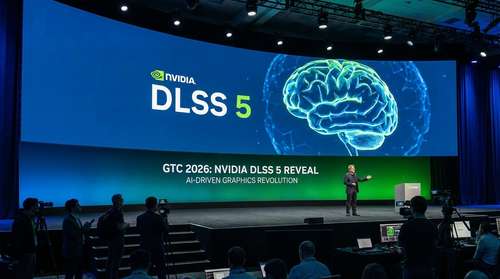
The line between reality and virtual worlds has officially blurred. During Monday's highly anticipated GTC 2026 gaming news updates, the Nvidia DLSS 5 reveal sent shockwaves through the tech industry. CEO Jensen Huang took the stage to announce a complete paradigm shift in how interactive media is drawn on our screens, famously declaring the technology as the "GPT moment for graphics". Moving entirely past standard upscaling, this new era of AI generative rendering promises to alter everything we know about visual fidelity and the future of graphics cards. It is a bold, controversial step that forces developers and players alike to rethink the very definition of a rendered frame.
Beyond Upscaling: The Shift to 3D-Guided Neural Rendering
For the past several years, hardware enthusiasts have relied on Deep Learning Super Sampling to squeeze extra performance out of demanding titles. However, the Jensen Huang keynote 2026 made it explicitly clear that Nvidia is no longer just guessing the next frame. DLSS 5 utilizes what the company calls 3D-guided neural rendering. Instead of merely taking a low-resolution image and scaling it up, the AI model analyzes a game engine's raw structural data—including color buffers, motion vectors, and base geometry—and infuses the scene with cinematic, photorealistic lighting.
This intricate process features "Material Intelligence," allowing the AI to instantly recognize the difference between a woven fabric tunic, the metallic reflection of a broadsword, or the delicate translucency of human skin. Real-time calculations handle complex subsurface scattering natively, theoretically eliminating the plastic, lifeless look that has haunted character models in role-playing games for decades. As Huang noted during his address, twenty-five years after the invention of the programmable shader, the company is fundamentally reinventing computer graphics from the ground up.
DLSS 5 vs DLSS 4.5: Redefining PC Gaming Performance Benchmarks
When looking at DLSS 5 vs DLSS 4.5, the architectural divergence is nothing short of staggering. The previous generation heavily utilized Multi Frame Generation to artificially boost frame rates between native renders. While DLSS 4.5 remains an exceptional tool that uses AI to miraculously draw 23 out of every 24 pixels on the screen, it ultimately still relies on the traditional rendering pipeline to dictate the final look of light and materials.
DLSS 5 abandons that strict reliance. It operates as a sophisticated, real-time VFX layer, generating a final output that mirrors the quality of offline movie CGI. While running natively at up to 4K resolution, it drastically reduces the raw computational load that would normally be required for such an immense visual leap. Because the AI handles the heavy lifting of material generation, upcoming PC gaming performance benchmarks will likely prioritize Tensor Core neural processing over raw rasterization brute force. To drive this point home, the early preview at GTC ran on a massive dual RTX 5090 setup—one dedicated entirely to the game engine, and the second isolated specifically to run the heavy DLSS 5 neural model.
The "Sloptracing" Controversy: Cinematic Masterpiece or AI Slop?
Despite the undeniable technical marvel, the immediate reception from players and game developers has been violently polarized. During the showcase, Nvidia displayed footage of DLSS 5 running on upcoming and existing heavy hitters like Resident Evil: Requiem, Starfield, and Hogwarts Legacy. While the environmental lighting improvements were universally praised, the AI's tendency to completely rewrite facial features left many viewers feeling unsettled.
Vocal critics quickly coined the derogatory term "sloptracing" to describe the phenomenon, accusing the technology of painting over handcrafted 3D assets with an overwrought, generative AI finish. In the Resident Evil: Requiem demo, classic characters appeared noticeably modified, stripped of their original artistic intent and replaced with uncanny, hyper-smooth internet model aesthetics. High-profile gaming content creators lambasted the feature as "AI slop," expressing deep concern that it disrespects the intentionality of dedicated 3D artists. Nvidia insists developers will retain granular control over intensity, color grading, and masking to preserve a game's unique aesthetic. However, early visual evidence suggests a rocky road ahead for widespread community acceptance.
What This Means for the Future of Graphics Cards
Players anxious about needing to rebuild their PC rigs from scratch can breathe a slight sigh of relief, at least for now. Nvidia confirmed that DLSS 5 will arrive this fall as a software driver update fully supported by the existing RTX 50 Series architecture. If you are already holding a modern 50-series desktop or laptop GPU, the neural rendering technology will be integrated seamlessly via the familiar Nvidia Streamline framework.
As major industry publishers including Bethesda, Capcom, Tencent, and Ubisoft prepare to integrate the tech into their upcoming releases, the gaming landscape stands at a critical crossroads. We are entering an era where the GPU is no longer just a passive calculator for polygons, but an active, creative participant in generating the final image you experience. Whether the global gaming audience will fully embrace this AI-driven reality or reject it in favor of traditional, human-directed artistic vision remains the single biggest question of 2026.