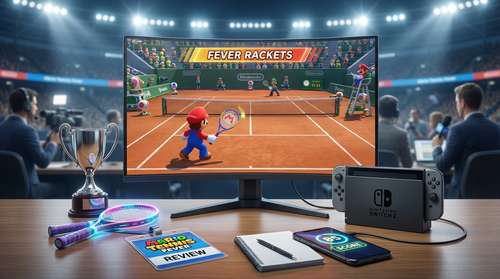
The next generation of Nintendo sports has officially arrived, and it brought a wicked slice. Mario Tennis Fever isn't just a shiny showcase for the Nintendo Switch 2 games library; it is a confident, chaotic, and technically flawless reinvention of arcade tennis. After spending a week trading rallies, dodging Thwomps, and testing the new Fever Rackets mechanics, it is clear that developer Camelot has finally found the sweet spot between competitive depth and pure Mushroom Kingdom party chaos. If you were lucky enough to snag a console this week, this is the multiplayer title you need to own.
Fever Rackets: A Game-Changing Mechanic
The headline innovation in Mario Tennis Fever is the introduction of "Fever Rackets," a system that completely replaces the fighting-game-style energy gauges of Mario Tennis Aces. Instead of complex zone shots and block timing, players now choose from over 30 unlockable rackets, each with a distinct passive and active ability. Building your Fever Gauge allows you to unleash a "Fever Shot" unique to your gear, adding a layer of MOBA-like strategy to the court.
During my Mario Tennis Fever gameplay sessions, the variety was staggering. The Bullet Bill Racket transforms your returns into un-reactable line drives that demand your opponent play close to the net, while the Ty-foo Racket summons tornadoes that physically alter the ball's trajectory mid-flight. Balancing these powers feels surprisingly fair; for instance, the devastating Thwomp Shot—which drops a massive stone obstacle on the enemy court—can be countered if you force your opponent to move before they can fully charge it. It’s a brilliant evolution that makes equipment choice just as important as character selection.
Nintendo Switch 2 4K Gaming: A Visual Ace
We have heard the promises about Nintendo Switch 2 4K gaming, but seeing it in motion is a revelation. Mario Tennis Fever runs at a locked 60 frames per second at razor-sharp 4K resolution when docked, without a single dropped frame. This performance is critical when the screen is filled with particle effects from Fire Flower boosts or the screen-warping effects of a Shadow Mario double.
The visual leap allows for details we’ve never seen in the series: the fuzz on the tennis ball, the stitching on Mario’s cap, and the reactive lighting of the court surfaces are stunning. Even more impressive is the online stability. In over 50 online matches, the netcode held up perfectly, a massive improvement over the peer-to-peer struggles of the previous generation. This technical polish easily cements it as one of the best Switch 2 sports games at launch.
Adventure Mode and Solo Content
If there is a double fault to be found, it lies in the Adventure Mode. While it serves as a competent tutorial for the new mechanics, the story—centering on saving the kingdom's babies from a mysterious power—is a breezy 4-hour affair that feels more like a warm-up than a main event. It lacks the RPG depth of the Game Boy Color era, though the boss battles are creative highlights that force you to master specific racket types.
Fortunately, the single-player offering is saved by the "Trial Towers," a gauntlet mode that provides a genuine challenge. Climbing the "Tower of Trickery" on the hardest difficulty requires mastery of every shot type and racket perk. It is here that the Mario Tennis Fever Metacritic score justification becomes clear; the gameplay loop is addictively "just one more try," satisfying both casual fans and hardcore tacticians.
Verdict: A Grand Slam Return
Mario Tennis Fever strips away the over-complicated mechanics of its predecessor and replaces them with a system that is accessible, strategic, and endlessly fun. The Fever Rackets add a layer of personality and customization that the series has desperately needed. While the story mode plays it safe, the core tennis action is the best it has ever been, bolstered by the technical muscle of Nintendo's new hardware.
For early adopters looking to justify their upgrade, this is an essential purchase. It sets a high bar for the future of arcade sports on the platform and proves that even after decades on the court, Mario still has plenty of new tricks up his sleeve.