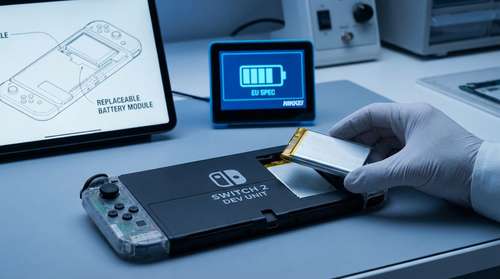
Hardware degradation has long been the Achilles' heel of portable gaming, but a massive new Nintendo Switch 2 battery leak suggests the company is finally addressing the issue. According to a highly publicized Switch 2 Nikkei report, Nintendo is actively developing a major hardware revision for its newest console, featuring a user-replaceable battery system. The move is designed to comply with stringent European Union regulations set to take effect next year, fundamentally changing how players will maintain their devices.
For gamers tired of sending consoles away for premium repairs or risking damage during DIY fixes, this development marks a massive paradigm shift. The Japanese publication notes that this new Switch 2 EU model will allow users to swap out lithium-ion batteries in both the main console and the attached Joy-Con 2 controllers using ordinary, everyday tools. Rather than treating a dying battery as the end of a console's natural lifespan, Nintendo is redesigning its architecture to prioritize long-term preservation and sustainability.
The Push for a Nintendo Right to Repair in 2026
The driving force behind these updated Nintendo hardware specs is the European Union's comprehensive 2023 Batteries Regulation. Under the impending law, any company selling portable consumer electronics in the EU must ensure their devices adhere to strict new standards:
- Batteries must be readily removable by the end-user.
- Disassembly cannot require proprietary tools or thermal solvents.
- The replacement process must not pose a safety risk or damage the device.
While the landmark legislation was passed three years ago, the strict enforcement deadline of February 2027 is now rapidly approaching, forcing tech manufacturers to finalize their compliant designs.
Nintendo is essentially getting ahead of the curve to avoid major supply chain disruptions. Currently, the company's standard hardware design relies heavily on industrial adhesives and specialized tri-point screws to keep internal components tightly secured. Teardown experts at iFixit previously criticized the launch version of the Switch 2 and its Pro Controller for utilizing strong glues that make a simple battery swap unnecessarily difficult and risky for the average consumer. By redesigning the internal chassis to eliminate the need for specialized prying spudgers, the company is finally aligning itself with the growing Nintendo Right to Repair 2026 movement.
What This Means for Joy-Con Battery Replacement
Perhaps the most exciting aspect of the Nikkei leak involves the console's detachable controllers. Continual charging cycles often leave handheld controllers struggling to hold a charge after a few years of heavy use, an issue that plagued the previous generation. The updated hardware will drastically streamline Joy-Con battery replacement, abandoning the tedious and delicate teardown process required for older models.
Under the new EU mandate, the risk of cracking the outer plastic shell or tearing microscopic internal ribbon cables just to replace a degraded lithium-ion cell must be entirely eliminated. This thoughtful redesign ensures that players can simply purchase a certified fresh battery and swap it out at the kitchen table. This will exponentially extend the lifespan of the Joy-Con 2 without forcing consumers to resort to costly mail-in factory repairs or entirely new controller purchases.
Will the Replaceable Switch 2 Battery Come to the US?
Right now, this highly anticipated replaceable Switch 2 battery model is specifically slated for the European market, acting as a regional exclusive to satisfy local regulators. Regional hardware variants are increasingly rare in modern console manufacturing due to overhead logistical costs, but the strict legal requirements in the EU have forced Nintendo's hand in this specific territory.
However, North American and Japanese gamers shouldn't lose hope just yet. The translated Nikkei report explicitly states that Nintendo is keeping a close eye on consumer sentiment globally. If awareness and legislative demand for right-to-repair standards continue to increase in the United States and Japan, the gaming giant may roll out this modular design worldwide rather than splitting its manufacturing lines. Tech giants like Apple and Sony have recently made similar global pivots—such as the DualSense controller updates and the iPhone's universal shift to USB-C ports—proving that localized EU laws often become the de facto global standard for consumer tech.
The Potential End of the Original Switch in Europe
While the media focus remains squarely on the Switch 2, industry analysts have pointed out a significant collateral impact of the upcoming 2027 deadline. The original Nintendo Switch, which launched back in 2017, completely fails to meet these modern European repairability standards.
Since the first-generation console relies on the exact same restrictive adhesives and proprietary screws that the EU is outlawing, the new legislation could legally force Nintendo to officially discontinue the original Switch in European territories by early 2027. Doing so would allow the company to clear out legacy stock and dedicate its manufacturing lines entirely to the compliant Switch 2 EU model.
Ultimately, this leaked hardware revision represents a massive victory for consumer rights, device longevity, and electronics preservation. Gamers will no longer have to treat aging batteries as a death sentence for their favorite console. Instead, maintaining your gaming hardware will soon be as straightforward and accessible as changing the batteries in a television remote.