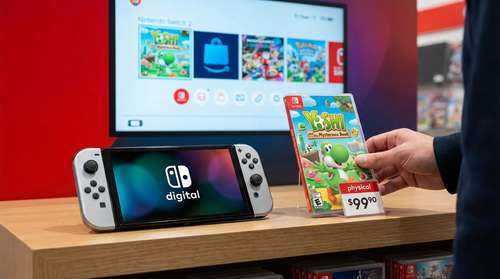
The gaming industry is undergoing a seismic shift, and the latest Nintendo Switch 2 news has just drawn a massive line in the sand regarding how we buy and own our video games. Nintendo has officially confirmed a monumental change to its retail strategy, announcing that first-party titles will no longer maintain price parity between digital and physical formats. The highly anticipated Yoshi and the Mysterious Book release on May 21, 2026, will serve as the pioneering testing ground for this new model, establishing a precedent that could permanently alter the console landscape.
The New Reality of Nintendo First-Party Pricing
For decades, console manufacturers and software publishers adhered to a strict, unspoken rule: whether you bought a game on a disc, a proprietary cartridge, or as a digital download, the manufacturer's suggested retail price (MSRP) remained identical. That era of parity is officially over. Under the newly announced Nintendo first-party pricing structure, players who prefer a physical box on their shelf will be required to pay a premium at the register.
When Yoshi and the Mysterious Book hits the market, it will carry a digital price tag of $59.99 on the Nintendo eShop. Meanwhile, the physical cartridge edition will retail for $69.99 at major outlets like Best Buy, GameStop, and Amazon. This $10 gap partially confirms the long-circulating Nintendo price hike rumors that began during the hardware's initial reveal. Rather than enforcing a blanket $70 or $80 standard across the board for every single title, Nintendo is adopting a variable pricing model that heavily incentivizes players to embrace digital media.
A Shift to Variable Game Pricing
It is crucial to note that this digital-to-physical split is part of a much broader, highly variable pricing ecosystem. Nintendo has clearly abandoned the one-size-fits-all model for its current generation. For example, earlier system exclusives like Mario Kart World launched with a premium $79.99 tag, while Donkey Kong Bananza landed at $69.99. By introducing a $59.99 digital tier for Yoshi, Nintendo is demonstrating that game length, development budget, and format will all dictate what consumers pay at checkout.
Why Are Digital vs Physical Game Prices Diverging?
The debate surrounding digital vs physical game prices has been brewing in online communities for years. Consumers have long argued that a digital file hosted on a server should cost less than a physical product that requires manufacturing, packaging, and global shipping. The technical realities of the Switch 2 have finally forced Nintendo to address this discrepancy publicly.
In a brief statement addressing the shift, the Japanese gaming giant explained that the pricing divergence "reflects the different costs associated with producing and distributing each format". Unlike optical discs utilized by PlayStation and Xbox, which cost pennies to stamp, Nintendo relies on proprietary flash memory cartridges. The hardware leap to the Switch 2 allows developers to push higher-fidelity assets and complex textures, demanding cartridges with significantly larger storage capacities.
When you combine the inflated manufacturing costs of these high-capacity cards with ongoing global supply chain constraints and the necessary revenue cut taken by brick-and-mortar retailers, the overhead for physical games is vastly higher. Nintendo has decided to pass those specific production costs directly to the physical consumer rather than raising the baseline price for everyone.
Are These Switch 2 eShop Discounts or a Physical Tax?
Consumer reaction to the announcement has been immediate and starkly divided. Many pragmatic players view the lower digital price point as an absolute win. In a modern economy where $70 has rapidly become the standard base price for AAA video games across competing platforms, securing brand-new, first-party releases for $60 feels like securing day-one Switch 2 eShop discounts. For the massive demographic of players who have already transitioned entirely to digital libraries, this policy effectively functions as a way to avoid industry-wide inflation.
Conversely, the physical gaming community views the strategy as a blatant penalty. Game preservationists and physical collectors argue that physical media already lacks the aggressive, frequent sales seen on digital storefronts. Raising the baseline entry point further isolates traditional buyers. Furthermore, physical game owners rely on the secondhand market. Buying a game for $70, playing it, and trading it in offsets the initial cost. By aggressively pushing players toward the eShop, Nintendo secures complete control over its revenue pipeline while slowly eroding the used-game ecosystem.
Gaming Retail Trends 2026: The Beginning of the End for Cartridges?
This bold maneuver perfectly encapsulates broader gaming retail trends 2026. According to recent industry data from Circana, physical media sales have plummeted by more than 50% since 2021, and a staggering 85% since their all-time peak in 2008. Publishers are eager to finalize the transition to all-digital ecosystems, and creating a financial incentive is the most effective catalyst.
The success of the Yoshi and the Mysterious Book release will likely dictate the entire industry's direction over the next hardware generation. If consumers overwhelmingly flock to the $59.99 digital version, third-party publishers like Capcom, Square Enix, and Sega are almost guaranteed to adopt similar tiered pricing for their own Switch 2 releases. While the nostalgic charm of a colorful game case and the tactile satisfaction of slotting in a physical cartridge remain undeniable, Nintendo has made its position crystal clear: the future of gaming is digital, and holding onto the past is going to carry a premium.