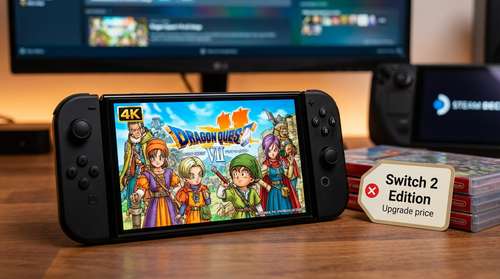
The promise of portable 4K gaming has finally materialized. With the release of Dragon Quest VII Reimagined and the massive scale of Dynasty Warriors: Origins this week, the Nintendo Switch 2 has officially entered its stride. This latest software wave acts as a definitive proof-of-concept for the hardware's DLSS-powered performance, confirming that Nintendo's latest console can indeed deliver docked 4K experiences that rival the PS5. However, this technical triumph is currently overshadowed by a growing controversy: the newly implemented 'Switch 2 Edition' upgrade fees for legacy titles. In this Nintendo Switch 2 review update, we break down the benchmarks, the visuals, and the anti-consumer pricing that has the community divided.
Dragon Quest VII Reimagined: The 4K DLSS Showcase
If the Switch 2's initial June 2025 launch lineup was a warm-up, Dragon Quest VII Reimagined is the main event. Released just two days ago on February 5, 2026, this remake is the first title to fully leverage the console's custom NVIDIA Tegra T239 processor to its theoretical limits. In docked mode, the game utilizes Deep Learning Super Sampling (DLSS) to upscale the internal resolution to a pristine 4K output.
The results are staggering. Unlike the blurry upscaling seen in the console's early days, Dragon Quest VII Reimagined maintains a rock-solid 60fps while displaying textures with a clarity that surpasses the original Dragon Quest XI. Reviews from outlets like Nintendo Life and Vooks confirm that the game eliminates the jagged edges typical of Switch titles, presenting a "seamless blend of photorealism" and Akira Toriyama's signature art style. For those searching for Switch 2 4K docked performance benchmarks, this is your new gold standard.
Handheld Performance Verdict
Undocked, the experience is equally impressive. The 7.9-inch LCD screen locks to a native 1080p resolution at 60fps, a massive leap over the 720p standard of its predecessor. Battery life during these high-fidelity sessions clocks in at roughly 3.5 hours—a respectable figure given the visual fidelity on display.
Dynasty Warriors: Origins – Stress Testing the CPU
While Dragon Quest showcases GPU prowess, Dynasty Warriors: Origins tests the CPU's limits. Musou games are notorious for performance bottlenecks, but the Switch 2 port, which landed in late January and is seeing a resurgence this week, handles the "1 vs. 1,000" combat with surprising grace. The game targets a stable 30fps in quality mode but offers an unlocked framerate mode that hovers around 40-50fps.
Critically, the enemy density remains on par with the PS5 and Xbox Series X versions. This parity is significant for Nintendo Switch 2 vs Steam Deck comparisons. While the Steam Deck often struggles to maintain battery life under such CPU strain, the Switch 2's optimization allows for dense, chaotic battlefields without turning the device into a furnace. It proves that the console's "Ounce" architecture is more than capable of handling complex physics simulations alongside high-end rendering.
The Controversy: 'Switch 2 Edition' Upgrade Fees
Despite the hardware accolades, the mood in the Nintendo community is souring. Alongside these new releases, Nintendo has rolled out its Switch 2 backwards compatibility review policy, and it involves hidden costs. Players looking to upgrade their physical Switch 1 copies of The Legend of Zelda: Tears of the Kingdom or Kirby and the Forgotten Land to the enhanced "Switch 2 Edition" are being met with a paywall.
Reports from PCMag and furious Reddit threads confirm that these upgrades cost between $10 and $20. A basic frame rate and resolution patch for Zelda commands a $10 fee, while upgrades adding content—like the new modes in Super Mario Party Jamboree—cost $20. This stands in stark contrast to the free "Smart Delivery" systems seen on competing platforms. While the Switch 2 backwards compatibility is technically seamless, locking performance patches behind a paywall has been labeled by critics as an "egregious" move that punishes loyal fans.
Upcoming Launch Games: The February Wave
Looking past the controversy, the software pipeline for February 2026 is robust. Following the Dragon Quest launch, we have a slew of titles dropping in the next two weeks that will further test the system's capabilities:
- Tokyo Scramble (Feb 11): A Switch 2 exclusive stealth-action game.
- Mario Tennis Fever (Feb 12): Expected to run at 120Hz in handheld mode.
- Reanimal (Feb 13): A co-op horror title from the creators of Little Nightmares.
These titles, combined with the current best Switch 2 launch games, solidify the console's library. The inclusion of 120Hz support in Mario Tennis Fever specifically suggests that Nintendo is finally ready to embrace high-refresh-rate gaming in the portable space.
Verdict: A Technical Triumph with a Catch
The Nintendo Switch 2 performance benchmarks are undeniable. With Dragon Quest VII Reimagined, the dream of handheld 4K gaming via DLSS is no longer a marketing buzzword—it is a reality. The hardware is punching significantly above its weight class, delivering experiences that blur the line between portable and home console gaming. However, Nintendo's decision to monetize performance patches for legacy titles is a significant unforced error. As we move deeper into 2026, the hardware will continue to impress, but the company's pricing policies may need their own "patch" to win back consumer goodwill.