PC gamers hoping to upgrade their rigs this spring have been dealt a crushing blow. In a sobering update delivered late this week, NVIDIA officially confirmed that the supply of GeForce RTX 50-series graphics cards will remain "very tight" for at least the next six months. Speaking during the company's fiscal Q4 earnings call, CFO Colette Kress warned that despite record gaming revenues, global component scarcity and a strategic pivot toward AI infrastructure will severely constrain consumer GPU availability through the first half of 2026.
The 2026 GPU Supply Crisis Explained
The confirmation of an NVIDIA RTX 50-series shortage comes after weeks of speculation regarding dwindling stock levels at major retailers like Newegg and Best Buy. NVIDIA has now validated these fears, attributing the bottleneck to a "global memory crisis" that is impacting the entire semiconductor industry. Unlike the crypto-mining shortages of 2021, this crisis is driven by an insatiable corporate demand for high-bandwidth memory (HBM) and GDDR7 modules, which are essential for both top-tier gaming cards and NVIDIA's enterprise AI accelerators.
According to reports surfacing over the weekend, NVIDIA is reportedly cutting production of consumer "Blackwell" GPUs by as much as 30-40% to prioritize its high-margin data center chips. With AI processors commanding profit margins nearly double that of consumer hardware, the company is reallocating its limited allocation of silicon wafers and memory modules. For the average gamer, this means the GPU supply crisis 2026 is not just a logistical hiccup, but a structural shift in how the market leader prioritizes its customers.
RTX 5090 Availability and Pricing Shock
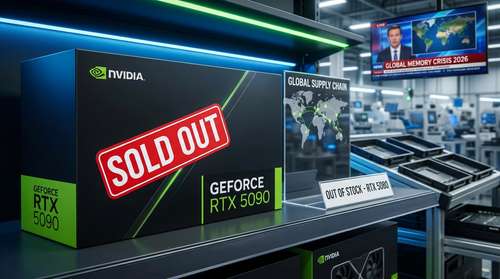
The impact of these constraints is already visible in the skyrocketing prices of high-end SKUs. The flagship RTX 5090 availability has virtually evaporated from official channels. In the last 48 hours alone, scalper listings on secondary markets have surged, with some units commanding prices upwards of $4,500—more than double the card's $1,999 MSRP.
The situation for the GeForce RTX 5080 stock update is equally grim. While technically more "available" than the 5090, the RTX 5080 is seeing aggressive retailer markups. Street prices have climbed from the $999 launch price to roughly $1,500-$1,700 overnight. Industry insiders suggest that because the RTX 5080 shares critical GDDR7 memory components with enterprise-grade products, it is disproportionately affected by the production shift. Gamers waiting for a "Super" refresh or a price drop are now facing the reality that PC gaming hardware prices 2026 will likely continue to climb before they stabilize.
Mid-Range Cards Are Not Safe
While the headlines focus on enthusiast cards, the shortage is trickling down. Reports indicate that even mid-range options like the RTX 5070 Ti and the popular RTX 5060 Ti 16GB models are facing production slowdowns. These cards, often the sweet spot for 1440p gaming, are becoming harder to find as NVIDIA allocates its limited memory supply to products with higher profit margins.
The Global Memory Shortage Warning
At the heart of this disruption is a Global RAM shortage 2026. NVIDIA's memory shortage warning highlighted that memory manufacturers like Samsung and SK Hynix are struggling to keep up with the explosive growth of AI data centers. These facilities require massive amounts of ultra-fast memory, leaving a smaller pool of resources for consumer graphics cards.
This "memory crunch" is a double-edged sword for gamers. Not only does it limit the number of GPUs that can be manufactured, but it also drives up the cost of the raw materials for the cards that are made. Analysts predict that this component inflation will prevent MSRPs from normalizing until at least Q4 2026. Consequently, the era of affordable, high-performance PC building appears to be on an indefinite pause.
What Can Gamers Do Now?
Facing a bleak outlook for the rest of the year, PC enthusiasts are left with few good options. If you absolutely need a GPU for professional work or high-end gaming, the advice from experts is to buy available stock immediately, even at a slight premium, as prices are expected to rise further.
For those strictly gaming, the used market for last-generation RTX 40-series cards may offer a temporary sanctuary, though prices there are reacting to the new shortage as well. Ultimately, this news serves as a stark reminder that in the battle between AI dominance and PC gaming, the industry's focus has shifted away from the consumer.