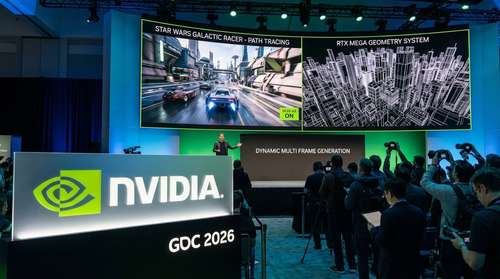
The landscape of next-gen PC gaming graphics is shifting once again. Amid a flood of GDC 2026 gaming news, NVIDIA took center stage to outline its highly anticipated software roadmap. For hardware enthusiasts and frame-rate purists alike, the highlight was the official NVIDIA DLSS 4.5 release date, backed by an impressive showcase of rendering technologies designed to push modern GPUs to their absolute limits. The showcase didn't just stop at upscaling; it introduced a fundamentally new way to render dense environments and confirmed robust support across two dozen upcoming blockbuster titles.
NVIDIA DLSS 4.5 Release Date and Dynamic Multi Frame Generation
Players looking to maximize their new RTX 50 Series hardware won't have to wait long. The highly anticipated NVIDIA DLSS 4.5 release date is set for March 31, 2026, rolling out initially as an opt-in beta via the NVIDIA app. While the foundational second-generation transformer model for Super Resolution was teased earlier this year at CES, the crown jewel of this spring update is the debut of Dynamic Multi Frame Generation.
Unlike previous iterations that generated a static, fixed number of frames, this new technology intelligently adjusts frame creation on the fly to hit a user's specified target frame rate. It strikes a precise balance between image quality, raw performance, and system latency. For gamers pushing displays to their absolute limits, NVIDIA also revealed a 6X Multi Frame Generation mode tailored specifically for 4K path-traced titles. By leveraging NVIDIA Reflex, the system generates up to five additional frames for every traditionally rendered frame, keeping the latency impact negligible and ensuring competitive responsiveness even while pushing massive pixel counts.
The Groundbreaking RTX Mega Geometry System
One of the most significant NVIDIA GDC 2026 announcements wasn't just about AI-driven frame generation, but raw architectural rendering efficiency. The new RTX Mega Geometry system is poised to fundamentally change how developers handle complex environmental structures, particularly when dealing with dense foliage and sprawling forests.
Traditional ray tracing struggles under the computational weight of millions of intersecting leaves, vines, and branches. Mega Geometry introduces a smarter, partitioned way to manage ray intersections using selectively updated ray-tracing structures. Early internal benchmarks from titles like Alan Wake 2 demonstrate up to a 20% framerate boost alongside a massive 300 MB reduction in VRAM usage.
Fans of rich, expansive open worlds will see this tech in action very soon. CD Projekt Red confirmed the RTX Mega Geometry system is being integrated directly into the PC version of The Witcher 4 to render its lush, path-traced forests without crippling system performance. Remedy Entertainment's upcoming sequel, Control Resonant, will also leverage the system from day one to manage its highly destructive, geometrically complex brutalist environments.
Star Wars Galactic Racer Path Tracing and 20 New Games
Cutting-edge rendering hardware requires ambitious software to truly shine. To that end, NVIDIA confirmed that 20 upcoming games will feature native DLSS 4.5 integrations. The lineup is incredibly diverse, ranging from IO Interactive's highly anticipated 007 First Light—launching May 27 with full path tracing—to immersive survival horror experiences like Supermassive's Directive 8020.
Perhaps the most unexpected visual powerhouse on the roster is Fuse Games' upcoming arcade title. The implementation of Star Wars Galactic Racer path tracing completely elevates the gritty, underground aesthetic of the Outer Rim racing circuit. The harsh, realistic shadows cast across dusty desert canyons and the vibrant neon reflections from syndicate-backed skim-speeders showcase how these advanced lighting models are successfully scaling beyond slow-paced narrative games and into high-speed, runs-based action. Other notable titles receiving the full path-traced treatment include Tides of Annihilation and Sea of Remnants, ensuring PC players have plenty of gorgeous environments to explore.
Modding the Classics with RTX Remix
Beyond brand-new releases, the toolsets provided to community creators are also receiving massive upgrades. The latest RTX Remix updates introduce an Advanced Particle VFX system, allowing modders to inject dynamic animations, realistic wind resistance, and complex gravitational effects into decades-old classic games. A stunning 15-level demo of Quake III Arena running on the new runtime is already available to download, proving that older titles can still benefit immensely from modern rendering techniques.
Shaping Next-Gen PC Gaming Graphics
What makes this wave of NVIDIA GDC 2026 announcements so compelling is the industry's clear pivot toward intelligent efficiency. We are rapidly moving past the brute-force era of graphics rendering. By combining the adaptive nature of Dynamic Multi Frame Generation with the structural smarts of the RTX Mega Geometry system, developers finally have the thermal and memory headroom to create richer, more interactive worlds without demanding impossible hardware requirements from their player base.
As we approach the end of March, the rollout of these features will serve as a major stress test for the latest graphics architectures. If the initial footage of Star Wars Galactic Racer path tracing and the dense, swaying woodlands of The Witcher 4 are any indication, PC gamers are in for a spectacular visual treat this year.