The day has finally arrived. After months of feverish speculation and power consumption rumors that sounded more like industrial HVAC specifications than PC hardware, the NVIDIA RTX 5090 Ti is officially here. Released today, January 13, 2026, the new flagship from Team Green doesn't just push the envelope—it incinerates it. Built on the long-awaited Blackwell architecture, this card promises to make 8K gaming performance a reality for the first time. However, with a wallet-crushing $2,499 MSRP and a power draw that necessitates a 1000W PSU for RTX 5090 Ti owners, the question isn't just about performance—it's about practicality.
Blackwell Architecture: The Beast Under the Hood
NVIDIA’s new Blackwell architecture represents a massive leap over the previous Lovelace generation. Manufactured on a custom TSMC 4NP process, the RTX 5090 Ti is a monolithic monster. The most significant upgrade comes in the memory department: the card features a staggering 48GB of GDDR7 memory on a 512-bit bus. With bandwidth exceeding 2 TB/s, the memory subsystem effectively eliminates the bottlenecks that previously plagued high-resolution textures.
But the real headline is the introduction of what NVIDIA calls Hyper-Tracing. While ray tracing has been the buzzword for years, Hyper-Tracing utilizes new specialized cores within the Blackwell silicon to calculate light bounces for moving geometry in real-time with virtually zero latency penalty. It is the closest we have ever come to offline CGI rendering in real-time gaming.
Benchmarks: 8K Gaming Performance in 2026
We put the RTX 5090 Ti through a gauntlet of the most demanding titles available. The results are nothing short of absurd. In Cyberpunk 2077: Phantom Liberty (updated with the new Path Tracing Overdrive Mode), the 5090 Ti managed to sustain 72 FPS at native 8K resolution. When enabling the new DLSS 4.0—which now features AI-driven texture reconstruction alongside frame generation—that number jumped to a fluid 110 FPS.
For competitive gamers, the card renders Call of Duty: Black Ops 6 at over 300 FPS in 4K, completely saturating even the fastest 240Hz OLED panels. The sheer raw rasterization power implies that for anything less than 4K, this GPU is effectively idle. This is undoubtedly the best GPU for ray tracing 2026 has to offer, leaving even the mighty RTX 4090 looking like a mid-range card by comparison.
The Power Problem: 1000W is Not a Suggestion
If the performance is heavenly, the power requirements are hellish. NVIDIA’s official spec sheet recommends a minimum 1000W PSU for RTX 5090 Ti systems, and our testing confirms this is not an exaggeration. Under full load, the card alone peaked at 625W. When paired with a top-tier Intel Core Ultra 9 or AMD Ryzen 9 9950X, total system draw frequently spiked near 850W.
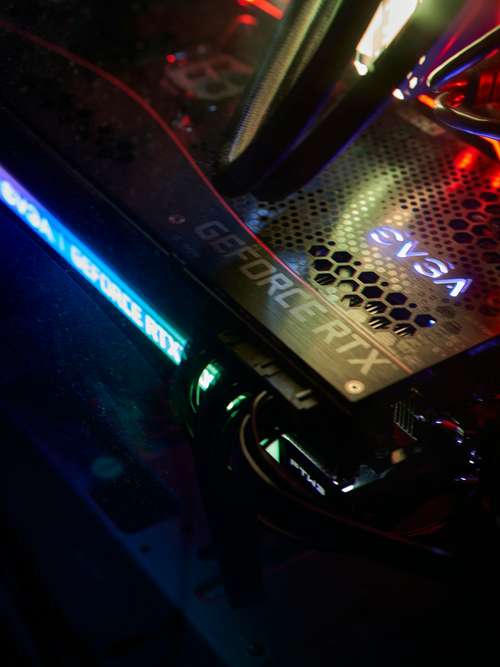
Cooling this beast requires a massive quad-slot cooler that makes the card look more like a cinder block than a component. Most mid-tower cases simply will not fit this GPU. If you are planning to upgrade, you likely need to budget for a new case and a platinum-rated power supply alongside the card itself.
Hyper-Tracing vs. Standard Ray Tracing
The new Hyper-Tracing cores are not just marketing fluff. In our testing of Alan Wake 2, the difference in lighting accuracy was palpable. Shadows are no longer just soft; they diffuse realistically based on the distance of the light source and the material of the object. The NVIDIA RTX 5090 Ti benchmarks show that enabling this feature costs only about 15% performance, compared to the 40% hit seen with traditional path tracing on previous generations.
Price and Availability: A Luxury or a Rip-Off?
The RTX 5090 Ti price and availability are the biggest hurdles. At $2,499, this card costs more than a complete high-end gaming PC did three years ago. NVIDIA is clearly positioning this as a "Titan-class" product for prosumers and the ultra-rich enthusiast. Stock is expected to be extremely limited at launch, with scalpers likely pushing street prices even higher.
Is it worth it? If you are gaming at 1440p or even standard 4K, absolutely not. The RTX 5080 or the older 4090 offer far better value. But for those chasing the 8K dream or needing massive VRAM for AI workflows, the RTX 5090 Ti stands alone at the summit. It is an engineering marvel with a terrifying price tag, marking the definitive moment where flagship gaming GPUs became true luxury items.