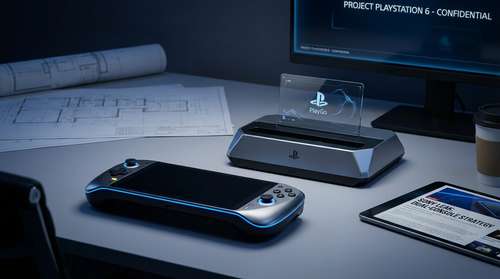
A monumental PlayStation 6 leak has just surfaced, giving gamers their most comprehensive look yet at Sony's hardware strategy for the upcoming generation. Over the past 48 hours, industry insiders have uncovered internal documents and developer kit updates that reveal an ambitious two-pronged approach. Rather than relying solely on a traditional home box, Sony is reportedly developing a unified hardware ecosystem featuring a high-powered, dedicated handheld companion device. Tying this cross-platform vision together is a revolutionary new delivery architecture dubbed 'PlayGo', which promises to fundamentally change how we download and optimize next-gen gaming console titles.
The 'PlayGo' Ecosystem: Sony's Answer to Smart Delivery
At the center of this recent PlayStation 6 leak is the newly discovered Sony PlayGo system. Uncovered deep within the recent PlayStation 5 SDK 13 update, this unified delivery framework acts as Sony's long-awaited, sophisticated equivalent to Xbox's Smart Delivery.
Currently, developers are forced to bundle massive, high-resolution textures meant for the PS5 Pro into every single game download. The PlayGo system changes this outdated paradigm entirely by allowing studios to segment game assets into modular, distinct chunks. Your hardware will only download the specific files required for the device you are actively using. This approach prevents unnecessary resource waste and solves the chronic storage space shortages that have plagued modern console gaming.
However, the most telling aspect of the PlayGo framework is a new developer preset called "Power Saver Mode". According to internal sources, this mode isn't just about saving electricity on home consoles. It operates as a strict compatibility layer designed as a "Trojan Horse" to help studios optimize their current software for the upcoming handheld. By restricting core usage and downscaling raw power profiles, developers can test how a game balances battery life and performance in a portable environment.
Leaked PS6 Handheld Specs: Unprecedented Portable Power
Speculation about a dedicated Sony portable has circulated since the Vita era, but the newly uncovered PS6 handheld specs paint a picture of a device that completely eclipses current market offerings. Codenamed 'Canis', the handheld will reportedly run on a custom AMD monolithic System-on-Chip (SoC).
Internal hardware targets point to an incredible amount of processing capability for a portable device:
- A custom Zen 6 CPU architecture featuring four main game cores and two low-power cores strictly reserved for background operating system tasks.
- An RDNA 5-based GPU clocked up to 1.65 GHz when operating in docked mode.
- A staggering 24GB of LPDDR5X RAM to seamlessly load massive open-world textures.
Hardware leakers emphasize that this portable PlayStation 6 hardware will actually outperform the current Xbox Series S in raw rasterization. Even more surprisingly, its ray tracing and path tracing capabilities are projected to be massively superior to Microsoft's entry-level console. Unlike the cloud-reliant PlayStation Portal, this new device is built to play AAA titles natively without requiring a constant internet connection.
Advanced AI Upscaling with PSSR 3
Pushing high-fidelity graphics on a battery-constrained device requires intelligent software, and Sony is leaning heavily into AI-driven upscaling to make the handheld viable. The leaks detail the implementation of PlayStation Spectral Super Resolution (PSSR) version 3.
This proprietary AI upscaler is said to outperform current market leaders, reportedly delivering better image quality than even NVIDIA's DLSS 4.5. By leveraging advanced machine learning, the handheld will render games natively at a much lower resolution to conserve battery life. When connected to an external display, PSSR 3 reconstructs the image to crisp, near-4K visual fidelity. This ensures the transition between home console graphics and portable performance is completely seamless.
What This Means for PS6 Release Date Rumors
When will players actually get their hands on this next-gen gaming console? While previous analysts speculated about an extended PS5 lifespan due to economic factors, these internal SDK changes suggest Sony is actively accelerating its timeline.
The active rollout of the PlayGo infrastructure to developers right now indicates that groundwork for the new generational cycle is already well underway. Current PS6 release date rumors point to a targeted launch window of late 2027 or early 2028. By quietly pushing the Power Saver Mode into developer toolkits today, Sony is giving major studios a multi-year head start to perfect their game engines for a synchronized, dual-console launch. Furthermore, insiders suggest this unified hardware approach has been designed from the ground up to be surprisingly cost-effective to produce, potentially keeping the consumer entry price lower than expected.
If these details prove entirely accurate, the landscape of Sony gaming news 2026 is shifting rapidly. Delivering a powerhouse home console alongside a dedicated handheld that plays the exact same library natively could redefine the broader gaming industry and force major competitors to rethink their own next-generation strategies.