The next era of console hardware might arrive sooner—and in a significantly different format—than the gaming industry anticipated. According to a massive wave of recent PlayStation 6 leaks, Sony Interactive Entertainment is pivoting away from its traditional single-box launch strategy. Instead, leaked internal AMD documents and reports from prominent hardware insiders suggest an ambitious multi-device lineup. This sweeping overhaul reportedly includes a premium flagship console, a budget-friendly home system, and a highly anticipated native PS6 handheld console. Coupled with massive internal upgrades and deep library integration, these next-gen gaming rumors are painting a picture of an interconnected Sony ecosystem rather than a standalone device.
A Three-Tiered Approach: The PlayStation 6 Lineup Explained
In a strategic shift that mirrors Microsoft’s current-generation approach but pushes the concept entirely further, Sony is reportedly preparing three distinct devices for the next generation. Industry insiders, including the prominent YouTube channel Moore's Law Is Dead, have detailed a hardware strategy designed to capture multiple price points and play styles simultaneously. This represents a fundamental departure from the singular console launches that defined the PS4 and PS5 eras.
At the top of the hierarchy sits the flagship console, currently codenamed "Orion." This premium machine represents the absolute peak of PS6 specs and features, aimed at enthusiast gamers who demand uncompromised fidelity and 4K performance. Below the Orion sits a rumored "Lite" model, frequently referred to as the "PS6 S." This system utilizes a slightly scaled-back chip to provide next-gen experiences at a more accessible entry point, perfectly suited for players who prioritize affordability over maximum resolution.
However, the most disruptive revelation from the recent leaks is the confirmation of a dedicated, native PS6 handheld console. Codenamed "Canis," this portable system is not a cloud-dependent streaming accessory like the existing PlayStation Portal. Instead, it features dedicated silicon designed to run demanding games locally. Rumored pricing estimates for this diverse lineup range dramatically, starting around $350 for the entry-level models and stretching up to a staggering $1,000 for the premium Orion configuration, an inflation largely driven by soaring global memory and manufacturing costs.
Powering the Future: AMD Zen 6 RDNA 5 and Advanced AI
Under the hood, Sony is continuing its highly successful, long-term partnership with AMD. The internal documents reveal that the flagship system will be driven by custom AMD Zen 6 RDNA 5 architectures. This cutting-edge silicon combination is expected to deliver unparalleled performance metrics, moving far beyond simple resolution bumps into entirely new rendering paradigms.
The leaks point to a massive leap in lighting fidelity, citing up to a 10-fold increase in ray tracing performance compared to the base PS5 hardware. This staggering hardware evolution means players will no longer have to choose between fluid frame rates and high-fidelity dynamic lighting. Additionally, Sony is heavily investing in machine learning hardware. AI upscaling capabilities—likely an advanced iteration of the PlayStation Spectral Super Resolution (PSSR 3.0)—will purportedly see a multiple-magnitude performance increase. This technology reconstructs complex visual data in real-time, dramatically enhancing image clarity without heavily straining the primary GPU.
The "Canis" Portable Specs
The handheld component is no slouch, either. The portable Canis chip reportedly features six CPU cores, partitioned perfectly for efficiency: four Zen 6c cores for gaming and two low-power cores dedicated to running the background operating system. Combined with 16 RDNA 5 compute units, this hardware aims to heavily outperform modern portable competitors like the ROG Ally X and the rumored Nintendo Switch successor, delivering robust graphical fidelity in a highly compact form factor.
Preserving Your Library: Sony Backwards Compatibility
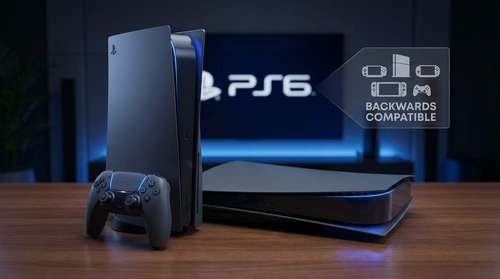
One of the most persistent concerns for players transitioning to new hardware is the fate of their existing, painstakingly built game libraries. Fortunately, the leaked AMD documents explicitly reference comprehensive Sony backwards compatibility.
The RDNA 5 architecture features dedicated backward compatibility support specifically engineered at the hardware level, ensuring that both the flagship home console and the native handheld can seamlessly run previous generations of games. This means your entire modern digital library—encompassing both PlayStation 4 and PlayStation 5 titles—will carry forward natively to the new ecosystem. By guaranteeing that older games run flawlessly on the Canis handheld, Sony is essentially launching the portable device with a massive, ready-to-play catalog on day one, avoiding the notorious software droughts that plague new console launches.
When is the Expected PlayStation 6 Release Date?
Despite the sudden influx of detailed hardware specifications, pinning down the exact PlayStation 6 release date remains a moving target. Historical console lifecycles, combined with initial supply chain whispers, originally pointed toward a late 2027 or early 2028 launch window.
However, the global technology landscape is currently facing severe DRAM shortages, heavily driven by the booming artificial intelligence sector aggressively consuming available memory resources. Several analysts and secondary leaks suggest these ongoing supply chain constraints could force Sony to push the full commercial rollout back to late 2028 or even 2029. Regardless of the final calendar date, Sony’s multi-device vision for the future is clear: they are building an interconnected, highly powerful ecosystem that completely blurs the lines between premium living room gaming and high-end portable play.