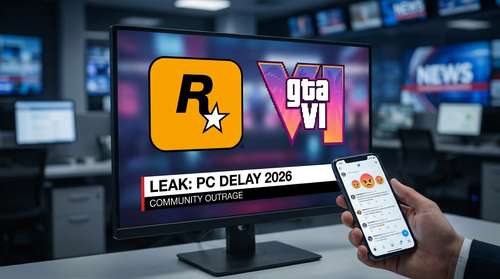
Over the past 48 hours, the gaming world has been reeling following the unprecedented Rockstar Games leak 2026. A massive data breach, executed by the cybercriminal syndicate ShinyHunters, has suddenly pulled back the curtain on the studio’s tightly guarded release strategy. While console players can eagerly circle their calendars for the highly anticipated GTA VI November 19 launch, internal documents indicate a much darker reality for desktop enthusiasts. Driven by staggering financial metrics rather than technical limitations, the elusive GTA VI PC release date might be pushed back much further than anyone initially anticipated.
The ShinyHunters Hack Rockstar: How the Breach Unfolded
For an industry accustomed to secrets, this recent breach was a shock to the system. In mid-April, the notorious extortion group known as ShinyHunters targeted Rockstar through a third-party cloud analytics provider, Anodot, accessing secure Snowflake database environments. After Rockstar executives understandably refused to negotiate a ransom demand by the April 14 deadline, the hackers unleashed over 8.1 gigabytes of internal business telemetry, anti-cheat frameworks, and financial data onto the dark web earlier this week.
A Controversial Corporate Response
Rockstar formally acknowledged the intrusion, stating that only a "limited amount of non-material company information" was exposed. While the studio quickly assured fans that individual player accounts and the core development pipeline remained strictly secure, the underlying business metrics exposed by the ShinyHunters hack Rockstar situation have ignited a firestorm of controversy. The curtain has been lifted, and the exposed numbers reveal a calculated strategy designed to maximize long-term profits at the expense of a massive segment of the player base.
Inside the GTA 6 Microtransaction Leak
The most damning revelation to emerge from the stolen analytics centers heavily on the Grand Theft Auto 6 PC delay. According to the leaked financial metrics, PC players historically spend significantly less on in-game purchases compared to their console counterparts. The GTA 6 microtransaction leak suggests that Take-Two Interactive and Rockstar are strategically stalling the PC port to maximize early online revenue on locked-down console ecosystems. Grand Theft Auto Online still generates upwards of $8 million per week, and executives are evidently desperate to protect their next golden goose from early exploitation.
The logic behind the corporate curtain is frustratingly transparent. Modding communities on PC frequently find creative workarounds to avoid paying for digital currency, essentially bypassing the lucrative microtransaction loops that publishers rely on. Furthermore, PC players are often more tech-savvy, utilizing third-party tools to unlock content that would otherwise require hundreds of hours of grinding or direct credit card payments. By keeping the initial launch exclusive to PlayStation 5 and Xbox Series X/S, the publisher guarantees a pristine, mod-free environment during the game’s most profitable window. The sheer volume of revenue expected from the new multiplayer iteration means that introducing PC vulnerabilities too early is viewed internally as an unacceptable financial risk.
GTA VI PC vs Console: A Multi-Year Waiting Game?
Historically, staggering game releases isn't a new playbook for Take-Two Interactive. Fans patiently waited over a year for both Grand Theft Auto V and Red Dead Redemption 2 to make the jump from televisions to computer monitors. However, the latest telemetry data hints at a much wider, more punitive gap. To meticulously protect the digital economy from external meddling, the multi-year delay is practically guaranteed. Leaked internal roadmaps cite three primary reasons for the strategy:
- Preventing revenue loss: Denying early access to mod tools that bypass digital currency purchases.
- Closed-loop ecosystems: Guaranteeing a heavily monetized, secure environment on PlayStation 5 and Xbox Series X/S.
- The Double-Dip: Enabling a massive secondary sales wave by forcing enthusiasts to buy the game twice.
The confirmed GTA VI November 19 launch is squarely focused on moving massive physical and digital volume on Sony and Microsoft platforms. Analyzing the GTA VI PC vs console dynamic highlights a stark reality: consoles offer a walled garden where developers maintain absolute, unchallenged control over the economy. In this scenario, impatient enthusiasts are practically forced to buy the title first on PlayStation 5, only to purchase it again years later to experience superior graphics, custom mods, and higher frame rates on their premium desktop rigs.
Community Backlash Over the Grand Theft Auto 6 PC Delay
Predictably, the gaming community is furious. Social media platforms and dedicated subreddits are currently overflowing with accusations of relentless corporate greed. Players feel deeply sidelined, arguing that punishing an entire platform to shield microtransaction profits is inherently anti-consumer. Compounding the anger are recent, unsettling reports suggesting that dozens of developers were allegedly let go after internally protesting the aggressive, casino-style real-money mechanics planned for the new online mode. This internal friction, paired with the public fallout from the hack, paints a picture of a company willing to sacrifice massive player goodwill for guaranteed quarterly earnings.
This unprecedented breach has completely transformed what should be a celebratory march toward a historic release into a bitter, exhausting debate about modern gaming economics. While the legendary studio continues to polish its next genre-defining blockbuster, the damage to its relationship with desktop players is undeniable. Until an official announcement directly addresses the timeline, fans are left deciphering stolen business spreadsheets rather than admiring gameplay trailers. If these leaked internal documents hold true, the ultimate crime committed in Vice City might just be the unbearable wait time.