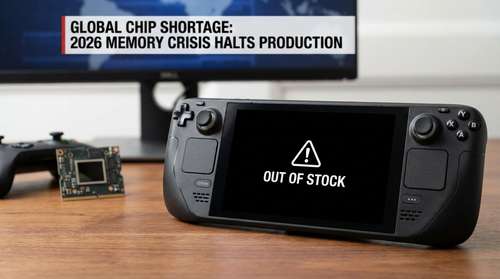
Valve's Steam Deck lineup has officially gone out of stock across major global markets, leaving gamers in North America and Asia unable to purchase the popular handheld PC. As of mid-February 2026, the shortage has hit critical levels, with industry insiders pointing to a deepening global memory crisis driven by the insatiable demand for AI hardware. As inventory dries up at Valve and its Asian partner Komodo, fears are mounting that this production halt could signal not just delays, but significant price hikes for the OLED models and a pushed-back timeline for the highly anticipated Steam Deck 2.
Steam Deck Out of Stock: A Global Hardware Freeze
For the first time since its initial launch window, the Steam Deck is facing a near-total availability blackout in key regions. Prospective buyers visiting the Steam store in the United States and Canada are met with greyed-out "Out of Stock" buttons for both the 512GB and 1TB OLED models. The entry-level LCD model, which Valve began phasing out late last year, remains permanently unavailable.
The situation is equally grim in Asia. Komodo, Valve's official distribution partner for Japan, Hong Kong, South Korea, and Taiwan, has listed all SKUs as unavailable. While a brief notification on the Komodo storefront suggests stock might return later in February, no specific dates have been promised. This synchronized global outage suggests a supply chain failure far more severe than a simple post-holiday demand spike.
The 2026 Memory Crisis: Why AI is Hurting Handheld Gaming
The culprit behind this sudden shortage appears to be the widespread 2026 gaming memory crisis. The explosive growth of artificial intelligence data centers has monopolized the global supply of LPDDR5 RAM and high-speed NAND flash storage—critical components for the Steam Deck.
Valve has indirectly acknowledged these supply chain struggles. In a recent update regarding their delayed "Steam Machine" console refresh, the company cited "unforeseen and exponential increases in component pricing" and "memory and storage shortages." It is now clear these same issues have cascaded down to the Steam Deck production lines. With major tech giants outbidding consumer electronics manufacturers for memory chips to power AI training clusters, handheld gaming devices are becoming collateral damage.
Steam Deck OLED Price Increase Rumors
With supply constrained and component costs skyrocketing, industry analysts are warning that the era of the $549 Steam Deck OLED may be coming to an end. Manufacturing experts estimate that the cost of RAM and SSD modules has nearly doubled since late 2025. If Valve cannot secure these parts at legacy prices, they face a difficult choice: absorb the massive loss or pass the cost to the consumer.
"We are seeing a market correction where hardware makers can no longer subsidize devices at the same aggressive rates," notes one hardware supply chain analyst. "If the Steam Deck returns to stock in March, do not be surprised if we see a quiet price adjustment, or perhaps a new 'refresh' model that justifies a higher MSRP."
Steam Deck 2 Release Date Rumors: Delayed Until 2027?
The ongoing hardware crunch has poured cold water on hopes for an imminent Steam Deck 2 release. While early rumors hinted at a late 2026 reveal, the current component landscape makes that timeline increasingly unlikely. Valve has historically stated they would only release a successor when there is a "generational leap" in performance without sacrificing battery life.
Current reports suggest that Valve may push the Steam Deck 2 into 2027 or even 2028 to wait out the memory crisis and allow for next-generation APU technology to mature. The priority right now appears to be stabilizing the supply chain for the existing OLED models rather than fracturing production lines for a new device that would struggle with the same component shortages.
What Can Gamers Do Now?
For those desperate to get their hands on a handheld, the options are limited. The used market has already reacted, with scalper prices on eBay jumping 20-30% in the last 48 hours. If you are in a region where stock is still flickering—like parts of Europe—purchasing immediately is recommended. For everyone else, the best bet is to add the item to your Steam wishlist and watch the Valve Komodo stock update channels closely for any surprise drops.