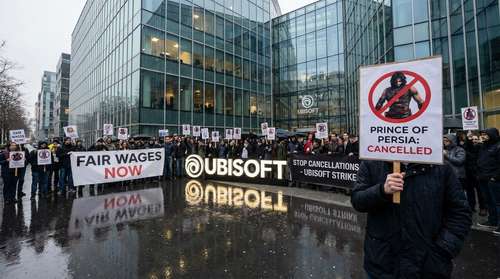
Ubisoft is facing one of the most turbulent weeks in its history after announcing a drastic "major reset" that has sent shockwaves through the gaming industry. The French publisher confirmed the cancellation of six upcoming titles—including the long-awaited Prince of Persia remake cancelled officially—and a delay for seven other projects. The restructuring news caused Ubisoft's stock to plummet 33%, erasing millions in value overnight. Compounding the crisis, unions representing employees across France have called for a massive strike in response to a new strict return-to-office (RTO) mandate and the company's deepening Ubisoft financial crisis. As of January 29, 2026, the situation remains volatile with the Ubisoft strike 2026 set to paralyze studios next month.
The "Major Reset": Prince of Persia Remake Cancelled and 6 Games Scrapped
In a move described by CEO Yves Guillemot as necessary to "reclaim creative leadership," Ubisoft has permanently halted development on six titles. The most high-profile casualty is the Prince of Persia: The Sands of Time Remake. Originally announced in 2020 and subject to multiple delays and studio changes, the project has now been scrapped entirely. According to internal memos, the cancelled titles did not meet the company's "new enhanced quality" benchmarks.
Alongside the Ubisoft game cancellations, the publisher is closing two studios: Ubisoft Stockholm and Ubisoft Halifax. The focus is shifting aggressively toward open-world adventures and "GaaS-native" (Games as a Service) experiences, leaving fans of the publisher's linear narrative games disappointed. The cancellation of the Prince of Persia remake marks the end of a troubled development cycle that spanned over five years, signaling a ruthless approach to cost-cutting under the new strategy.
Ubisoft Restructuring News: 5 Creative Houses and Financial Turmoil
The Ubisoft restructuring news reveals a complete overhaul of the company's internal operations. The publisher is reorganizing into five distinct "Creative Houses," each with its own leadership and financial accountability. This pivot aims to save €200 million over the next two years but comes at a steep price. Following the announcement, Ubisoft shares suffered their worst day on record, dropping 33% as the company warned investors of an expected €1 billion operating loss for the fiscal year.
"We are transforming Ubisoft's operating model," Guillemot stated, emphasizing a new reliance on player-facing Generative AI and established franchises. However, industry analysts warn that this "reset" might destabilize the company further before any benefits are realized. The reorganization also includes a controversial push for a full-time, five-day in-office work week, overturning previous hybrid work agreements.
Assassin's Creed Black Flag Remake Delay
While cancellations grabbed headlines, the "reset" also pushed back the release windows for seven other titles. Among the delayed projects is an unannounced title widely understood to be the Assassin's Creed Black Flag remake delay. Originally targeted for the current fiscal year, this highly anticipated return to the Golden Age of Piracy has been pushed to fiscal year 2027. This delay suggests that even Ubisoft's flagship franchise is not immune to the operational chaos, as the company scrambles to polish its remaining pipeline to avoid further critical flops.
Ubisoft France Strike: Unions Declare "Massive International Strike"
The operational changes have triggered an immediate and furious response from the workforce. A coalition of five French unions, including STJV and Solidaires Informatique, has announced a Ubisoft France strike scheduled for February 10, 11, and 12, 2026. This three-day walkout (often referred to as a four-day disruption due to adjacent half-day protests) aims to paralyze production to protest the "arbitrary" return-to-office policy and the lack of employee consultation regarding the restructuring.
"We will not be bullied into submission," the unions declared in a joint statement released yesterday. Employees are demanding the reinstatement of remote work agreements and meaningful dialogue regarding the studio closures. With the Ubisoft strike 2026 gaining international support, the publisher faces a dual crisis: a loss of investor confidence and an open revolt from the talent required to build its future games.