
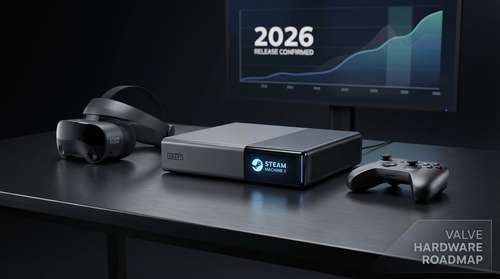
Following a frantic week of speculation within the gaming community, Valve has officially reaffirmed that its highly anticipated Valve Steam Machine 2, alongside the mysterious 'Steam Frame' VR headset, remains fully on track for a 2026 release. This confirmation arrives directly after a briefly published—and rapidly amended—blog post sparked widespread fears that severe global memory shortages might push the company's ambitious hardware slate into next year.
For PC gaming enthusiasts closely following Steam gaming news 2026, the temporary confusion was palpable. However, Valve has now clarified its stance, reassuring fans that its next-generation hardware ecosystem is moving forward. Here is everything you need to know about the updated launch window, the component crisis, and what to expect from Valve's upcoming devices.
Valve's Quick Pivot on the Hardware Roadmap
The rumor mill went into overdrive in early March when Valve published its "Steam Year in Review 2025" update. In the initial draft, the company stated that it "hoped to ship in 2026" but noted that memory and storage shortages had created significant hurdles. Gamers and media outlets immediately interpreted this hesitant language as a soft delay for the entire Valve hardware roadmap.
Just days later, Valve scrubbed the pessimistic phrasing from the blog post. The updated statement now definitively reads, "we will be shipping all three products this year". While the company has yet to lock down an exact month, a spokesperson clarified to tech journalists that the 2026 window is secure. The hesitation simply stemmed from the challenge of finalizing concrete pricing and launch dates in an incredibly volatile component market.
The "RAMpocalypse" and AI's Market Impact
The core reason behind Valve's initial hesitation is a phenomenon the tech community has dubbed the Valve RAMpocalypse. Driven by the tech industry's insatiable pursuit of artificial intelligence, major AI companies have been rapidly buying up global supplies of RAM and solid-state storage. This unprecedented demand has resulted in skyrocketing prices for DDR5 memory, GDDR6 VRAM, and NVMe SSDs.
Because the next-gen Steam Machine is designed to be an accessible, budget-friendly console alternative—rumored by tech analysts to target a $700 price point—these component hikes heavily squeeze Valve's profit margins. Rather than passing exorbitant costs onto the consumer, Valve has opted to wait for the supply chain to stabilize before announcing official retail prices.
What to Expect from the Next-Gen Steam Machine
When the dust settles on the supply chain woes, gamers are in for a serious hardware treat. The Valve Steam Machine 2 is shaping up to be a powerhouse living-room PC. Unlike the fragmented attempts of the past decade, this new iteration is a streamlined, 6-inch console-like cube running on a highly optimized version of SteamOS.
Under the hood, the device reportedly features a custom six-core AMD Zen 4 processor paired with RDNA3 graphics. Armed with 16GB of DDR5 RAM and 8GB of dedicated GDDR6 VRAM, Valve claims the system will be capable of delivering 4K gaming at 60 FPS utilizing AMD's FidelityFX Super Resolution (FSR) upscaling technology. It is a massive leap forward that promises to bridge the gap between traditional console convenience and high-end PC modularity.
Steam Controller 2 2026 Innovations
You cannot launch a living-room console without a proper input device, and the Steam Controller 2 2026 edition aims to right the wrongs of its predecessor. Moving away from the polarizing dual-trackpad-only design of the 2015 original, the new gamepad heavily borrows from the ergonomic success of the Steam Deck.
Players can expect two full-size, drift-resistant magnetic thumbsticks (TMR), dual capacitive trackpads for precision mouse input, adaptive triggers, and four assignable back grip buttons. Furthermore, the controller features a dedicated wireless "puck" that simultaneously acts as a low-latency transmitter and a convenient charging dock. Valve is ensuring that whether you play strategy games or fast-paced shooters, the transition to the couch feels seamless.
The Steam Frame Release Date and VR's Next Step
Rounding out the trio of new devices is Valve's highly anticipated standalone virtual reality headset. While exact pricing remains unconfirmed, the Steam Frame release date will coincide with the console and controller rollouts later this year. Designed as a lighter, more affordable alternative to the ultra-premium Valve Index, the Steam Frame directly targets the mainstream standalone VR market currently dominated by competitors like Meta.
Powered by a robust Snapdragon 8 Gen 3 chipset, the headset offers both tethered PC VR experiences and untethered standalone gameplay via SteamOS. It boasts crisp LCD screens pushing a 2160 x 2160 resolution per eye, custom pancake lenses offering a 110-degree field of view, and a buttery-smooth 144Hz refresh rate. Because the standalone headset relies on slightly different mobile components, its production timeline is less threatened by the desktop memory shortages.
Why This Ecosystem Matters for PC Gaming
The interconnected nature of this new ecosystem is what makes Valve's 2026 hardware push so compelling. The Steam Controller 2 is fully cross-compatible with the Steam Deck, standard PCs, and the Steam Machine. Simultaneously, the Steam Frame can wirelessly stream robust VR titles directly from the new living-room console, bypassing the need for a bulky desktop tower.
Despite the turbulent economic landscape and the ongoing hardware shortages, Valve's commitment to modernizing the PC gaming space remains unwavering. While specific launch days and price tags are still being kept under wraps, the confirmation that these devices will arrive before the end of the year ensures that the future of Steam hardware is brighter—and closer—than ever.