The review embargo has officially lifted, and the highly anticipated Steam Machine review coverage from major tech publications is finally sweeping the internet. Released in late June 2026, Valve’s ambitious return to the living room computing market has sparked fierce debate among gamers, hardware enthusiasts, and industry analysts. Affectionately dubbed the "GabeCube" by the community for its compact, nostalgic form factor, the system delivers an incredibly slick SteamOS experience alongside whisper-quiet acoustics. However, severe global supply chain constraints have severely impacted the launch, forcing Valve to stick the mini-PC with a shocking $1,049 base price. For that extreme premium, early technical testing reveals a harsh reality: the hardware struggles to consistently outpace Sony's standard PlayStation 5.
The 'GabeCube' Design and a Flawless SteamOS Experience
If there is one aspect where every hardware critic agrees, it is that Valve’s engineering and design teams have delivered an absolute aesthetic masterpiece. Standing in stark contrast to the towering obelisks of current-generation consoles, the device looks like a taller, modernized Nintendo GameCube. Despite the small footprint, it operates with virtually no noise, remaining whisper-quiet even under the heaviest gaming workloads.
Reviewers at outlets like Rock Paper Shotgun and PC Gamer were particularly enamored with the premium customization options. The chassis utilizes a clever magnetic system that allows users to easily swap faceplates, with Valve offering luxurious materials like solid walnut and red fabric directly at launch. Third-party manufacturers are already preparing custom variants, ensuring the console can match any living room decor.
Beyond the physical hardware, the software integration is drawing universal praise. The latest iterations of SteamOS bring the seamless, controller-friendly navigation of the Steam Deck directly to your television screen. Setup takes mere minutes, utilizing straightforward pictograms to guide users through audio configuration and controller synchronization. As a dedicated SteamOS mini PC review experience, the system proves that Linux gaming has finally matured enough to natively rival closed console ecosystems without the hassle of traditional Windows desktop environments.
The RAMpocalypse: Decoding the Steam Machine Price 2026
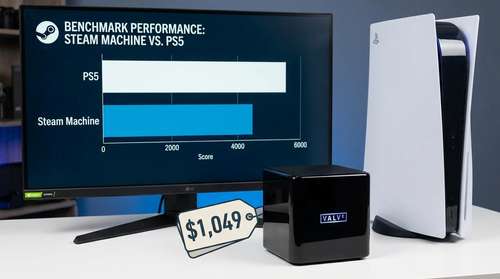
The glowing praise for Valve's engineering abruptly ends when the conversation shifts to cost. The official Steam Machine price 2026 stands at a staggering $1,049 for the entry-level 512GB model. If you want the flagship 2TB version bundled with the newly redesigned Steam Controller, the price skyrockets to an eye-watering $1,428. For context, initial community predictions last November placed the base model at a highly competitive $525.
So, what exactly went wrong between the initial concept and the June 2026 launch? The technology manufacturing sector is currently enduring what analysts have dubbed the "RAMpocalypse". Unprecedented hardware demand from AI data centers has completely swallowed global manufacturing capacity for both DRAM and NAND memory, causing consumer electronics components to balloon in price. Unlike Sony or Microsoft, Valve outright refuses to subsidize the hardware at a massive loss. Because the Steam Machine remains an unlocked, open PC platform where users are free to install alternative software, Valve cannot guarantee software royalty returns. Unfortunately, the consumer is left footing the bill for this hardware reality.
Valve Steam Machine Benchmarks: Falling Short of Expectations
When PC gamers spend over a thousand dollars on a new rig, they expect bleeding-edge graphical fidelity. Sadly, the leaked and official Valve Steam Machine benchmarks tell a disappointing story. Under the hood, the "Valve Fremont" system is powered by a six-core AMD Zen 4 processor and an RDNA 3 graphics unit (roughly equivalent to a desktop Radeon RX 7600) paired with 8GB of VRAM. While this setup is certainly capable, it feels distinctly outdated for a premium device launching this summer.
Steam Machine vs PS5 Performance
The most damning comparisons come from the Digital Foundry Steam Machine technical analysis and community testing. When evaluating the Steam Machine vs PS5 performance at matched visual settings, Valve’s new hardware frequently falls short of the current console standard. Recent Geekbench scores show the Linux system hovering around 2,334 for single-core and 7,316 for multi-core performance. These metrics look incredibly unimpressive when placed next to modern laptops and dedicated desktop rigs.
While racing titles like Forza Horizon 6 run adequately using AMD's FSR upscaling to output 4K at 60 frames per second, native rendering and heavy ray tracing workloads push the limited 8GB of VRAM to its absolute breaking point. Technical analysts and broader communities on Reddit have pointed out that paying double the cost of a PS5 for hardware that occasionally dips below standard console frame rates is a terribly difficult proposition to justify.
Final Verdict: A Luxury PC for the Living Room
Ultimately, the 2026 iteration of the Steam Machine is an iconoclastic device born into a uniquely unforgiving hardware market. It succeeds brilliantly in its primary mission: providing a frictionless, beautifully designed bridge between your sprawling Steam library and the living room television. The Valve GabeCube console PC is easily the most premium couch computing experience currently available, completely devoid of the required multiplayer subscription fees and locked ecosystems of traditional consoles.
However, the value proposition is severely skewed by external market forces. Unless you are a dedicated Linux advocate or an enthusiast with deep pockets looking for the ultimate plug-and-play aesthetic, the entry fee is simply too steep. You could easily build a more powerful standard desktop PC, or purchase both a PS5 and a Nintendo Switch, for less than the cost of the base model. Until the global memory supply stabilizes and components become affordable again, Valve's stunning mini-PC will likely remain a highly coveted, yet prohibitively expensive, luxury item.