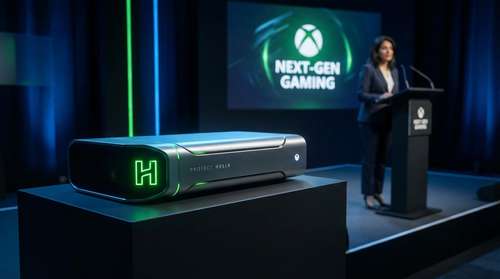
In a watershed moment for the gaming industry, Microsoft has officially unveiled 'Project Helix', its highly anticipated next-generation console designed to shatter the barrier between console and PC gaming. The announcement, delivered on Thursday by Microsoft Gaming's new CEO Asha Sharma, confirms long-standing rumors that the tech giant is building a high-performance machine capable of running native PC titles alongside traditional Xbox games. With promises to "lead in performance," Project Helix represents a bold new direction for the Xbox brand following a turbulent 2025.
The 'Project Helix' Reveal: A New Era for Xbox
Breaking her silence just weeks after taking the helm, Asha Sharma took to X (formerly Twitter) to confirm the existence of the device, sharing a teaser image of the Project Helix logo. "Great start to the morning with Team Xbox, where we talked about our commitment to the return of Xbox including Project Helix, the code name for our next generation console," Sharma wrote. Her statement directly addressed the core feature that has dominated leaks for months: the console's ability to play PC games natively.
"Project Helix will lead in performance and play your Xbox and PC games," Sharma affirmed. This confirmation marks a strategic pivot for Microsoft, effectively positioning the Project Helix PC game compatibility as its killer app. By unifying the fragmented PC and console markets, Microsoft aims to offer a living-room device that provides the simplicity of a console with the vast library and flexibility of a high-end gaming rig. Industry analysts suggest this hybrid approach could be the "return to form" the brand desperately needs.
Next-Gen Specs: Inside the Beast
While official specifications are slated for a deeper dive at the upcoming Game Developers Conference (GDC), leaks regarding the Xbox Series X successor specs paint a picture of a monster machine. Reports from reliable hardware insiders indicate that Project Helix will be powered by a massive semi-custom AMD System-on-Chip (SoC) codenamed "Magnus." This chip is rumored to feature a die size of 408mm², making it significantly larger and more powerful than the silicon found in the PlayStation 5 or Xbox Series X.
The device is expected to utilize AMD's next-generation Zen 6 architecture for its CPU and RDNA 5 for graphics, targeting native 4K resolution at 120 frames per second. Early benchmarks cited in leaks suggest Project Helix could offer a 25% performance lead over Sony's rumored PlayStation 6. Unlike previous generations that focused on proprietary ecosystems, Project Helix's architecture appears specifically engineered to handle Windows-based gaming environments efficiently, potentially allowing users to access storefronts like Steam and the Epic Games Store directly from the dashboard.
The $1,000 Price Tag Rumor
Unmatched power, however, comes at a premium. The most contentious topic surrounding the reveal is the swirling Project Helix price rumors. Due to the sheer size of the "Magnus" chip and the inclusion of cutting-edge components, analysts predict the console could debut with a price tag exceeding $1,000. This would position Project Helix not as a mass-market toy, but as an enthusiast-grade device—essentially a pre-built, high-end PC optimized for the living room.
This premium pricing strategy risks alienating casual gamers but aligns with the hardware's "super-console" positioning. If Microsoft can deliver a device that outperforms a $2,000 gaming PC for half the price, the value proposition remains strong. "It's a risky move," notes one industry insider, "but if it truly runs your entire Steam library out of the box, a $1,000 price point might be justified for core gamers tired of upgrading GPUs."
Future of Xbox Hardware and Release Window
The future of Xbox hardware hangs in the balance with this release. After yielding significant market share to Sony in the previous generation, Microsoft is betting on raw power and open compatibility to regain its footing. AMD CEO Lisa Su recently hinted that development is on track for a 2027 launch, giving Microsoft ample time to refine the software experience—a critical factor in making a PC-hybrid console feel seamless.
As we look toward Microsoft gaming news 2026, all eyes are now on next week's GDC presentation. Gamers are eager to see if Project Helix can truly deliver on its promise of unification. If successful, it won't just be a new Xbox; it could be the last traditional console you ever need to buy.