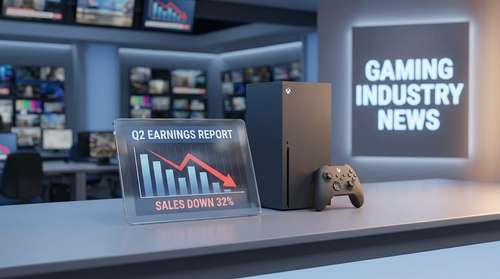
The future of Microsoft's gaming division faces its most significant test yet as the company's latest financial disclosure reveals a dramatic downturn in its traditional business model. Microsoft's Q2 earnings report, released earlier this week, confirmed that Xbox hardware sales 2026 have plummeted by a staggering 32% year-over-year. This sharp decline coincides with a troubling new metric from the GDC 2026 State of the Industry report, suggesting a growing exodus of developer support for the platform.
Xbox Hardware Revenue Drops 32% in Q2 Earnings
Microsoft's fiscal Q2 2026 results paint a stark picture of the current console landscape. While the tech giant reported healthy growth in its AI and cloud sectors, the gaming division struggled. Total gaming revenue fell 9% to $5.99 billion, dragged down significantly by the 32% collapse in hardware revenue. This marks the second consecutive quarter of double-digit declines for the Xbox Series X and S, signaling that the current console generation may have peaked prematurely.
Perhaps more alarming for investors is the stagnation in software services. Xbox content and services revenue—typically the company's safety net—dipped by 5%. Microsoft CFO Amy Hood cited difficult comparisons to the previous year's blockbuster launch of Call of Duty: Black Ops 6, noting that late 2025 releases like The Outer Worlds 2 and Black Ops 7 failed to sustain the same momentum. For industry analysts following gaming industry financial news, these numbers suggest that the "content is king" strategy is facing diminishing returns.
GDC 2026 State of the Industry: Developers Drift Away
As financial numbers trend downward, a perhaps more existential threat has emerged from the creative side of the industry. The GDC 2026 State of the Industry report, published just days ago, reveals a startling shift in developer priorities. According to the survey of over 2,300 industry professionals, only 20% of developers expressed interest in creating games for Xbox Series X/S.
In stark contrast, the PlayStation 5 and the newly launched Nintendo Switch 2 both commanded nearly 40% developer interest, while the PC remains the undisputed king with 80%. This widening gap raises serious questions about the future of Xbox consoles. If creators are deprioritizing the platform, the content pipeline for 2027 and beyond could thin significantly, creating a negative feedback loop that further depresses hardware sales.
The Multi-Platform Shift
The GDC data underscores a broader industry trend: the death of exclusivity. With Microsoft pushing its "This is an Xbox" campaign—which brands everything from smart TVs to handhelds as entry points—developers are increasingly treating the Xbox console hardware as just one of many endpoints rather than a primary target. While this aligns with Microsoft's long-term goals, it appears to be cannibalizing their dedicated hardware sales faster than anticipated.
Xbox Game Pass and the Cloud Strategy
The Xbox cloud gaming strategy was supposed to offset hardware declines, but the transition is proving turbulent. The reported 5% dip in content and services revenue indicates that Xbox Game Pass subscriber growth may have hit a saturation point, particularly following the price hikes implemented in late 2025. While paid streaming hours reached record highs, the revenue per user isn't climbing fast enough to fill the hole left by plummeting console sales.
Satya Nadella, Microsoft's CEO, attempted to reassure investors by highlighting the ecosystem's reach. "We are committed to delivering great games across Xbox, PC, cloud, and every other device," Nadella stated during the earnings call. However, with mobile devices (Android/iOS) now nipping at the heels of Xbox in developer interest (16% vs 20%), the company's struggle to dominate the mobile space remains a critical weakness.
What is the Future of Xbox Consoles?
Is the dedicated home console dead for Microsoft? Not quite, but its role is diminishing. Rumors of a new handheld device—potentially a successor to the Series S architecture—continue to swirl, bolstered by the company's partnerships with hardware manufacturers like ASUS. Yet, the Microsoft Q2 earnings report makes one thing clear: the era of measuring success by box sales is over.
As we move further into 2026, the industry is watching closely. Microsoft must now prove that its service-first, hardware-agnostic gamble can remain profitable without the traditional anchor of a thriving console install base. If developer interest continues to slide, the "Xbox" of the future might exist solely as an app on your TV, rather than a box under it.