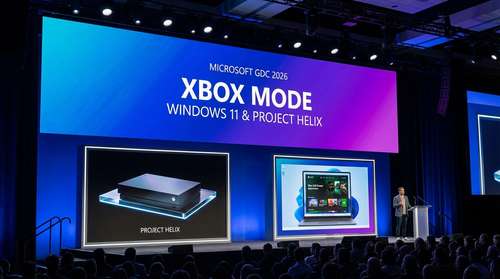
At the 2026 Game Developers Conference (GDC), Microsoft fundamentally redefined the intersection of PC and console gaming. Leading the wave of major GDC 2026 Microsoft news is the official announcement of a dedicated Xbox Mode Windows 11 update, set to transform traditional desktop rigs and portable devices into controller-optimized gaming machines. In tandem, Xbox leadership pulled back the curtain on the future of Xbox hardware, confirming the ambitious scope of "Project Helix." This next-generation hybrid console, being developed in deep collaboration with AMD, is designed to natively run both PC and Xbox titles, effectively breaking down the historical walled gardens of the gaming industry,.
Windows 11 Transforms with Xbox Mode
Starting this April, the long-awaited Xbox Mode will begin its global rollout across all Windows 11 form factors, including laptops, desktops, and tablets,. Conceived as a robust evolution of the existing Xbox Full Screen Experience, this update provides a distraction-free, controller-first interface that eliminates traditional desktop friction. Whether you are playing on a high-end custom build or seeking the ultimate Xbox handheld PC interface for a portable device, the operating system now adapts instantly to your preferred input method.
Players can launch their libraries, navigate storefronts, and interact with the Xbox Game Bar using only a gamepad. Crucially, Microsoft is not locking users into a restricted environment. The feature allows a seamless toggle between the curated console-style dashboard and the standard open Windows desktop. This dual-nature approach specifically addresses the booming handheld market, where navigating a standard desktop OS with thumbsticks has historically been a significant pain point. Furthermore, running this dedicated environment frees up vital system resources on constrained devices, dedicating more memory and processing power directly to the active game.
Project Helix: The Future of Xbox Hardware
While the April software update dominated immediate headlines, the most compelling long-term reveal was undoubtedly the Project Helix next-gen Xbox. As Xbox celebrates its 25th anniversary this year, Jason Ronald, Vice President of Next Generation at Xbox, detailed a bold vision for the brand's trajectory. Project Helix is envisioned as an all-in-one hardware powerhouse engineered from the ground up to play your existing Xbox console library alongside standard PC games,.
Under the hood, this upcoming platform is driven by a custom system-on-chip (SoC) designed through a multi-year partnership with AMD. Rather than merely boosting clock speeds, the engineering team is overhauling the underlying architectural pipeline. Microsoft confirmed that alpha development kits for the new hardware will begin shipping to partner studios in 2027, laying the groundwork for a massive generational leap,. Early technical briefings suggest this unified approach could disrupt the traditional hardware market by offering the plug-and-play simplicity of a console with the expansive library and flexibility of a high-end PC.
AMD FSR Next Technology and Ray Tracing Leaps
To achieve its ambitious visual milestones, Project Helix relies heavily on advanced machine learning integration. The custom SoC is codesigned to natively support AMD FSR Next technology, a forward-looking rendering suite that incorporates machine-learning-based upscaling, ML-powered multi-frame generation, and next-generation ray regeneration specifically optimized for path-traced titles,. According to Microsoft, these innovations will deliver an order-of-magnitude increase in ray tracing performance compared to current hardware.
Microsoft also introduced game-changing memory management tools to complement the raw graphical power. Advanced features like Neural Texture Compression and DirectStorage 1.4 paired with Zstandard (Zstd) compression mean drastically improved memory efficiency and reduced game footprints,. Additionally, the hardware will utilize "GPU-directed Work Graph Execution," an innovation allowing the graphics processor to manage its own complex rendering tasks dynamically without stalling for CPU instructions,.
Bridging the PC and Console Divide
The overarching theme of Microsoft's GDC 2026 presentation was unified development. To support both the impending Windows OS updates and the upcoming Project Helix launch, the company is refining its developer toolkits so studios can package and distribute games efficiently across all Microsoft platforms. New features like Advanced Shader Delivery (ASD) are entering third-party trials this May. This technology mitigates frustrating PC compilation stutter by allowing developers to pre-package and distribute compiled shader databases directly through the Xbox storefront, bypassing slow first-run compilations entirely,.
By bringing a native console interface to Windows 11 this April and architecting a future console that speaks the exact same language as PC hardware, Microsoft is aggressively positioning itself to dominate the next decade of interactive entertainment,. Gamers can expect an era of unprecedented flexibility, where the choice between PC and console becomes a simple matter of form factor, budget, and lifestyle rather than restrictive software boundaries.