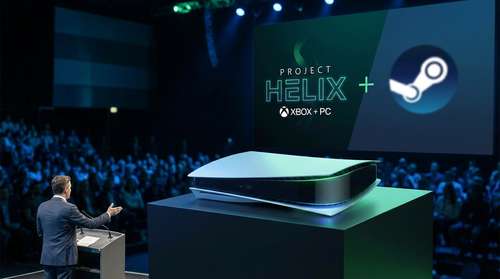
The wait for definitive next-gen Xbox news 2026 is officially over. Following weeks of intense speculation, Microsoft took the stage at this week's Game Developers Conference (GDC) to pull back the curtain on its highly anticipated next-generation hardware. Codenamed "Project Helix," this ambitious new platform promises to demolish the traditional walls between console ecosystems and PC gaming. Confirming a massive wave of recent Microsoft gaming hardware leaks, the tech giant revealed that its upcoming flagship device will operate as a true living-room PC, granting players native access to third-party storefronts like the Epic Games Store and seamlessly integrating Steam on Xbox console hardware for the first time.
According to recently appointed Microsoft Gaming CEO Asha Sharma, this hybrid machine is designed to "lead in performance" while playing both traditional Xbox titles and your expansive PC library. This announcement comes as the industry grapples with skyrocketing development costs and stagnant hardware sales, positioning Helix as a necessary evolution rather than a simple generational step forward. By converging the flexibility of Windows with a streamlined living room experience, Microsoft is fundamentally altering what it means to own a home console.
What is Xbox Project Helix? A True Hybrid Ecosystem
At the core of the March 16 GDC presentation was Microsoft's new unified development paradigm. Rather than forcing developers to choose between optimizing for PC or console, the new architecture aligns the two platforms perfectly. Xbox Project Helix isn't just a gaming box; it is essentially a high-end gaming PC running a dedicated, controller-friendly interface known as "Xbox Mode".
This open-ecosystem approach marks a radical departure from the closed-garden strategy of decades past. Epic Games Store VP Steve Allison has already confirmed active discussions with Microsoft, teasing a "day one" native launch for the Epic launcher on the upcoming hardware. This means gamers won't be locked into purchasing digital titles exclusively through the Microsoft Store. By effectively running a customized compatibility layer over a Windows core, players will have instant access to their existing PC catalogs without having to rebuy a single game.
Next-Generation Console Specs: Powering the Future
If you want to understand how Microsoft plans to deliver on these lofty promises, you have to look under the hood. The next-generation console specs detailed at GDC are nothing short of staggering. Developed in tandem with AMD, the custom System on Chip (SoC)—reportedly codenamed "Magnus"—is built to deliver an unprecedented leap in visual fidelity.
RDNA 5, Zen 6, and FSR Diamond
Hardware insiders note the system will utilize a blend of three high-performance Zen 6 CPU cores paired with eight dense Zen 6c cores, alongside a massive 68 Compute Unit GPU based on AMD's upcoming RDNA 5 architecture. This setup reportedly supports up to 48GB of GDDR7 memory. More crucially, Microsoft is integrating a dedicated Neural Processing Unit (NPU) capable of 110 TOPS of AI performance. This hardware muscle is explicitly designed to power "FSR Diamond," a brand-new machine learning upscaler that promises multi-frame generation and real-time path tracing denoising, pushing in-game lighting to photorealistic levels previously reserved for ultra-premium desktop rigs.
During the GDC panel, AMD's Jack Huynh highlighted how the DirectX team and AMD engineers built the architecture from the ground up to reduce CPU bottlenecks. With the new "work graph" model, the GPU operates with far greater autonomy, freeing up system resources for complex physics simulations and smarter non-player character AI.
Project Helix Release Date and Premium Pricing
When can you get your hands on this hardware? According to the latest credible leaks from hardware insider KeplerL2 this week, the target Project Helix release date is currently slated for Holiday 2027. Alpha developer kits are reportedly shipping out later this year, giving studios ample time to optimize their titles for the new DirectX API.
However, this bleeding-edge technology will not come cheap. Because Project Helix effectively houses the equivalent of an AMD 9070 XT graphics card and massive pools of RAM, industry analysts like Moore's Law is Dead suggest the console could retail anywhere between $999 and $1,200. The pricing strategy marks a massive pivot. Traditionally, console manufacturers sell hardware at a loss and recoup costs through digital store fees. However, by opening the platform to third-party stores like Steam, Microsoft sacrifices its monopoly on software revenue. For hardcore PC enthusiasts looking for a compact, hassle-free living room setup, a $1,000 Project Helix might still represent a bargain compared to building a comparable desktop rig from scratch.
Xbox vs PlayStation 6: The Ultimate Hardware Showdown
The impending launch of Project Helix sets the stage for a fascinating philosophical battle in the Xbox vs PlayStation 6 rivalry. Sony is widely expected to stick to its highly successful, traditional console model—delivering bespoke, closed-ecosystem hardware at a more accessible price point. In contrast, Microsoft is building a bridge out of the standard console market entirely.
By transforming the Xbox into an open PC platform, Microsoft is directly challenging Valve's Steam Machines while completely sidestepping the traditional console war constraints. The company recognizes that today's gamers are heavily invested in digital libraries across multiple storefronts. If Project Helix can flawlessly execute a premium, uncompromised PC gaming experience from the comfort of a couch, it might just redefine the entire industry landscape for decades to come.