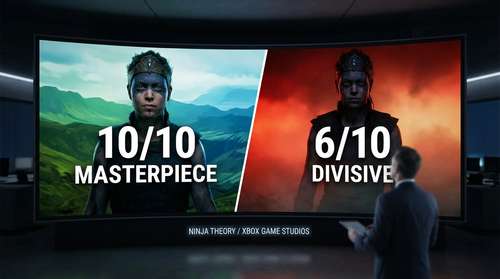
With recent industry reports suggesting Ninja Theory is pivoting toward more interactive gameplay for their next project, the Hellblade 2 review scores have once again become a focal point of gaming discourse. When Senua’s Saga: Hellblade II launched, it didn't just release; it ignited a firestorm. Critics were deeply divided, awarding scores that ranged from perfect masterpieces to middling disappointments. As we examine the game's lasting impact in 2026, it is clear that this title remains one of the most artistically significant yet mechanically debated releases of the generation.
A Critical Divide: The Metacritic Split
Rarely does a flagship title generate such a wide spectrum of opinions. The Senua's Saga Hellblade II Metacritic aggregate tells a story of two different games. On one side, outlets awarded the game perfect 10/10s, citing its unrivaled fidelity and emotional storytelling. On the other, major publications dropped scores as low as 5/10, labeling it a beautiful but hollow experience. This polarization highlights a fundamental question in the industry: how much does gameplay agency matter in a narrative-driven experience?
The disparity largely stems from the game's design philosophy. Reviewers who prioritized immersion and audio-visual presentation championed the game as a benchmark for the Xbox Series X game reviews landscape. Conversely, critics looking for mechanical depth found the experience wanting, often comparing it unfavorably to the combat complexity found in other action-adventure contemporaries.
Visuals and Audio: A Universal Acclaim
Despite the divisive scores, there is one area of universal agreement: the presentation. Virtually every Hellblade 2 review praised Ninja Theory for pushing the boundaries of Unreal Engine 5. The facial animations, photogrammetry-based environments, and the implementation of binaural audio created a sense of presence that few games have matched since.
For players and critics alike, the technical achievement was undeniable. The game served as a graphical showcase, originally bolstering the library of the Ninja Theory Xbox exclusive lineup before its eventual migration to other platforms. The seamless transition between cinematics and gameplay blurred the lines of interactive media, a feat that remains a high-water mark for digital performance capture.
The Gameplay Controversy: "Walking Sim" or Interactive Drama?
The core of the criticism focused heavily on the is Hellblade 2 a walking sim debate. Many reviews pointed out that outside of specific combat encounters, the player's interaction with the world was limited to walking and solving perspective-based puzzles. Critics argued that this lack of agency diminished the stakes, making the journey feel more like a movie than a game.
Furthermore, the Hellblade 2 gameplay length—clocking in at roughly 6 to 8 hours—was a major point of contention. While some praised the tight, pacing-focused runtime, others felt that the $50 price point demanded more content. Comparisons in the Hellblade 2 vs Hellblade 1 discourse often noted that while the sequel looked infinitely better, the first game arguably balanced its pacing and gameplay loops more effectively for its time.
Legacy and Future: What The Reviews Mean for Hellblade 3
The feedback from this Hellblade 2 review scores cycle appears to be shaping the future. Recent insider reports from January 2026 indicate that Ninja Theory's next rumored entry will focus significantly more on interactive elements and combat depth. This direct response to the "walking simulator" criticism suggests that while Hellblade II was a triumph of art, the studio is listening to the demand for more robust gameplay mechanics.
Ultimately, Senua’s Saga: Hellblade II stands as a polarizing masterpiece. It is a title that demands to be experienced, if only to decide which side of the critical divide you fall on. Whether you see it as a hollow tech demo or an emotional tour de force, its impact on the industry conversation is undeniable.