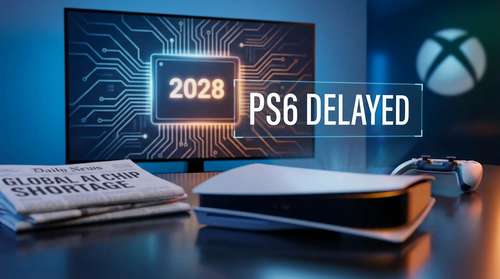
Sony Interactive Entertainment is reportedly rewriting its next-generation hardware roadmap, with new leaks suggesting the PlayStation 6 launch could be pushed back to 2028 or even 2029. According to a bombshell report from Bloomberg, the gaming giant is facing unprecedented pressure from the exploding cost of memory chips—a supply chain bottleneck driven by the insatiable appetite of global AI data centers. If accurate, this delay would mark a historic extension of the PlayStation 5 lifecycle, fundamentally altering the competitive landscape against Microsoft’s Xbox.
The AI Chip Crisis: Why Sony is Hitting the Brakes
The core catalyst behind this potential delay is being dubbed "RAMmageddon" by industry insiders. While gamers typically focus on GPU teraflops, the current crisis centers on high-bandwidth memory. Artificial intelligence heavyweights like NVIDIA, Google, and OpenAI are currently buying up vast reserves of advanced memory modules to power massive data centers. This gold rush for silicon has sent prices soaring and created severe shortages for consumer electronics manufacturers.
For a console like the PlayStation 6, which is rumored to target specs including 30GB of GDDR7 memory to handle 8K textures and complex ray tracing, these component costs are becoming prohibitive. Launching a console with such premium hardware in the current market would likely force Sony to price the machine well above the mass-market sweet spot of $499-$599. By delaying the release to 2028, Sony reportedly hopes that supply chains will stabilize and manufacturing costs will normalize.
PlayStation 6 Specs: What We Know So Far
Despite the delay news, technical details about the console continue to surface, painting a picture of a beastly machine. Leaked documentation suggests the PS6—codenamed "Orion" in some circles—will continue Sony's partnership with AMD. The architecture is expected to utilize a next-generation Zen 6 CPU paired with a GPU based on RDNA 5 (or a highly customized fork thereof).
The Memory Dilemma
The most ambitious part of the leaked spec sheet is the memory configuration. To deliver a true generational leap over the PS5 Pro, Sony engineers are targeting a unified memory pool of roughly 30GB of GDDR7. This is nearly double the 16GB found in the current PS5. However, securing this volume of high-speed memory for millions of units is virtually impossible in the current economic climate without incurring massive losses per unit sold—a risk Sony appears unwilling to take.
Xbox Could Gain a Critical Head Start
Perhaps the most alarming consequence of a 2028 release date is the window it opens for Microsoft. Contrary to Sony’s hesitation, reports indicate that the next-generation Xbox is still targeting a late 2026 or 2027 launch. Microsoft’s hardware team is reportedly further along in locking down their silicon contracts, potentially allowing them to hit the market a full year or two before the PlayStation 6.
This scenario mirrors the Xbox 360 era, where a significantly earlier launch helped Microsoft capture a massive install base before the PlayStation 3 arrived. If the next Xbox launches in 2027 with next-gen features while Sony is still leaning on the PS5, the market dynamics could shift dramatically. However, some analysts argue that launching later allows Sony to deliver a significantly more powerful machine, effectively "leapfrogging" the early-mover advantage.
Extending the PS5 Lifecycle
For the average gamer, this delay means the PlayStation 5 will remain the flagship console for significantly longer than previous generations. We are already seeing signs of this extended tail with the release of the PS5 Pro, which is designed to bridge the gap between standard 4K gaming and the high-fidelity future.
Developers will essentially be forced to optimize their engines for PS5 hardware for another three to four years. While this ensures a massive library of polished titles for existing owners, it may stifle the introduction of truly revolutionary game mechanics that require next-gen CPU power. On the flip side, it gives studios more time to extract every ounce of performance from the current architecture, potentially leading to visually stunning late-gen titles similar to The Last of Us Part II on PS4.
What This Means for Gamers
If you were holding off on buying a PS5 or PS5 Pro in hopes of a 2027 PS6 launch, you might want to reconsider. A delay to 2028 or 2029 suggests that the current generation is barely at its halfway point. The "mid-gen refresh" is no longer just a stopgap; it is now the standard-bearer for high-end console gaming for the foreseeable future.
As the industry grapples with the AI chip shortage, the era of the consistent 7-year console cycle appears to be over. Whether this delay results in a better, more affordable PlayStation 6 remains to be seen, but for now, Sony seems content to wait out the storm rather than launch a console that no one can afford.